President Donald Trump has launched a new push to rebuild America’s hollowed-out naval shipbuilding base, with an eye toward countering China’s vast maritime capacity.
The presidential strategy draws on a “Finland model,” allowing carefully conditioned initial construction at allied foreign yards while requiring technology transfer, U.S. investment, workforce training, and eventual domestic production.
The new National Security Presidential Memorandum urges the expansion of the so-called “Finland model” currently employed to build the Coast Guard’s Arctic Security Cutters where initial vessels are built in Finland by foreign yards and subsequent vessels are constructed domestically. The memo says that as long as foreign shipbuilders agree to some stringent conditions on-shoring future work to the US, they would be allowed to build up to two ships in three different ship classes at their parent docks, which would then be transferred to the US.
These ship classes include surface combatants with “sufficient inherent capabilities to perform anti‑submarine warfare, surface warfare, and convoy escort duties,” as well as those that meet “the requirements for Consolidated Cargo Replenishment at Sea (CONSOL) Tankers and — separately — Roll-On, Roll-Off Vessels,” according to the memo.
Trump just signed an order for a 5th public Navy shipyard, plus a “Finland Model” forcing foreign shipbuilders to build US yards and train American workers to win contracts.
Capacity doesn’t build itself – manufacturing labor access will be critical.
— Matt Horine 🇺🇸 (@Matt_Horine) August 16, 2026
If executed successfully, the plan could turn short-term reliance on trusted partners into a long-term revival of American shipyards, repair capacity, and sea power.
Additionally, the order also instructs Secretary of War Pete Hegseth, working with Acting Navy Secretary Hung Cao, to deliver a plan within 120 days to improve the readiness of nuclear-powered submarines and aircraft carriers. The proposal is expected to draw on private-sector capacity and establish a fifth government-operated Navy Yard.
This new yard is to possess the “sufficient drydock capacity” needed to assist with the upkeep and maintenance of the nation’s growing submarine fleet. The plan is to assess potential locations near the U.S. Pacific Fleet, including those in the continental United States, Alaska, Hawaii, and existing U.S. territories.
The memo’s final major prong directs Hegseth, in consultation with Cao, to submit a plan within 60 days that requires “measures to replace the Electromagnetic Aircraft Launch System and Advanced Weapons Elevators with steam and hydraulic systems for the construction” of the future USS Doris Miller (CVN-81), an upcoming Ford-class aircraft carrier. As noted by gCaptain, “The move would represent a major departure from the technologies introduced aboard the Ford class and potentially require significant redesign work on a carrier already under construction.”
The edict builds upon the president’s April 2025 executive order and subsequent “Maritime Action Plan” aimed at reversing America’s shipbuilding decline.
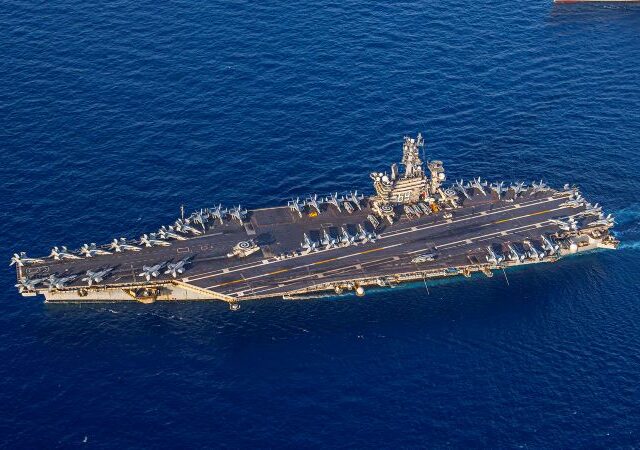
In addition to the shipbuilding measures, the presidential memorandum also directs a significant change to the design of future Ford-class aircraft carriers by returning steam catapults to those vessels.
Within 60 days, the Secretary of War, in consultation with the Secretary of the Navy, must submit a plan detailing how to replace the Electromagnetic Aircraft Launch System (EMALS) and advanced weapons elevators (AWE) with steam and hydraulic systems on CVN-81, the fourth Ford-class carrier.
The directive would mark a reversal from the technology adopted for the Ford class. EMALS uses stored kinetic energy and electrical power conversion to launch aircraft, replacing the steam catapults used aboard the Navy’s Nimitz-class carriers.
According to the navy, the system was designed to provide greater control and efficiency, reduced manpower and maintenance requirements, and the ability to launch a wider range of aircraft, including unmanned platforms.
President Donald J. Trump has issued a memorandum directing a major overhaul of U.S. Navy shipbuilding, citing cost growth, delays, design complexity and insufficient industrial capacity.
Among the key directives:
• CVN-81: Within 60 days, the administration will develop a plan… pic.twitter.com/UpV3w670t3— OSINTdefender (@sentdefender) August 14, 2026
Clearly, our nation cannot deter a rising naval China and its maritime antics with policy papers, delayed hulls, and shipyards operating far below the capacity needed to meet our military needs.
The Finland model offers a pragmatic approach that leverages trusted allies immediately while insisting that the jobs, expertise, and actual shipbuilding eventually return to American soil.
If the administration follows through, this could become the beginning of a long-overdue revival of America’s maritime capacity…and that is a good thing.
Donations tax deductible
to the full extent allowed by law.