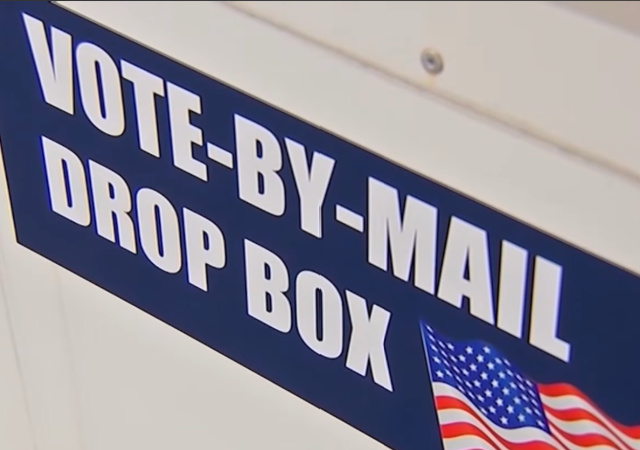
U.S. District Judge Indira Talwani in Massachusetts paused key parts of the United States Postal Service’s (USPS) new rule on mail-in ballots.
Remember, the Supreme Court did not decide the rule on Monday. The majority said the states and District of Columbia sued over the new rule too early because the USPS had not finalized it.
Well, the USPS finalized the new rules on how to handle mail-in and absentee ballots on Wednesday.
The defendants returned to Talwani with the rule, arguing the USPS exceeded its authority and inserted itself into federal elections.
Talwani determined the plaintiffs will likely succeed on the merits and face irreparable harm. She also said the balance of harms and the public interest warrants the temporary restraining order.
The Trump administration will likely appeal the ruling, which means it will land at the Supreme Court.
The judge blocked:
a. DMM Section 705.24.3.1, to the extent that the section makes Ballot Mail Envelope Standards mandatory;
b. DMM Section 705.24.3.2, to the extent that the section makes Return Federal Ballot Mail Envelope Standards mandatory;
c. DMM Section 705.24.4.1; to the extent that the section makes Postal Service Federal Ballot Mail Portal registration mandatory;
d. DMM Section 705.24.4.2; to the extent that the section makes voter enrollment in the Postal Service Federal Ballot Mail Portal mandatory
e. DMM Section 705.24.5.1;
f. The first two sentences of DMM Section 705.24.5.2; and
g. DMM Section 705.24.5.3(a), (b), (c).
Talwani wrote:
Through the Final Rule, the USPS is refusing to send mail ballots to eligible voters unless States or local election officials submit their mail ballot envelopes and return envelopes and receive advance approval from the USPS without regard to impending deadlines for the November 3, 2026 election. 91 Fed. Reg. at 54990–91 (DMM 705.24.3.1–2). Additionally, the Final Rule requires elections officials to create accounts for a new electronic portal, certify that they have received approval regarding the mail ballot design, and thereafter upload to the USPS portal each voter’s information, including name, address, and a unique intelligent mail barcode. Id. (DMM 705.24.4.2(b), (e), (f)). The court finds Plaintiffs likely to succeed on the merits of their claims that (1) the USPS lacked authority to issue the Final Rule; (2) the Final Rule is unconstitutional in imposing these requirements on the States; and (3) the Final Rule is unconstitutional in prohibiting non-compliant State and local officials from using the United States Postal Service to mail ballots.
Talwani also said that the record lacks “any evidence regarding fraudulent absentee or mail-in voting.”
“In any event, the USPS’s interest in correcting an unsubstantiated problem through likely unconstitutional means is dwarfed by the overwhelming risk of pervasive disenfranchisement of citizens who need access to mail ballots in order to vote,” Talwani wrote.
Talwani decided the plaintiffs face irreparable harm because the requirements are impossible to meet before the November elections.
“Plaintiff States have neither time nor funds to design new mail ballots, seek approval of the new designs, order production of mail ballots, update their own election management systems, train election officials to use the USPS portal, and upload citizen data to the portal, all before the midterms,” according to Talwani.
Donations tax deductible
to the full extent allowed by law.