The Gujarat High Court Arbitration Centre (Domestic & International) (GHAC), in collaboration with the Gujarat High Court, is organising GHAC Arbitration Week 2026, a three-day programme being held from 4 September to 6 September 2026 at the prestigious GIFT City Club, Gandhinagar, dedicated to strengthening Gujarat’s institutional arbitration ecosystem and positioning the State as a leading destination for efficient, credible and institutionally driven dispute resolution.
The programme commenced with a distinguished Opening Ceremony on 3 September 2026 under the overarching theme “Building Gujarat’s Institutional Arbitration Ecosystem.”
Also Read:
GHAC Arbitration Week 2026: From vision to action in Institutional Arbitration
Envisaged as a significant platform for dialogue, professional engagement and knowledge exchange, GHAC Arbitration Week 2026 brings together members of the judiciary, legal profession, business and industry community, arbitrators and representatives of arbitral institutions to deliberate on contemporary developments and the future of institutional arbitration.
Against this backdrop, Justice R.F. Nariman, former Judge of the Supreme Court of India, delivered the keynote address on Day 1, offering a wide-ranging assessment of the evolution and working of the Arbitration and Conciliation Act, 1996, and highlighting the challenges that have emerged over its three decades of operation.
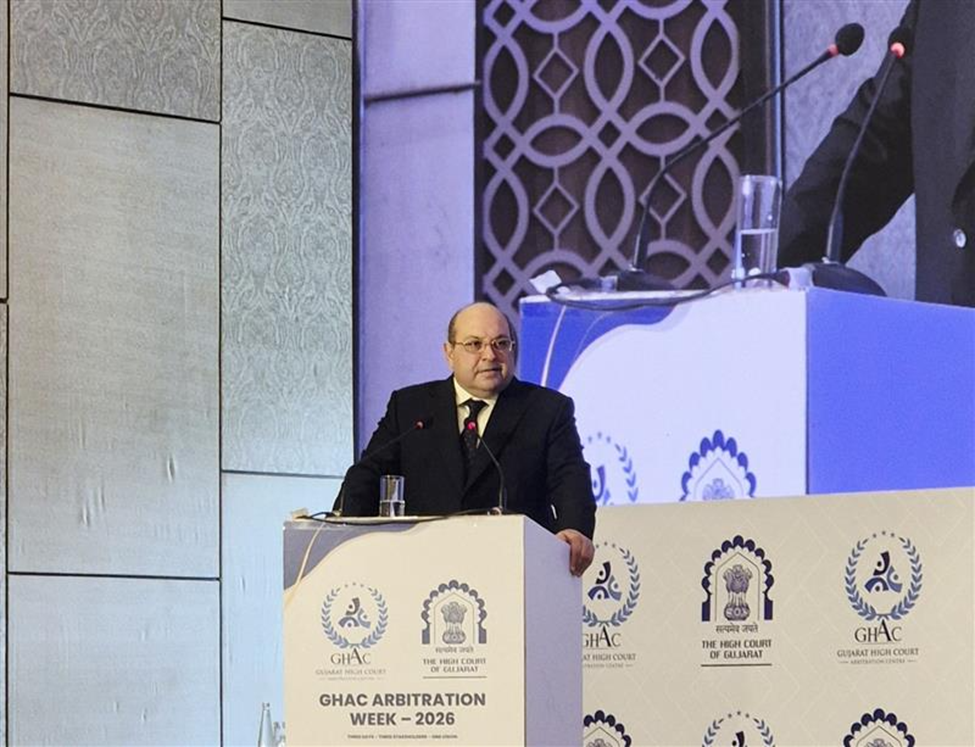
From Panchayats to the Arbitration Act, 1996
Justice Nariman began by tracing the historical development of arbitration in India, taking the audience from the traditional village panchayat system to the statutory frameworks introduced during British rule and, subsequently, the Arbitration Act, 1940.
He noted that the 1940 Act represented a significant step towards codifying arbitration law in India, but its functioning came to be associated with considerable procedural delays. The absence of adequate timelines, the role of an umpire in proceedings involving two arbitrators, the absence of a requirement to provide reasons for awards and the need for awards to pass through the judicial process before becoming enforceable contributed, in his assessment, to an increasingly cumbersome system.
The international development of arbitration law, particularly the New York Convention, 1958 and the UNCITRAL Model Law, 1985, eventually paved the way for the 1996 legislation.
Justice Nariman, however, pointed to what he described as a significant feature of the 1996 Act. Although the New York Convention grounds for setting aside awards were designed for international awards and did not permit a review on merits, the same restrictive approach was extended to domestic awards under Indian law. He noted that, as a consequence, an award could be erroneous in fact or law and nevertheless withstand challenge.
Three Decades of the 1996 Act: Has certainty been achieved?
Turning to the present state of arbitration law, Justice Nariman examined five recent Supreme Court decisions concerning, principally, the appointment of arbitrators and the setting aside of arbitral awards.
He observed that several of these cases arose because questions of law had remained uncertain and required reconsideration by larger Benches. However, in his view, the subsequent judgments have not always produced the degree of certainty that reference proceedings are expected to achieve.
Cox & Kings and the importance of consent
Discussing the five-Judge Bench decision in Cox & Kings Ltd. v. SAP India (P) Ltd., (2024) 4 SCC 1, Justice Nariman explained the Court’s treatment of the “group of companies” doctrine.
He emphasised the importance of reading the Arbitration Act alongside the Contract Act, particularly while determining whether a non-signatory intended to be bound by an arbitration agreement. According to him, the decisive consideration is ultimately consent, whether the person sought to be bound intended to be bound by the arbitration agreement.
The assessment, he noted, may extend beyond the formal execution of documents to the circumstances surrounding the formation and performance of the transaction. The mere existence of a corporate relationship, however, cannot by itself determine whether a party is bound by an arbitration agreement.
Justice Nariman described the central proposition emerging from Cox & Kings as requiring consideration of the party, the arbitration agreement and the Contract Act, rather than treating the group of companies doctrine as an independent basis for binding a non-signatory.
Stamp Act and Arbitration Act: Questions of legal certainty
Justice Nariman next examined the Supreme Court’s decisions concerning the interplay between an unstamped instrument and arbitration proceedings.
Tracing the line of authorities from SMS Tea Estates (P) Ltd. v. Chandmari Tea Co. (P) Ltd., (2011) 14 SCC 66, through Garware Wall Ropes Ltd. v. Coastal Marine Constructions & Engg. Ltd., (2019) 9 SCC 209, and N.N. Global Mercantile (P) Ltd. v. Indo Unique Flame Ltd., (2023) 7 SCC 1, he pointed to the eventual decision of a seven-Judge Bench and raised questions concerning whether the subsequent position had enhanced certainty in the law.
In particular, he drew attention to concerns arising from the reasoning that the Arbitration Act operates as a self-contained enactment, arguing that the Contract Act remains fundamental to determining whether an agreement has acquired the legal status of a contract. He also highlighted the practical consequences of the present position, including the potential for questions concerning stamp duty to prolong arbitral proceedings.
For Justice Nariman, the issue was not merely doctrinal. He observed that a succession of larger Bench decisions reaching different conclusions can make it difficult to achieve the certainty that commercial arbitration requires.
Delhi Metro Rail: Limits of curative intervention
Justice Nariman then turned to the Supreme Court’s decision in DMRC Ltd. v. Delhi Airport Metro Express (P) Ltd., (2024) 6 SCC 357, examining its implications for the finality of arbitral awards.
He explained that the case concerned an arbitral award arising out of a dispute between a joint venture vehicle and the Delhi Metro Rail Corporation concerning defects in metro infrastructure. Although the arbitral tribunal had unanimously ruled in favour of the claimant, the award subsequently underwent multiple stages of judicial scrutiny.
Justice Nariman expressed concern about the invocation of “miscarriage of justice” at the curative stage and whether such intervention could result in an award being reconsidered on questions of fact even after the statutory avenues of challenge and review had been exhausted.
Referring to the Supreme Court’s earlier decision in Rupa Ashok Hurra v. Ashok Hurra, (2002) 4 SCC 388, he stressed that curative jurisdiction was intended for exceptional situations involving egregious and irremediable injustice, such as violation of natural justice, bias or a complete lack of jurisdiction, rather than as another opportunity to revisit the merits of an arbitral award.
Justice Nariman observed that an expansion of curative intervention could have implications for the finality that arbitration is intended to provide.
Modification of Awards: “Where does ‘modify’ come in?”
Discussing the decision in Gayatri Balasamy v. ISG Novasoft Technologies Ltd., (2025) 7 SCC 1, Justice Nariman examined the question whether the power to “set aside” an arbitral award under Section 34 could include a power to modify it.
Referring to the statutory scheme of the 1996 Act, he emphasised that Section 33 gives the arbitrator the power to correct clerical or similar errors and to interpret or supplement an award in specified circumstances. Where an award suffers from a defect requiring reconsideration, Section 34(4) provides for the matter to be returned to the arbitral tribunal.
Justice Nariman therefore questioned the expansion of the expression “set aside” to encompass modification by courts, particularly when the statutory framework itself contemplates the arbitrator undertaking such corrective action.
He observed that the judgment ultimately retained what he regarded as the basic position in NHAI v. M. Hakeem, (2021) 9 SCC 1, while carving out a limited space for judicial correction in clear cases such as typographical or clerical errors.
Describing the significance of this departure as “a storm in a teacup,” Justice Nariman explained: “The tweaking is that the court can also do what the arbitrator does, but only in clear cases. And what clear cases? Typographical, clerical, etc. Nothing that goes to the root.”
He further noted that where the issue is not a clear case of such an error, the matter would have to be sent back to the arbitrator.
Unilateral appointment of arbitrators and independence
The final decision discussed by Justice Nariman was the five-Judge decision in Central Organisation for Railway Electrification v. ECI SPIC SMO MCML (JV), (2025) 4 SCC 641.
The issue concerned whether an arbitration clause permitting one party, particularly a government entity, to choose an arbitrator from a panel constituted by that party could withstand scrutiny.
Justice Nariman noted that the majority considered such arrangements problematic in light of Article 14 of the Constitution and the principles governing arbitration. He also discussed the differing approaches adopted by the judges, including reliance on Section 23 of the Contract Act and public policy.
The discussion, he suggested, once again illustrated the difficulty of achieving certainty when different doctrinal routes are adopted to address similar concerns.
Drawing these issues together, Justice Nariman offered his assessment of the present arbitration landscape:
“According to me not particularly well, because firstly the judgments don’t conduce to certainty.”
He identified the repeated reconsideration of legal questions as a significant concern, observing that uncertainty in arbitration law is particularly problematic for a system intended to provide an efficient and predictable alternative to court litigation.
The way forward: Fixed fees and greater institutional discipline
Justice Nariman then turned from the existing jurisprudential framework to possible reforms.
On the arbitral side, he questioned whether the existing fee incentives under Section 29A were sufficient to discourage delays. As an alternative, he proposed that arbitrators and parties should determine a lump-sum fee at the outset of the proceedings, which would not vary with the number of hearings.
He suggested that the fee could be deposited in an escrow account and released to the arbitrator upon pronouncement of the award. In his view, such a structure could provide a stronger incentive for arbitrators to conclude proceedings efficiently.
He also called for greater institutional attention to statutory timelines once an arbitration dispute enters the judicial process. In particular, he suggested that Chief Justices of High Courts should be sensitised to the timelines prescribed under the Arbitration Act.
A Proposal for Greater Appellate Scrutiny
One of the key reform proposals emerging from Justice Nariman’s address concerned the appellate framework.
He suggested eliminating one stage of judicial proceedings and moving directly to a Division Bench of the High Court, rather than requiring an award to first pass through a single-Judge stage. In his view, this could substantially reduce delays.
Going further, Justice Nariman proposed that, after 30 years of experience under the 1996 Act, the time had come to consider a full-fledged appeal on both facts and law at one stage before a Division Bench of the High Court.
His reasoning was rooted in the changing nature of commercial arbitration. The traditional justification for arbitration as a form of “rough justice” delivered swiftly, he observed, arose in a very different commercial environment. Modern arbitration involves complex commercial contracts, sophisticated corporations and disputes of enormous economic significance.
Accordingly, he argued that arbitration today must pursue not only speed and cost-effectiveness, but also accuracy.
“Today, according to me, not only should there be speed, cost-effectiveness, there has to be accuracy.”
Justice Nariman proposed that a Division Bench should therefore have the power to examine an award fully on facts and law, with the award expected to meet a standard comparable to that of a trial court judgment.
In his view, such a model could preserve the principal advantages of arbitration, namely cost-effectiveness and decongestion of courts, while providing a meaningful mechanism to correct erroneous awards.
Rebuilding Confidence in Arbitration
Concluding his keynote, Justice Nariman said that the objective should be to restore arbitration to its intended footing: an efficient mechanism capable of delivering timely, cost-effective and accurate dispute resolution.
Under his proposed framework, an award would be delivered within a prescribed period, tested by a Division Bench within a prescribed period, and thereafter be subject only to the jurisdiction of the Supreme Court.
His address thus placed certainty, finality and accuracy at the centre of the next phase of Indian arbitration reform.
Justice Nariman concluded by noting that his suggestions were directed towards the domestic arbitration regime, while the international arbitration framework continued to operate within the established framework of the New York Convention.
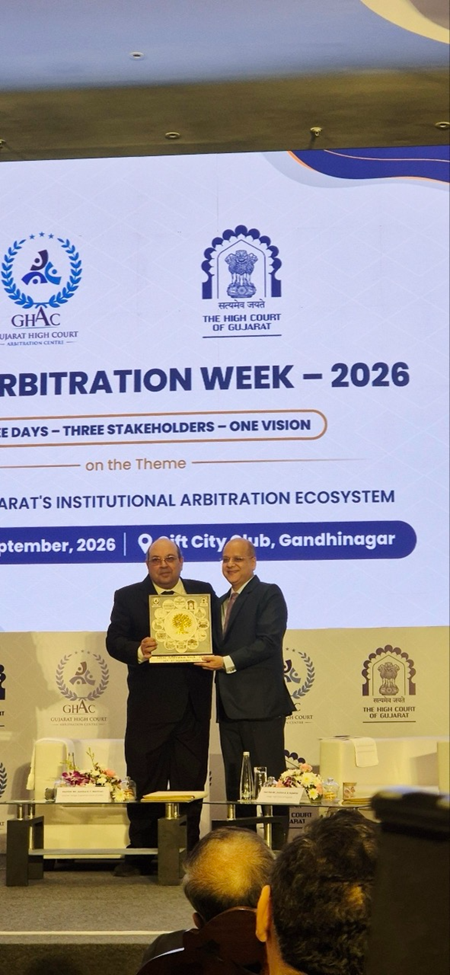
The keynote was followed by the presentation of a memento to Justice Nariman by Justice A. Subbiah, Judge, Gujarat High Court.