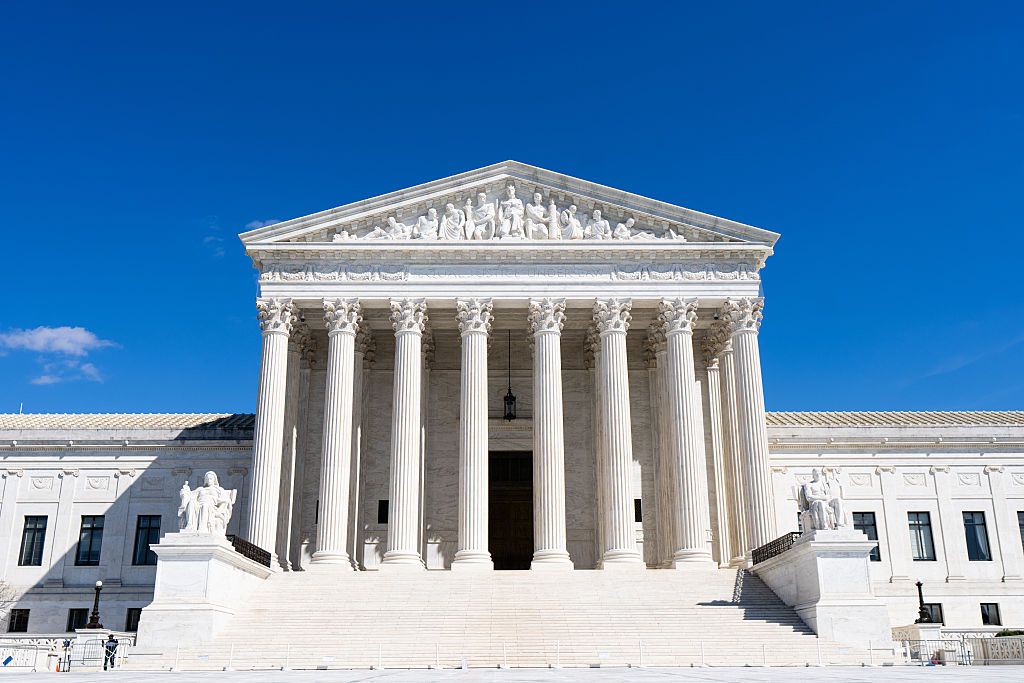
Justice Brett Kavanaugh on Tuesday blocked Missouri from using a new congressional map, intended to give Republicans an additional seat in the U.S. House of Representatives, in the November elections. In a brief order sent to reporters on Tuesday afternoon, Kavanaugh – who handles emergency appeals from the 8th Circuit, which includes Missouri – turned down a request from the state’s top election official to pause a ruling by the Missouri Supreme Court that bars the state from deploying the new map.
Although Tuesday’s order came on the Supreme Court’s interim docket, the court’s ruling likely settles the issue of the maps for the 2026 election, restoring the map that the state adopted in 2022 in the wake of the 2020 census.
Missouri was one of several states that redrew its congressional maps in advance of the 2026 elections with the encouragement of President Donald Trump. The new map, known as HB 1, was intended to give Republicans seven of the state’s eight seats in the U.S. House.
In December 2025, opponents of the state’s new map – including Richard von Glahn, the plaintiff in the case now before the Supreme Court – submitted more than 300,000 signatures in support of a petition to put a statewide referendum on the new maps on the ballot in the November 2026 elections. The state’s top election official, Missouri Secretary of State Denny Hoskins, rejected the petition on Aug. 4, 2026, the last day on which he could make that determination as well as the day of the state’s primary election. In Hoskins’ view, Missouri’s constitution “does not authorize a referendum on congressional redistricting plans passed by the General Assembly.”
Just a few hours later, von Glahn filed a lawsuit, asking a state court to reverse Hoskins’ decision and bar Missouri from using the new map. In a unanimous ruling on Sept. 3, the Missouri Supreme Court granted his request. The state supreme court wrote that “the plain language of … the Missouri Constitution authorizes a referendum as to ‘any act of the general assembly’ and no exception applies.” Because the referendum petition “was legal, sufficient, and timely,” the court concluded, the new map was never in effect and will not go into effect “unless and until approved by the voters at the November 2026 general election.”
The state supreme court deemed “wholly unpersuasive” Hoskins’ argument that, if the state cannot use the new map, it will lead to “confusion, expense, and practical difficulties.” “[T]hese arguments are particularly misplaced given the secretary’s delay created” the problems about which he is now complaining, the court wrote.
Hoskins came to the Supreme Court on Friday night, where he told the justices that “[a] federal-election-administration disaster is unfolding in Missouri” and that the state was “genuinely unsure whether it can switch its governing congressional map in time to run a timely federal election.” He argued that the Missouri Supreme Court’s ruling violates the U.S. Constitution in several ways. Among other things, he contended, it runs afoul of the elections clause, which in his view gives state legislatures – rather than the voters who sign a petition – the power to prescribe the “Times, Places, and Manner” of federal elections. The Supreme Court, he wrote, “has never held that just 3.3% of a State’s voters can unilaterally suspend a disfavored congressional map by submitting a referendum petition.”
The Missouri Supreme Court’s ruling, Hoskins continued, also unconstitutionally disenfranchised “hundreds of thousands” of voters by putting them in new districts, where they will be “forced to vote on General Election candidates they had no role in choosing.” This violates the “fundamental right to vote” protected by the Constitution, he contended.
Von Glahn countered that the Supreme Court lacks the power to weigh in because the Missouri Supreme Court’s ruling had rested only on state law – known as an “adequate and independent state-law” bar to Supreme Court review. The Missouri Supreme Court indicated that Hoskins could not make his arguments based on federal law because he had not originally made them in rejecting von Glahn’s petition.
A stay of the Missouri Supreme Court’s ruling also would not actually provide the relief that Hoskins seeks, von Glahn continued, because HB 1 never went into effect. “In short,” von Glahn reasoned, “under Missouri law, the 2022 Plan is the legal status quo, not HB 1.” If Hoskins want to be able to use HB 1 in the upcoming election, von Glahn said, he needs an injunction – “an order affirmatively establishing [his] authority to use it,” which requires him to meet a much higher bar.
But even if the Supreme Court could review Hoskins’ appeal, von Glahn concluded, his arguments on the merits are wrong. His “Elections Clause theory runs headlong into more than a century of precedent recognizing that state constitutional referendum procedures may constrain congressional-redistricting legislation.” And Hoskins, he said, “ask[s] this Court to recognize a right no precedent confers: a guarantee to preserve every consequence of a primary vote through November.”
Kavanaugh turned down Hoskins’ request on Tuesday afternoon without referring it to the full court.