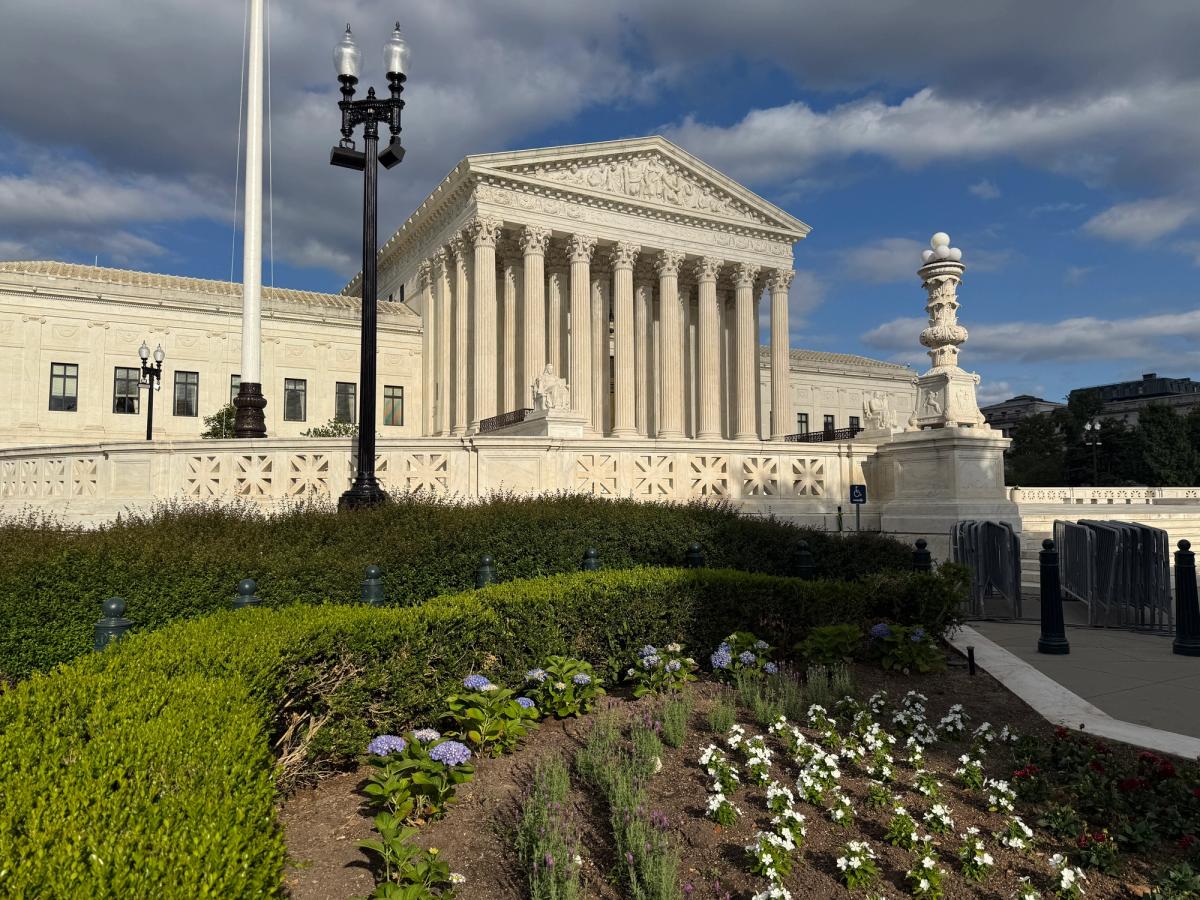
The Supreme Court on Thursday morning paused a ruling by a federal judge in Missouri that would have allowed the state to use a new congressional map intended to give Republicans an additional seat in the U.S. House of Representatives in the upcoming elections. In a brief, unsigned order, the court granted a request by the organizers of a referendum on the new map to put a ruling by Chief U.S. District Judge Stephen Clark on hold while litigation in the dispute moves forward.
The justices’ order, from which there were no public dissents, came less than two days after Justice Brett Kavanaugh, who handles emergency appeals from Missouri, declined to disturb a ruling by the Missouri Supreme Court that barred Missouri from using the new map. With the deadline to send out ballots for military and overseas voters just nine days away, Thursday morning’s order likely means that the state will use the map that it adopted in 2022 – a different map from the one that it used for the state’s primary election on Aug. 4 – for the November elections.
The dispute began last year, when – with President Donald Trump’s encouragement – Missouri adopted a new map, known as HB 1. In December, opponents of the state’s new map – including Richard von Glahn – submitted more than 300,000 signatures in support of a petition to put the new map up for a vote in November 2026. Missouri’s top election official, Secretary of State Denny Hoskins, rejected the petition on Aug. 4, 2026 – the last day to do so.
Von Glahn filed a lawsuit in state court on the same day, asking it to reverse Hoskins’ decision and block Missouri from using the new map. On Sept. 3, the Missouri Supreme Court unanimously granted that request. It wrote that “the plain language of … the Missouri Constitution authorizes a referendum as to ‘any act of the general assembly’ and no exception applies.” Because the referendum petition “was legal, sufficient, and timely,” the court concluded, the new map was never in effect and will not go into effect “unless and until approved by the voters at the November 2026 general election.”
The Missouri Supreme Court deemed “wholly unpersuasive” Hoskins’ argument that the failure to use the new map would lead to “confusion, expense, and practical difficulties.” “[T]hese arguments are particularly misplaced given the secretary’s delay created” the problems about which he is now complaining, the court wrote.
Hoskins went to the Supreme Court last Friday night, asking the justices to step in. He said that the state was “genuinely unsure whether it can switch its governing congressional map in time to run a timely federal election,” and he argued that the Missouri Supreme Court’s ruling violates several provisions of the U.S. Constitution.
Von Glahn pushed back, arguing that the Supreme Court lacks the power to weigh in because the Missouri Supreme Court’s ruling had rested only on state law – known as an “adequate and independent state-law” bar to Supreme Court review. But in any event, von Glahn continued, Hoskins’ federal constitutional arguments fall short on the merits.
Kavanaugh turned down Hoskins’ request on Tuesday afternoon without referring it to the full court.
Less than an hour after Kavanaugh’s decision was released, Clark issued a temporary restraining order that instructed the state to use the 2025 map. That case was filed on Sept. 4 by Rep. Robert Onder, a Republican who represents Missouri’s 3rd congressional district, as well as another congressional candidate and two individual voters who – if the 2022 map is restored – will vote in November in a different congressional district than they did in the primary election. Clark acknowledged that “[c]onducting state elections in accordance with the Missouri Constitution undoubtedly qualifies as an important interest.” But, he countered, the challengers in the federal case “face irreparable harm” without a temporary restraining order “because many Missouri voters would have to cast their general-election votes for candidates whom they had no role in nominating.”
On Tuesday night, von Glahn and a group known as People Not Politicians – who had joined the federal case – asked the U.S. Court of Appeals for the 8th Circuit to put Clark’s order on hold. The court of appeals turned that request down on Wednesday.
On Wednesday afternoon, von Glahn and People Not Politicians asked the justices to intervene. They told the court that Clark’s order “requires Missouri to conduct its congressional election using a map that, under the authoritative decision of Missouri’s highest court, ‘is not the law and has never been the law.’” If Clark’s order is put on hold, they continued, “both the public and election officials can proceed under a map that is not marred by legal uncertainty. Officials have confirmed that this outcome is feasible.” Indeed, they emphasized, immediately after the Missouri Supreme Court’s order on Tuesday, Hoskins “himself instructed elections administrators to implement the 2022 map in accordance with the Missouri Supreme Court’s ruling.”
Kavanaugh instructed Hoskins and the other plaintiffs to respond by 10 a.m. EDT on Thursday.
In his brief, submitted shortly before 10 a.m., Hoskins argued that Clark’s order “ensures that” the state can conduct “a timely and orderly congressional election in 2026.” By contrast, he suggested, putting that order on hold “would change Missouri’s congressional map for a third time in a week—and … would come after the state-law deadline to alter ballots and just nine days before the federal-law deadline to send out military and overseas ballots.” Moreover, he added, “county election officials have already started printing ballots in compliance with” Clark’s order.
In an order distributed to reporters at 10:16 a.m. EDT, the Supreme Court granted the request by von Glahn and People Not Politicians to block Clark’s order.
In a related proceeding, the Missouri Supreme Court held oral arguments on Thursday on whether to hold Hoskins in contempt of court for sending an email on Sept. 8 that instructed election officials to use the 2025 map. That proceeding began as scheduled, just over 45 minutes after the court’s order; it ended approximately 37 minutes later without a ruling from the state supreme court.