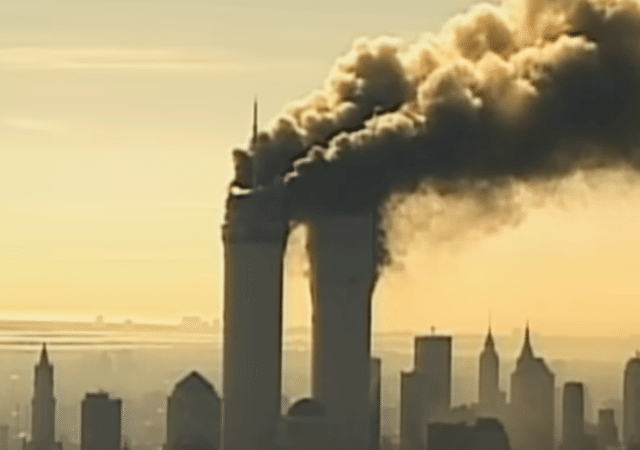
Twenty-five years ago, Islamic terrorists attacked the United States, killing more than 3,000 people. Several Legal Insurrection staffers were in New York City that day. Others lost friends and family. Regardless of where we were, those attacks changed everyone’s lives.
William Jacobson:
I was at my office in Providence, Rhode Island, pretty early in the morning as usual. I first saw reports on the internet — probably AOL! — about a small plane hitting the World Trade Center. It didn’t seem crazy at first. Having grown up around NYC I always wondered if a plane would mistakenly hit the Towers. But then there was another report that a second plane hit the WTC, and all of the sudden something didn’t seem right.
I don’t think at that point I knew the first “small plane” was not small at all. At some point it became clear that this was an attack. I headed home and my wife went to the schools to pick up our kids. I don’t remember if the schools let all the kids out or just whoever came to get them, but we were not alone. We didn’t know the full scope of the attack yet.
The rest of the day is something of a blur. When we saw the towers fall, it was unimaginable and otherworldly. We knew a lot of people and had relatives in NYC, and there were frantic calls to see if everyone was okay (one of my relatives was in the WTC during the 1993 bombing). Most of all I remember the feeling of helplessness, something our nation never should feel again.
Mary Chastain:
I entered my junior year at Oklahoma State University in August 2001. I slept in on September 11 since I only had one class. I logged onto AOL to check my email or chat with friends. After I finally connected to the internet, I saw something about the World Trade Center on the welcome page.
I figured outlets were just commemorating the 1993 WTC bombing. But I decided to click on the article because I swore the WTC bombing happened in February.
Yeah…the news was not about the 1993 bombing. Needless to say, I did not attend class that day.
The atmosphere at OSU changed a lot right after 9/11. Don’t forget that the OKC bombing happened only six years earlier, in 1995. The wounds and memories were still fresh for Oklahomans, especially since the state and city opened the indoor museum in February 2001 and held the annual memorial ceremony in April 2001.
Leslie Eastman:
Six months pregnant on September 11, 2001, I was awakened at about 6 a.m. by a call from one of my husband’s work friends with news that a plane had struck a World Trade Center tower. My husband immediately turned on the television, and we watched the second plane hit live. In that instant, any thought of accident disappeared. We knew we were watching a terrorist attack unfold, and were stunned by the terrifying developments that unfolded.
To preserve some sense of normalcy and to reduce the stress that might be harmful to my baby, I kept to my routine and swimming before work. For me, the day’s most haunting memory is the soundscape: It was warm in San Diego, so windows throughout the neighborhood were wide open. On my way to the pool, I heard the television and radio broadcasts being carried out into the streets. Everywhere, people were listening to the breaking news. The country had been attacked thousands of miles away, yet the voices from those broadcasts made it feel as though the disaster had entered every home, through every open window.
Vijeta Uniyal:
September 11, 2001, was the day that changed the trajectory of my life.
I was about to finish my degree in German philology at a university in Delhi when the news of the terror attacks hit me like a bombshell. I remember the crowds of leftist students gleefully celebrating the carnage. When classes resumed, a Marxist professor told us that the Pentagon and White House were “legitimate targets.”
A few years later, I committed a faux pas by defending U.S. foreign policy at a gathering of Indian “intellectuals” at the residence of a European diplomat. It was a clash between civilization and Islamist barbarism, and I had dared to say so. That day I lost many “friends” but received an offer to join the reform and reconstruction effort in Afghanistan and the region.
I started as secretary to the German ambassador in Tashkent, Uzbekistan. My plan to take up a position in Kabul changed after the security situation there deteriorated drastically by 2005. My experience in a former Soviet state cured me of whatever leftist inclinations I had. And my stay in Muslim-majority Central Asia made me aware of the threat of Islamism.
Twenty-five years later, the U.S. has withdrawn from Afghanistan, but the conflict between civilization and barbarism is far from over.
As the 9/11 anniversary approached this year, I was reading Churchill’s The Story of the Malakand Field Force, narrating his experiences as a 22-year-old cavalry officer in the frontier war between British India and Afghan-Jihadist invaders. “The forces of progress clash with those of reaction,” he observed in 1898. “The religion of blood and war is face to face with that of peace. Luckily the religion of peace is usually the better armed.”
May, in this existential battle, the forces of civilization always be better armed.
Stacey Matthews:
I was in New York City on 9/11. It was the first trip I’d ever taken up north beyond Virginia, and late afternoon on 9/11 was when my friend and I were scheduled to leave to go back home after several days of sightseeing. The morning of 9/11, we had plans to meet another friend – one who lived in NYC – for breakfast in an area not far from the World Trade Center, but the plans were changed at the last minute to a lunch get-together, which never happened.
When the first plane hit, we were in Times Square, unaware that the city was under attack, and we didn’t find out what happened until after both towers were hit and the Pentagon had been struck. We were thankful to have been able to drive out a few days later and return home, but the day sticks with me not just because of the profound sadness for the victims and their families, but also because it was a day that changed America forever, in ways that are still being felt. My thoughts and prayers are with the families as they reflect on what happened and the loss of their loved ones. Never Forget.
Maureen Riordan:
On 9/11 I was in NYC to monitor the NYC primary elections as an attorney with DOJ. I had been at the World Trade Center on 9/10 to have lunch with my brother who was in charge of the elevators at the World Trade Center. When the planes hit, I was at a polling place in a public school in the Bronx. I watched on the TV in the school. I assumed my brother was dead. I drove north out of the City to Westchester where our hotel for the assignment was booked. The strangest part was our original hotel was the WTC Marriott. But they raised their rate and we never went there. Thank God.
I found out later in the afternoon that my brother survived despite being in the lobby of the South Tower when the 2nd plane hit. I lost a dear friend and a cousin that day. One worked at Cantor Fitzgerald and the other at Aon.
Such a horrible day.
Jane Coleman:
When Bill asked for our “where we were on 9/11” stories, I hesitated at first, because I don’t think mine is all that remarkable. More remarkable, in retrospect, is where I was two months before: at the World Trade Center with my family.
The outing was my husband’s idea. And it did seem like a great one at first, something fun for each of our boys, who ranged in age from two to nine. So one Sunday morning in July, we piled them into the car and drove in from New Jersey. The closer we got, the more excited they were—and the more I wanted to turn around and go home.
True, it had been more than eight uneventful years since a bomb exploded in the parking garage beneath the World Trade Center. But that bomb had killed six people and wounded more than a thousand. Why was I taking my children to a known terror target?
By the time we arrived and stepped into the elevator, my mind was made up. We have to leave, I insisted. Now.
We argued all the way up to the top, Ron confidently reassuring me: There was no chance whatsoever of the terrorists attacking the World Trade Center again. They had tried and failed to bring down the Twin Towers in 1993. They wouldn’t try again.
We did leave, of course, but not before stopping at one of the concessions to have a souvenir picture taken of the family with the Towers in the background.
I asked Ron yesterday if we still had it somewhere, so I could include it with this story. No, he said. He didn’t want to buy it, because I wasn’t in it.
I had forgotten that part. I had refused to pose for the picture—not so much in protest, but because I could not wait to get out of there.
We left, Ron shaking his head at my stubbornness.
He was right—that Sunday in July 2001.
Nora Clinton:
I was in the final year of my PhD program in Classics at Cornell on September 11, 2001. It was a quiet, sunny morning, and I had walked to my favorite café in downtown Ithaca, College Town Bagels, when a friend told me that the Twin Towers had been attacked. I could hardly believe it. Because there was no television in my building, I joined several friends at a nearby house and watched the tragedy unfold.
Later, I learned that a former fellow student who worked at the World Trade Center had stayed home sick that day—a circumstance that saved his life. In the days that followed, nearly everyone I spoke with was heartbroken, though some, influenced by anti-American propaganda and “suicidal empathy,” wondered what the United States had done to provoke such hatred. I was shocked by their naivete. No actual or perceived grievance can excuse the deliberate murder of innocent people. Hatred of the West is instilled through relentless indoctrination from childhood; it should be confronted plainly and decisively, never rationalized.
People from former Communist countries often understand this instinctively. Recently, I hosted guests from Bulgaria who deeply admire the United States. Because of their love for America, they especially wanted to visit the Prince William County Liberty Memorial. Its beautiful fountain lends the site a sense of serenity and reflection, complementing the memorial’s solemn tribute to the lives lost on September 11. The memorial honors the county residents who died in the attacks and contains a piece of steel recovered from the World Trade Center.
Standing there offered a powerful reminder that the events of that day continue to shape our communities—and that remembrance remains both a personal duty and a shared national responsibility.
Matt Lamb:
I was waiting to leave for second grade that day. I remember being upstairs in my parents’ room watching their small TV on top of their dresser, as the planes hit the Twin Towers. I didn’t really understand what was happening – I thought one plane must have hit the tower by accident. In fact being a second grader I thought a “commercial” airplane was a plane filming a commercial.
I do remember we were worried because my dad was working in downtown Chicago and there was concern about attacks on other major cities. At school that day the teachers were talking about what happened. We would later find out that an alumnus of our Catholic school, Infant Jesus of Prague in the suburbs of Chicago, had died in the Pentagon. Patrick Jude Murphy was a Naval Reserve officer. He was also one year behind my mom in high school. I later found out a family friend’s dad was one of the Cantor Fitzgerald employees on the phone with a New York colleague when the lines went dead.
One other thing I always think about that makes me a bit emotional: My uncle was an officer in the Marine Corps at the time and working at the Pentagon. He was supposed to bring his son, my cousin, into the facility’s daycare that day. But since it was also his wedding anniversary he decided to stay at home that day.
Finally, September 10 and September 11 will now always deliver a one-two punch of memories every year since I used to work for Turning Point USA and knew Charlie Kirk since 2013. Though we were not particularly close the past few years, I have good memories of him and am grateful for having known him personally in the early years of Turning Point.
[Featured image via YouTube]
Donations tax deductible
to the full extent allowed by law.