The inaugural session of the India Digital ADR Summit 2026, held on September 12, 2026, at the National Forensic Sciences University (NFSU), Gandhinagar, examined the evolving role of artificial intelligence (AI) in arbitration and the need to preserve human judgment in adjudicatory processes. The session, titled “Artificial Intelligence in Arbitration: Enhancing Decision-Making Without Replacing Human Judgment”, was organised by the School of Law, Forensic Justice and Policy Studies, NFSU, through the International Digital Dispute Resolution Centre (IDDRC).
The inaugural session was attended by:
-
Justice N. V. Anjaria, Judge, Supreme Court of India;
-
R. Venkataramani, Attorney General for India;
-
Justice Sunita Agarwal, Chief Justice, High Court of Gujarat;
-
Justice M. R. Shah, Former Judge, Supreme Court of India;
-
Justice Rajesh Bindal, Former Judge, Supreme Court of India;
-
Professor Dr. S. O. Junare, Campus Director, NFSU Gandhinagar; and
-
Professor Dr. Purvi Pokhariyal, Dean, School of Law, Forensic Justice and Policy Studies, NFSU and Campus Director, NFSU Delhi.
The session featured addresses by Justice N. V. Anjaria and R. Venkataramani , who approached the use of AI in dispute resolution from different but complementary perspectives. While R. Venkataramani focused on the broader questions of digital justice, regulation, verification and the limits of technological reliance, Justice N. V. Anjaria examined the implications of AI-assisted decision-making for arbitral independence, accountability and the human qualities underlying the administration of justice.
Justice N. V. Anjaria: AI can improve efficiency, but the arbitrator must remain the decision-maker
Taking the discussion forward, Justice N. V. Anjaria said that the theme of the inaugural session was particularly timely and could be understood through three connected questions: the role of AI in arbitration, the ways in which it could enhance arbitral decision-making, and the need to ensure that such assistance did not compromise human judgment.
Justice N. V. Anjaria clarified that he was not opposed to AI, but rejected its blind or indiscriminate use, particularly in legal adjudication. He questioned the expression “artificial intelligence”, observing that intelligence ultimately stemmed from the human mind and describing AI instead as technology at an advanced stage of development.
He used an analogy drawn from Section 58(e) of the Transfer of Property Act to warn against excessive dependence on AI. Just as an English mortgage involves an absolute transfer of property, he suggested that indiscriminate use of AI could amount to transferring one’s intellect to a machine, leaving the individual increasingly dependent on its outputs.
The concern, he said, was no longer theoretical. Justice N. V. Anjaria referred to a Canadian court decision in which an arbitral award was set aside after it emerged that authorities relied upon in the award had been generated by AI and did not exist. He also referred to recent decisions of the Supreme Court and the Gujarat High Court that had raised concerns about the mindless and indiscriminate use of AI in legal processes.
Against this backdrop, he considered the proper role of AI in arbitration. Parties, he noted, select an arbitrator because they place confidence in the arbitrator’s experience, independence, integrity and judgment. They do not select an algorithm to determine their dispute. Arbitration, therefore, is not merely party-centric but also fundamentally human-centric. Delegating even part of the decision-making function to AI could consequently raise questions about the very basis on which parties had chosen arbitration.
Justice N. V. Anjaria nevertheless cautioned against responding to technological developments with fear or resistance. Properly used, AI could assist an arbitrator in managing an extensive evidentiary record, identifying inconsistencies that might escape human attention and improving efficiency. But, he emphasised, efficiency could not be equated with judgment. A machine might identify two pieces of evidence that appeared inconsistent; it was the arbitrator who had to determine why the inconsistency existed. Likewise, AI could identify numerous authorities dealing with a legal provision, but the arbitrator had to determine which authority actually applied to the dispute.
He also highlighted the potential of AI-powered Online Dispute Resolution platforms to improve access to arbitration by facilitating virtual hearings and enabling parties, counsel, witnesses and arbitrators to participate from different locations. Such capabilities could be particularly relevant in international arbitration, where disputes frequently involve multiple jurisdictions.
At the same time, Justice N. V. Anjaria drew a firm boundary around the role of AI in determining disputes. Technology could assist in identifying patterns, improving case preparation, monitoring proceedings and learning from past cases. “AI can tell us what happened in hundreds of cases,” he observed, “but it cannot tell what ought to happen in the case on hand.”
He described AI as capable of becoming a participant in the arbitral process, but not its decision-maker. “The boundary of AI ends where the realm of decision-making begins,” he said. The risk, he added, was not confined to direct delegation of decision-making. It could also arise when the technology subtly began to shape the arbitrator’s own thinking. The arbitrator must therefore remain intellectually engaged and capable of questioning the assumptions, tests and conclusions produced by the system.
Justice N. V. Anjaria further examined the “black box problem”, where an AI system may produce an answer without the reasoning process that generated it being capable of clear identification or understanding. In arbitration, he said, this raised an important issue because a reasoned decision is not simply a formal requirement. It enables parties to understand the basis of the outcome, protects against arbitrariness and reinforces confidence in the process. The legitimacy of justice, therefore, derives not only from the decision reached but also from the manner in which it is reached.
He consequently stressed that every AI-generated proposition, citation, quotation and factual assessment must be subjected to human verification. Confidentiality and data security would also have to be protected, while meaningful human oversight would remain essential.
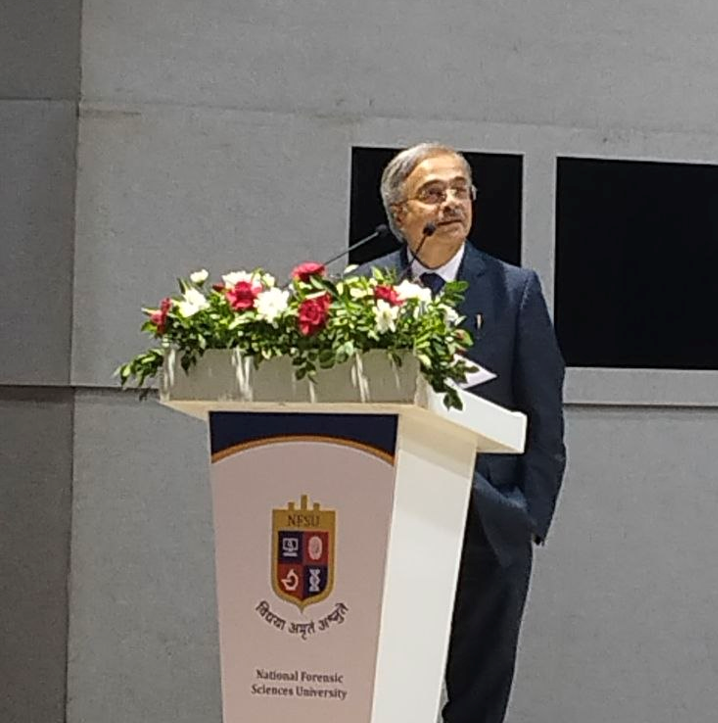
Justice N. V. Anjaria identified five qualities that, in his view, could not be guaranteed by AI in an adjudicatory process: integrity, authenticity, sensitivity, discretion, and human application of mind and human approach.
To illustrate the importance of these qualities, he narrated a story about a king who gave seeds to young men of his kingdom and instructed them to return after a year with the finest plant grown from the seed. While the others returned with flourishing plants, the king’s son returned with an empty pot because his seed had never germinated. The king then revealed that all the seeds had been boiled and could not have grown. The young men who returned with plants had therefore replaced their seeds, while the prince alone had told the truth. The king rewarded him because he had demonstrated “integrity, truthfulness, honesty and committedness.”
Justice N. V. Anjaria connected the story to contemporary digital culture, observing that modern society often places greater emphasis on appearance than authenticity. He cautioned that AI could reinforce such tendencies if used without sufficient care and circumspection. In the context of adjudication, he warned that mindless acceptance of AI could ultimately undermine the human-driven, human-centric and human-sensitive character of justice delivery.
He further emphasised that judges and arbitrators should remain the authors of their own minds.
“AI may be intelligent in its own way, but AI is not intelligible. … Intelligibility is a larger thing than mere intelligence.”
Towards the conclusion of his address, Justice N. V. Anjaria referred to the Supreme Court’s judgment in Pooja Ramesh Singh[1]. Referring to observations from the judgment, he highlighted the danger of developing a habit of delegating thought itself. Such delegation, he said, could have serious consequences for the human capacity to distinguish between right and wrong, truth and falsehood, virtue and vice, and what is just and unjust. He stressed that this capacity develops through deliberate discipline, systematic training of the mind and lived experience.
He concluded with a call for careful control over the adoption of AI in adjudicatory processes, stating that it was “compelling and necessary to have absolute and total control over the application and usage of AI.”
Vote of thanks by Dr. Shubham Pandey
The inaugural ceremony concluded with a vote of thanks delivered by Dr. Shubham Pandey, Assistant Professor, who began by expressing gratitude to the distinguished dignitaries and speakers for attending the programme and lending their support to the initiative. He also acknowledged the guidance and encouragement extended by the university leadership for their continued support in bringing the programme together.
Dr. Shubham Pandey then acknowledged the Gujarat High Court Arbitration Centre (GHAC) as a key partner in the programme and expressed gratitude to the academic partners for contributing to the academic and professional dimensions of the event.
He also thanked SCC Times, the information and documentation partner, for its support to the programme.
The vote of thanks also recognised the faculty members and the wider institutional team for their work across academic coordination, logistics, hospitality and execution.
He reserved special appreciation for the students, the ADR Committee and the volunteers, noting that they had worked over the preceding month on planning, coordination, follow-ups, logistics and the numerous arrangements required for an event of this scale. Describing their contribution as a significant part of the event’s achievement, he said that the programme marked the beginning of the India Digital ADR Summit 2026.
Bringing the inaugural ceremony to a close, Dr. Shubham Pandey looked ahead to the programme and noted that the Summit would engage with important questions at the intersection of dispute resolution and technology and their implications for the evolution of India’s ADR ecosystem. He concluded by thanking the dignitaries, partners, colleagues, students and volunteers for being part of the initiative.
R. Venkataramani: Digital justice requires questioning not only what technology can do, but how it should be used
Addressing the gathering, Shri R. Venkataramani began by reflecting on the value of bringing together persons with varied experience and perspectives to examine a common subject. He said that such discussions could draw attention to subtler questions that might otherwise be overlooked.
Against this backdrop, he described NFSU and the IDDRC as representing a new beginning in India’s potential to emerge as an international centre by connecting digital science with legal science. He spoke of the possibility of using digital platforms to create new links between justice and social development, commercial justice and economic wealth, and science and technology and the development of legal norms that facilitate innovation.
R. Venkataramani said that NFSU provided an appropriate setting for examining how digital science could contribute to alternative modes of justice delivery. He suggested that “doing justice” in the present context involved looking beyond conventional adversarial court rules and considering mechanisms that enable easier participation by disputing parties, operate with minimal procedural barriers and produce outcomes capable of reducing dissatisfaction and enduring grievances. He acknowledged that developing such a framework would require moving beyond some deeply entrenched ideas about how justice is to be delivered.
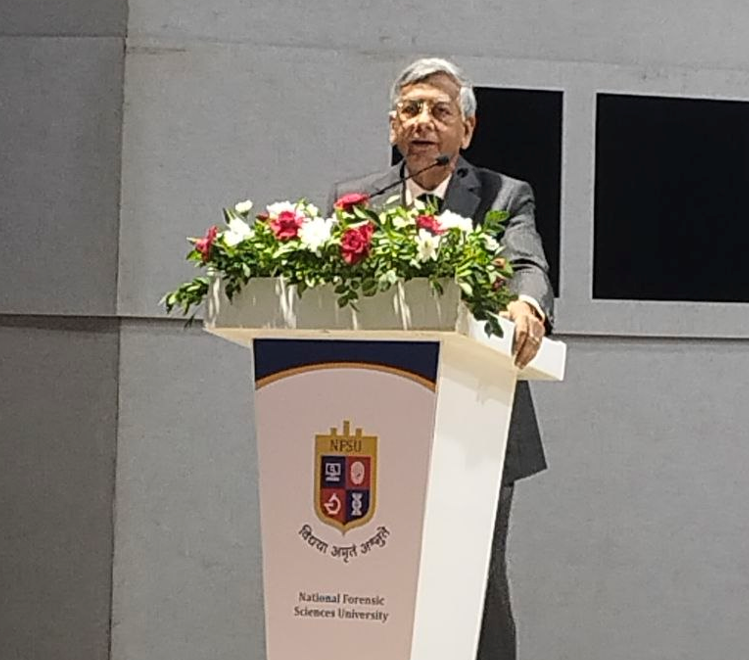
His discussion then turned to a more fundamental question: whether technology could ever be regarded as neutral. Referring to the book Technology is Not Neutral[2], R. Venkataramani observed that technological progress and technological risk often emerge together. He illustrated the point by referring to the proposition that the invention of a ship also creates the possibility of a shipwreck, just as the invention of an aircraft creates the possibility of a plane crash and electricity creates the possibility of electrocution.
He elaborated on this concern through two examples involving computer-generated decisions. In the first, a pilot flying from London to Edinburgh was informed by the aircraft’s computer system that the weather conditions did not permit a safe landing and consequently returned to London. In the second, R. Venkataramani referred to a 1983 incident in which a computer system indicated that a missile attack from the United States had been launched against Soviet Union (now Russia). The officer responsible questioned the warning rather than accepting it, thereby avoiding a possible retaliatory response. For R. Venkataramani, the two situations demonstrated the importance of knowing when technological advice should be accepted and when it should be questioned.
This led him to the question of speed, which he said had become particularly important in the “bullet train age”. While technology could make processes faster, he cautioned that speed could not be allowed to eclipse justice or fairness. He also drew attention to the importance of attention itself, particularly for students and professionals operating in an environment saturated with digital information. The ability to engage carefully with digital spaces, he said, was an increasingly important capability.
R. Venkataramani then placed this discussion in the context of the growing presence of AI in professional and legal environments. He observed that digital technology had entered virtually every area of human interaction and that AI had similarly moved into transactional spaces, including the legal sector, where it had generated a range of task-assisting tools.
He identified several questions that, in his view, required careful examination. These included the transformation of higher-order cognitive processes into machine cognition; the ability of AI systems to detect patterns and systematise information; the extent to which abstract reasoning, conceptual comprehension and context-specific solutions could be incorporated into AI systems; and, importantly, the need to consider the regulatory and management framework surrounding AI rather than merely asking which problems the technology could solve.
Building on these concerns, R. Venkataramani outlined what he described as the AI selection process, AI adoption process, the question of AI’s limits and the identification of particular roles for AI. He also called for an “AI due process” framework dealing with confidentiality, data integrity and security, accuracy, information paucity, transparency in evidentiary analysis, impartiality and independence, compliance with law and procedural rules, and the distinction between assistance in decision-making and the substitution of decision-making. He further raised the question of whether unequal access to AI tools could create a procedural disadvantage for one side in a dispute.
He said that the emerging field would require professionals who could combine legal and AI expertise, as well as legal professionals capable of understanding AI. In this regard, he called upon the IDDRC to contribute to developing answers to questions for which established textbooks could provide little guidance. The task, he suggested, was to generate original responses to the challenges created by a new technological environment.
R. Venkataramani concluded by drawing a parallel between the treatment of AI and the scientific method. He emphasised that scepticism, refutation and verification were fundamental to science and urged students to carry the same principles into their engagement with technology. “Please be a sceptic, please refute, please verify,” he said, as the next generation of digital technology and alternative approaches to justice continue to develop.
Read more reports from India Digital ADR Summit 2026:
-
India Digital ADR Summit 2026: CJ Sunita Agarwal on 5 AI use principles | SCC Times
-
India Digital ADR Summit 2026: Justice Rajesh Bindal on AI | SCC Times
1. Pooja Ramesh Singh v. Jammu & Kashmir Bank Ltd., 2026 SCC OnLine SC 1258
2. Technology is Not Neutral: A Short Guide to Technology Ethics, by Stephanie Hare