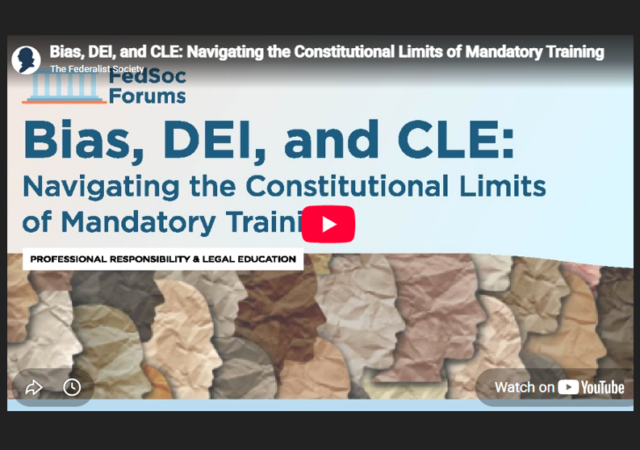
I appeared on September 2, 2026, on a Continuing Legal Education (CLE) program run by The Federalist Society. The topic was mandatory Diversity Equity and Inclusion (DEI) requirements under state CLE rules in order to maintain Bar membership.
Full video at bottom of this post. My segment and initial comments start at 20:15 (click here to jump to that point)
(Transcript auto-generated, may contain transcription errors, lightly edited for transcript clarity)
Thank you for having me. I want to emphasize a lot of the points that have been made and make a couple of others.
I am sending my greetings from the State of Rhode Island, until about three years ago, known as the State of Rhode Island and Providence Plantations. But the of the state was changed as part of the mad DEI dash post George Floyd, even though historically ‘plantations’ did not have to do with slavery in Rhode Island, it meant something very different.
There was a mass virtue signaling push, which also came to be in our CLE rules. So in 2023, I believe it was at the instigation of the Rhode Island Bar DEI committee, who knows what they actually do, but the Rhode Island Supreme Court issued a proposal and opened it for comment to change our CLE rules, which are regulated by the Supreme Court in Rhode Island, to require of the 10 mandatory credits that one of them be in diversity, equity, and inclusion.
I filed an opposition to it on my own behalf and also on behalf of the Equal Protection Project. So Legal Insurrection is not just a political website, it’s also a foundation. And one of our key projects is the Equal Protection Project, which brings legal challenges to discrimination done in the name of DEI.
The reason that we opposed it, that I opposed it, is one, the mandatory nature of it. It created a reasonable appearance that the Supreme Court, and therefore the court system, was taking sides in a hotly contested political and legal issue. The politics were essentially, what you would see on any college campus, which is critical race theory, DEI, whatever you want to call it, essentially Ibram Kendi’s formulation that attributes any disparate outcome to racism and requires people to be actively anti-racist. So in his formulation, which became something of a religion on campuses for three to four years, it’s died down a little, failing to be anti-racist made you racist.
And so in fact, that was the Cornell formulation. In July of 2020, Cornell president initiated an anti-racism initiative, and the suggested reading was Ibram Kendi’s book, How to Be an Anti-Racist.
It’s been a complete disaster, but the school’s clinging to it, bitter clingers.
So anyway, we took the position that there were existing at the time in 2023, DEI style CLE programs which people could take voluntarily and get credit. We weren’t challenging that, but it was the mandatory nature and particularly the way the proposed amendment was worded certainly suggested a Kendian sort of outlook.
[The RI Supreme Court definition of DEI] was “DEI shall include programs that recognize the diversity of society and teach attorneys to effectively serve and have regard for multilingual, multiracial, multi-religious, and multi-gender society while focusing on equity.” And that’s a key term, “while focusing on equity by highlighting equal opportunity and outcomes for all.”
So that is very much a radicalized DEI perspective, a Kendian perspective, which was now being incorporated into the rules of the Rhode Island Supreme Court as to what qualifies as a DEI credit and DEI program.
So we oppose that as being, one, hotly contested. As was pointed out, there’s no evidence that any of this programming actually works and makes things better, and there’s plenty of evidence that it makes things worse. And I think we all know from our own ‘lived experiences’ that forcing people to endure this doesn’t actually improve anything.
It also was, in our view, contrary to law, that this focus on equity and outcomes was contrary to United States federal law, contrary to Rhode Island law, which for the purpose of discrimination essentially mirrors federal law, and therefore, rather than focusing on the rights of individuals, which is what our federal and state constitutions are about, this is focusing on group outcomes.
And so our position was there’s no evidence it works. It’s hotly contested because it’s essentially Kafkatrapping that, under Kendi’s formulation, your denial of being racist is the proof of your racism, and it’s contrary to law. So why are we doing this and what good will come out of it?
Well, obviously, I wrote that lengthy letter to the [Rhode Island] Supreme Court, not exactly expecting it to succeed, and, and it didn’t succeed.
They did pass the rule, and so now under this broad outcome-oriented definition of what is DEI, we are required to take one of our 10 credits for DEI. In practice, I’m not really sure anybody actually follows the Supreme Court’s formulation of what DEI is. I just went to the Rhode Island Bar Association annual meeting to get all my credits, and I know I signed up for a couple of things that were DEI credits that really had nothing to do with any of these topics, race or anything, more emotional oriented things like that, and they called them DEI. So I’m not really sure what it means.
But what we did do at Equal Protection Project is we gathered up the three conservative lawyers in Rhode Island,
So we created a DEI CLE program. We got it approved by the Rhode Island Bar Association. So we could have done it outside, but really to get people to sign up, you need to go through the Bar Association. It was a little bit of back and forth, and they were very helpful. I don’t really have any criticisms, but they were very concerned that this might turn into a political sort of discussion attacking DEI. So we had to massage it and work through it.
Very well attended, shockingly well attended. I don’t remember the precise number, but I think we had 50 plus people, which for Rhode Island CLE is really good. And that’s what we did. So what you have now is a DEI credit definition in the rules that nobody actually seems to follow.
This was all virtue signaling. This is all the remnants of post-George Floyd purges in 2020, and the mad rush for DEI that captured the campuses. And of course, what happens on campuses never stays on campuses.
So, I’m not sure what they’re achieving by this, but we did object to it. I think it’s improper. I think it should not have been done. I don’t think anybody actually takes it seriously, but it’s just put in your hour and do it. But I think it is pernicious. I think it has encouraged perhaps the various DEI committees around the state to push harder and further, to prove that they are more virtuous than everybody else.
And so that’s where we are in Rhode Island. We opposed it, couldn’t stop it, so we’re doing it on our own.
And I think people welcome a neutral sort of topic. And the topic of our CLE was, Is DEI Still Legal After Students for Fair Admissions?
And so that’s where we are in the State of Rhode Island, formerly known as the State of Rhode Island and Providence Plantations.
Donations tax deductible
to the full extent allowed by law.