The National Green Tribunal (NGT) International Conference on “The Future of Environment and Climate Dynamics” was inaugurated by Prime Minister Narendra Modi on 19 September 2026 at Vigyan Bhawan, New Delhi. The two-day conference, being organised by the NGT on September 19 and 20, brings together jurists, scientists, policymakers, academicians and environmental experts from India and abroad to deliberate on environmental governance and contemporary climate challenges. The inaugural session was graced by
-
Justice Surya Kant, Chief Justice of India;
-
R. Venkataramani, Attorney General for India;
-
Bhupender Yadav, Union Minister for Environment, Forest and Climate Change; and
-
Justice Prakash Shrivastava, Chairperson, NGT.
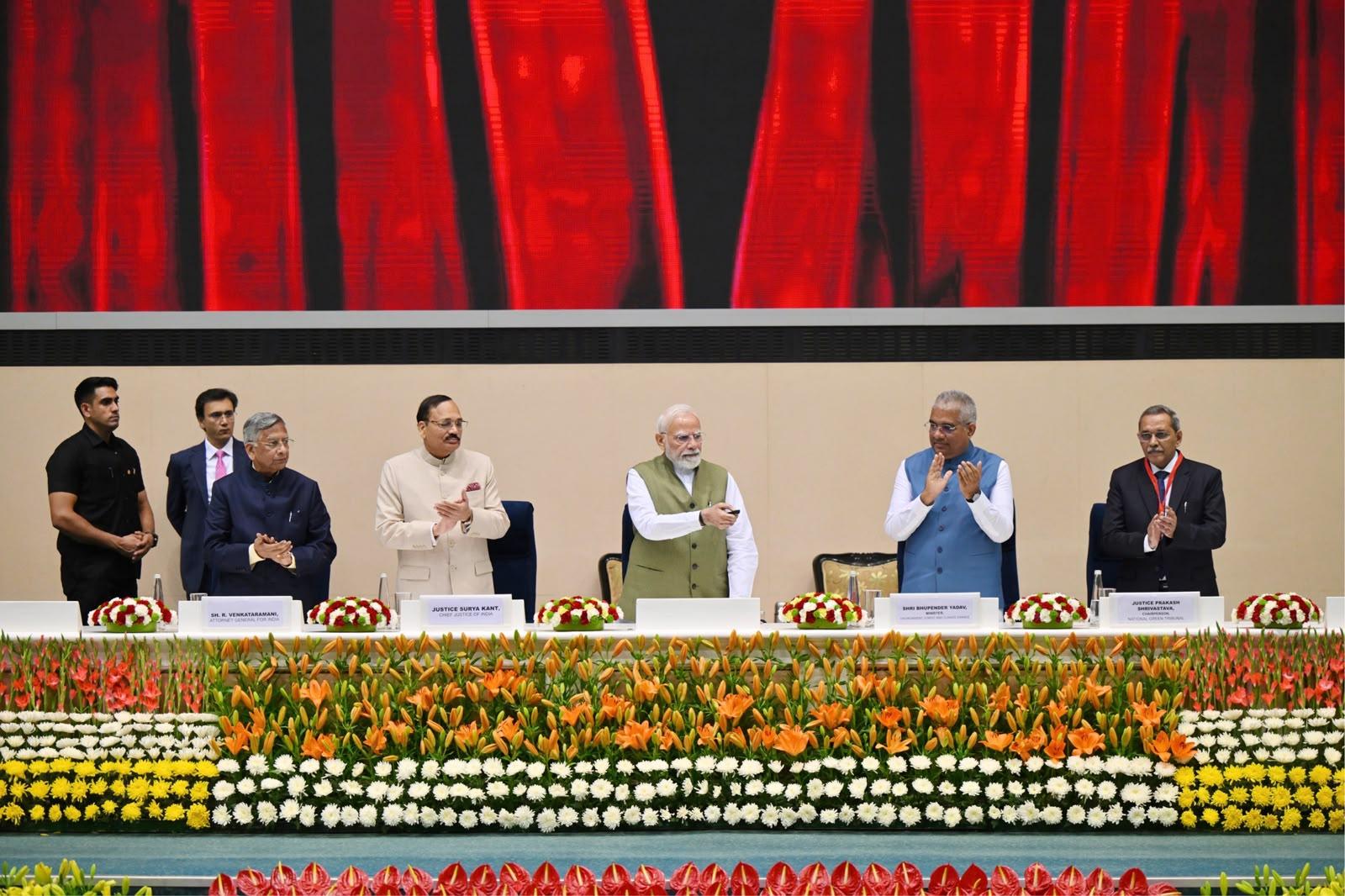
Representatives from 17 countries and international organisations including the United Nations Environment Programme (UNEP) and Asian Development Bank (ADB) are participating in the conference.
During the inaugural session, Prime Minister Narendra Modi spoke on India’s environmental and climate initiatives, while CJI Surya Kant traced the development of Indian environmental jurisprudence and its emerging engagement with climate-related rights. The Prime Minister also launched the NGT Mobile Application during the session.
PM Modi: India is showing how development and environmental sustainability can go hand in hand
Addressing the conference, Prime Minister Shri Narendra Modi began by referring to India’s longstanding relationship with nature and its environmental traditions. He said that the country’s cultural understanding of nature continues to inform contemporary approaches to climate action and that India was now developing solutions to modern environmental challenges while also advocating collective global action.
Climate action and the question of equity
The Prime Minister placed particular emphasis on the question of equity in global climate discussions. He argued that developing countries have often been assigned a disproportionate responsibility for carbon emissions, despite significant differences in per-capita emissions. He stated that India’s per-capita carbon emissions remain less than half the global average.
He also referred to India’s engagement with international climate initiatives, including One Sun, One World, One Grid, the International Solar Alliance, the Coalition for Disaster Resilient Infrastructure (CDRI), the Global Biofuel Alliance and the International Big Cat Alliance. These, he said, represented efforts to develop international cooperation alongside domestic environmental measures.
The Prime Minister further said that, among the G20 countries, India had fulfilled the commitments made at the COP21 Paris Summit ahead of schedule. He described the country’s approach in the formulation: “Our development is speedy as well as sustainable.”
Renewable energy forms a major part of India’s environmental efforts
The Prime Minister highlighted the expansion of renewable energy over the past 12 years, particularly solar power. He said India’s solar capacity had increased from around 2 gigawatts to more than 160 gigawatts during this period.
He also referred to the PM Surya Ghar Muft Bijli Yojana, under which more than 50 lakh homes have been equipped with rooftop solar systems, with financial assistance of up to ₹80,000 per household. According to the figures cited by him, around 30 lakh farmers have received solar pumps under the PM-KUSUM scheme.
The Prime Minister further referred to the completion of One Nation-One Grid, stating that the project had helped prevent approximately 200 million tonnes of carbon emissions. He described rooftop solar as part of an effort to make individual homes centres of solar power generation.
Beyond solar power, he pointed to the expansion of wind and hydropower and a renewed focus on nuclear energy. He also referred to cleaner technologies including coal gasification and said that the country’s non-fossil energy capacity had expanded substantially.
Hydrogen, electric vehicles and public transport
The Prime Minister also linked environmental policy with developments in the transport sector. He highlighted the recent launch of India’s first Hydrogen Train, describing it as a development in clean mobility.
He stated that electric vehicle sales had increased around 950-fold, from fewer than 3,000 before 2014 to approximately 25 lakh in the previous year. He also referred to FASTag and its role in reducing waiting time at toll plazas and, consequently, fuel wastage.
Public transportation was another area highlighted in his address. He contrasted the metro network of approximately 250 kilometres across five cities in 2014 with the current network operating across more than 20 cities and extending beyond 1,000 kilometres.
The Prime Minister also referred to the near-total electrification of the Indian railway network and the environmental impact of the 3,000-kilometre Dedicated Freight Corridor. He noted that double-stack container trains can replace large numbers of road freight vehicles on certain routes. He further highlighted the operationalisation of around 5,000 kilometres of inland waterways, pointing to their ability to carry freight with fewer road vehicles.
These developments, he said, demonstrated that environmental protection and rapid development could be pursued together.
Water conservation and climate-resilient agriculture
The Prime Minister then turned to water conservation. He referred to the construction of more than 70,000 Amrit Sarovars and around 1.5 crore rainwater harvesting structures under the Catch the Rain campaign.
He also highlighted irrigation initiatives under the Pradhan Mantri Krishi Sinchayee Yojana and Per Drop, More Crop, stating that they were contributing to water conservation for more than 2 crore farmers.
The promotion of millets or Shree Anna was another part of his discussion. The Prime Minister referred to their relatively lower water requirements and noted an increase in domestic production and exports, with exports reaching approximately 1.5 lakh tonnes. He also linked India’s efforts to promote millets with the United Nations’ declaration of 2023 as the International Year of Millets.
He further referred to 24,000 natural farming clusters covering 12.5 lakh hectares, around 3,000 climate-resilient crop varieties, and the promotion of agro-forestry as part of measures aimed at reducing environmental and carbon footprints.
Forest cover, tree plantation and waste management
The Prime Minister stated that very dense forest cover had increased by more than 22% over the preceding 12 years. He also referred to the Ek Ped Maa Ke Naam campaign and the participation of citizens in tree plantation activities across the country.
Addressing plastic pollution and waste management, he reiterated the country’s approach towards restricting single-use plastics and promoting a Circular Economy based on reducing, reusing and recycling waste.
He referred to the GOBARdhan Yojana as an example of converting rural organic waste into useful resources. The broader objective, he said, should be to treat waste not merely as a problem but as a resource.
The Prime Minister concluded this part of his address by placing these environmental measures in a wider context, saying that the figures represented not only domestic achievements but also India’s contribution to the future of humanity. He expressed the view that India was working towards a responsible and sustainable future and said he expected the deliberations of the Conference to contribute further ideas and solutions.
CJI Surya Kant: Indian environmental jurisprudence has evolved towards climate-related rights
Delivering the inaugural remarks, CJI Surya Kant examined the development of environmental jurisprudence in India, beginning with the country’s constitutional and civilisational understanding of environmental protection. He observed that environmental preservation had been deeply embedded in India’s heritage even before modern environmental law developed its present terminology and institutional structures.
CJI referred to Article 48A of the Constitution, which directs the State to protect and improve the environment, and Article 51A, which places a duty upon citizens to protect the natural environment. He described these provisions as reflecting responsibilities extending across generations.
Right to a pollution-free environment and foundational principles
Tracing the contribution of the Supreme Court, CJI referred to Municipal Council, Ratlam v. Vardichan, (1980) 4 SCC 162, as an early example of environmental adjudication in which administrative and financial limitations were not accepted as a basis for allowing unhealthy environmental conditions to continue.
He then referred to the recognition of the right to a pollution-free environment within Article 21 and the development of several foundational environmental principles. These included the Precautionary Principle, which requires preventive action in anticipation of environmental harm, and the Polluter Pays Principle, under which responsibility for restoration is placed upon the party responsible for environmental damage.
He further noted the application of absolute liability in cases involving industrial harm and referred to the recognition of the M.C. Mehta v. Kamal Nath, (1997) 1 SCC 388. Under this doctrine, resources such as forests, rivers and air are treated as being held by the State in trust for the benefit of the public.
From environmental protection to balancing development and conservation
CJI said that subsequent jurisprudence had moved towards an approach in which development was neither prohibited altogether nor permitted without scrutiny. Instead, development could proceed subject to enforceable conditions, expert oversight, restoration, compensatory afforestation and accountability.
He referred to the recent articulation of “eco-centric proportionality”, under which environmental protection is required to remain rigorous while engaging with practical developmental realities. The resulting question before courts, he said, is increasingly not whether conservation and development should be treated as competing choices, but how the two can be harmonised and sustained together.
Climate change brings equality, livelihood and health into environmental adjudication
CJI identified the movement from environmental rights towards climate-related rights as an important development in Indian jurisprudence. He said that the adverse effects of climate change can implicate fundamental rights relating to equality, livelihood and health, as well as the conditions required for their meaningful enjoyment.
He also pointed to a shift from analysing isolated instances of environmental injury towards considering cumulative ecological harm. Environmental consequences, he observed, do not necessarily follow administrative boundaries. Rivers, forests and the atmosphere function as connected ecological systems. Climate adjudication therefore requires courts to consider the larger ecological system in which individual projects and activities operate.
CJI noted that these issues would become increasingly complex as the energy transition creates new infrastructure and patterns of land and resource use. Cities, he said, would have to reconcile mobility, housing and economic activity with air quality, water security and ecological resilience. Climate disputes could also involve multiple actors and jurisdictions.
Comparative environmental jurisprudence across jurisdictions
CJI then examined environmental jurisprudence from different legal systems. He referred to Nepal, where environmental protection has been connected with the right to life; Sri Lanka’s Eppawela case, which addressed sustainable development and finite natural resources; South Africa, where sustainable development has been used to reconcile environmental protection with socio-economic development; and Brazil, where the Supreme Federal Court has addressed governmental omissions and the functioning of environmental policy.
He further referred to developments in Chile, Russia and Armenia concerning constitutional environmental rights and responsibilities towards future generations. The experience of Thailand, he said, illustrates the role of administrative jurisprudence in environmental protection, while the United States demonstrates the importance of statutory boundaries and institutional competence. Australia, meanwhile, has required its courts to confront questions concerning climate science, causation and the scope of possible common-law duties.
The comparative examples included Surya Prasad Sharma Dhungel v. Godavari Marble Industries from Nepal, Sri Lanka’s Bulankulama v. Secretary, Ministry of Industrial Development (the Eppawela case), South Africa’s Fuel Retailers Association of Southern Africa v. Director-General: Environmental Management, Brazil’s ADPF 708 and ADO 59, Thailand’s Map Ta Phut Industrial Estate and Klity Creek cases, the United States Supreme Court’s West Virginia v. Environmental Protection Agency, and Australia’s Minister for the Environment v. Sharma.
Comparative jurisprudence should encourage dialogue
Drawing together these different approaches, CJI cautioned against treating comparative environmental jurisprudence as an exercise in directly transplanting one jurisdiction’s legal approach into another. Instead, he said, it should serve as a basis for dialogue among courts and legal systems.
He concluded by emphasising that environmental justice cannot be pursued by courts in isolation. Judicial reasoning, he said, must draw strength from collective will, scientific knowledge and international cooperation. He described the ongoing task as one of connecting the environmental wisdom of the past with the needs of future generations while ensuring that development does not come at the cost of ecological destruction.
NGT launches mobile application as Conference begins technical deliberations
The inaugural programme also saw the launch of the NGT Mobile Application by Prime Minister Narendra Modi.
The two-day Conference includes four technical sessions examining different aspects of environmental and climate governance. On the first day, Technical Session-I, titled “Climate Justice, Equity and Inclusion: From Principles to Action”, considered equity and inclusion in climate action, environmental and social safeguards, and the interconnected effects of climate change and environmental degradation.
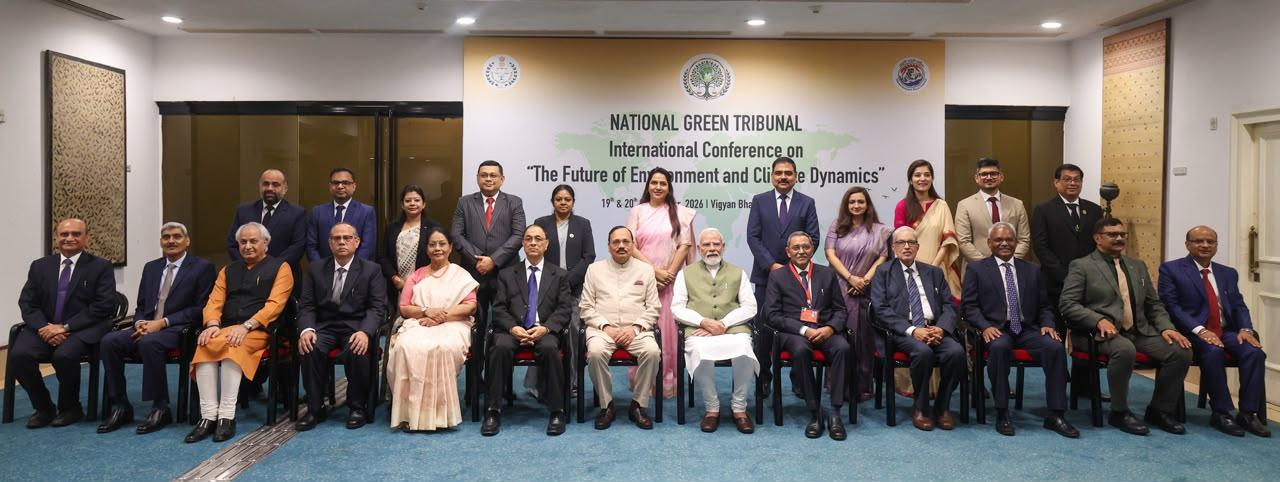
Technical Session II, titled “The Future of Environmental Law and Governance”, focused on institutional and enforcement mechanisms, sustainable and liveable cities, energy transition, green infrastructure and green finance.
The Conference brings together judicial, scientific, policy and institutional perspectives from India and abroad, with the stated objective of strengthening environmental law and institutions, advancing climate justice and inter-generational equity, promoting sustainable and resilient cities, facilitating a just energy transition and encouraging cooperation on transboundary environmental challenges.