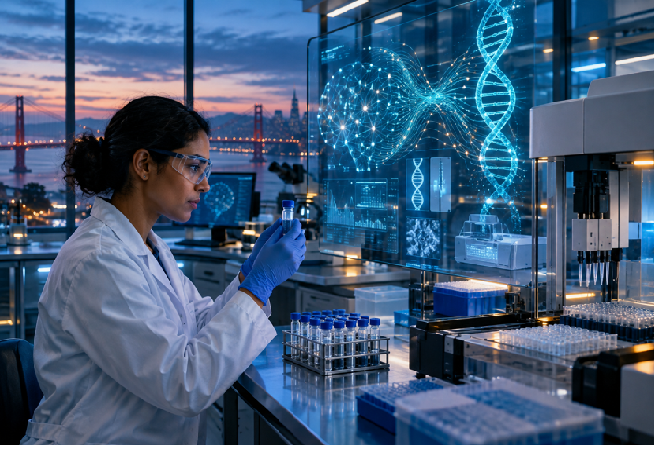
In a fascinating new artificial development, especially in the wake of artificial intelligence hysteria being pushed by “experts” and the mainstream media last week, Anthropic has confirmed that it operates a wet biology lab in the San Francisco Bay Area.
A wet lab is a facility designed for hands-on experimental work with biological materials, rather than purely computational modeling or simulation. Essentially, the lab is designed to conduct the biology experiments AI suggests could expand research in the life sciences, especially in discovering treatment options for rare diseases.
At a time when fears of AI are gripping the public, the startup has built a wet lab, or place for physical experiments, in the San Francisco Bay Area, two people familiar with the matter said. Anthropic has said it wants to unlock treatments for rare diseases, and its biology work has gone beyond “in silico” or computer evaluations.
In a Reuters interview on Tuesday, Anthropic’s head of life sciences, Eric Kauderer-Abrams, confirmed the startup’s wet lab.
“We believe that to do biology, the final test is still and will be for a while in real lab work,” he said. “We absolutely are doing that today, and I would describe our approach as being typical of what you would see in most biotech companies, where there’s some amount of that that we’re doing in our own facilities and some amount of that that we’re working with external partners on.”
A spokesperson later clarified that Anthropic’s lab is not for drug discovery specifically, declining to elaborate.
At a time when fears of AI are gripping the public, the startup has built a wet lab — or place for physical experiments — in the San Francisco Bay Area, two people familiar with the matter said. https://t.co/7kKHA8BEe8
— Reuters Legal (@ReutersLegal) September 18, 2026
I recently reported that Anthropic had said that it shut down accounts belonging to scientists who used its Claude model in ways that could have supported biological-weapons research, including work related to making avian influenza more capable of infecting mammals.
Therefore, it is understandable that many are still a little jittery after the dire warning that has been recently issued.
The fervor has grown so intense that CEO Dario Amodei published a post last weekend calling on the industry to slow down and institute self-regulation. He has repeatedly called bioterrorism one of AI’s biggest risks.
The juxtaposition of these dire warnings and the wet lab has not gone unnoticed in the tech industry. As investor and AI coding startup founder Chamath Palihapitiya posted on X, somewhat tongue in cheek: “The group behind such hits as: ‘We’re All Going To Die’ and ‘Regulate Me Now’ are building a wet lab in SF. I do not recommend this.”
I would like to note that despite all the warning and demands for “pacing” and “government intervention”, the work with the wet lab is proceeding….along with the preparation for the Initial Public Offering (IPO).
…[E]ven as Dr. Amodei became embroiled in a contentious A.I. safety debate, his company — which makes the Claude chatbot — continued to prepare for a blockbuster initial public offering that may shape up to be the biggest listing ever.
The company is expected to reach more than $100 billion in annualized revenue by the end of this year, according to four people familiar with the matter. That’s up from $65 billion in annualized revenue as of July. Investors seeking to get a piece of the I.P.O. are using those soaring numbers to justify Anthropic’s staggering potential valuation of $2 trillion.
The A.I. lab could publicly release financial documents detailing its offering as soon as in the coming weeks, which could put it on track for its shares to start trading as soon as November, said two people with knowledge of the situation who, like others quoted in this article, spoke on condition of anonymity to discuss the confidential plans.
The people stressed that the plans could still change. The timing of I.P.O.s are always subject to change because of factors like shifting investor sentiment and market volatility.
Let us hope Anthropic’s wet lab follows every biosafety and biosecurity rule, especially after its own warnings about Claude’s potential use in dangerous biological research.
The company’s safety rhetoric certainly deserves scrutiny as it expands into hands-on biology work and prepares for a potentially enormous IPO.
I suggest that the best gauge of real AI risks is to see what the “frontier AI” firms do, rather than what they say, at this point.
Donations tax deductible
to the full extent allowed by law.