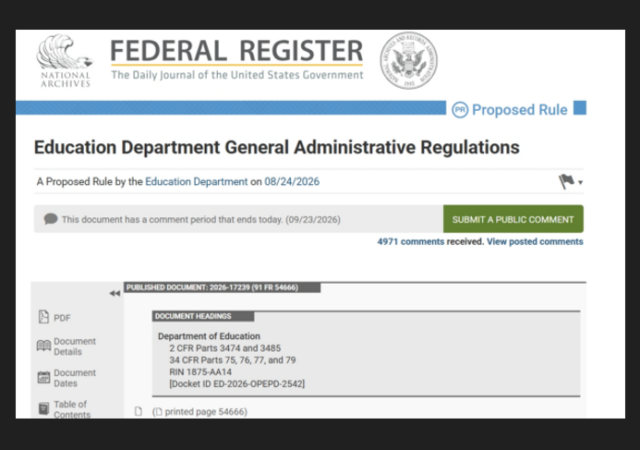
On September 22, 2026, the Legal Insurrection Foundation (LIF) submitted a public comment (Letter here) supporting the U.S. Department of Education’s proposed amendments to the Education Department General Administrative Regulations, or EDGAR. LIF also recommended one narrow clarification to make those reforms harder to evade.
The filing builds on LIF’s work exposing how intersectionality has spread across education, media, and government programs. Intersectionality is an ideology that categorizes individuals by group identity—such as race, gender, sexuality, or immigration status—and justifies discriminatory treatment based on automatically presumed privilege or oppression, without examining the relevant evidence in each case. In practice, it can turn legally protected traits into operative criteria, raising concerns under nondiscrimination laws.
LIF’s work includes two reports produced with the Defense of Freedom Institute for Policy Studies. Our April 2026 report, Intersectionality – The Rise of a Dangerous Anti-American Ideology and How to Stop It, examines the ideology’s rise and reach. Our August 2026 report, Federal Spending on Intersectionality: The Case for Executive Action to End Identity-Based Preferences in Federal Grantmaking, documents the federal spending tied to it.
The Education Department’s August 24, 2026, proposal would revise rules for application notices and priorities, unsolicited applications, multi-tier review, selection criteria, continuation awards, merit practices, high standards, and evidence definitions. In LIF’s view, the proposal moves federal education grantmaking in the right direction. It advances transparency, efficiency, merit, and accountability.
But even a strong rule can be weakened by an obfuscating maneuver. A direct identity preference can be disguised under new labels. LIF therefore asks the Department to add a focused anti-circumvention provision. The rule should make clear that a practice forbidden directly cannot be revived indirectly through “intersectionality,” an “intersectional identity category,” or substantially similar terminology.
Intersectionality analyzes social conditions through overlapping identities, including race, sex, religion, national origin, class, disability, and immigration status. It can treat those combinations as presumptive evidence of privilege, oppression, marginalization, or systemic disadvantage. In grantmaking, that approach risks replacing individual facts, neutral standards, and merit with group classifications.
Intersectionality is the octopus at the center of the identity-politics ecosystem. New identities sprout like tentacles, then intertwine to generate fresh claims of privilege or oppression. The labels change; the method does not. The question is simple: Does a criterion treat people differently because of legally protected traits subject to nondiscrimination laws?
That is why the clarification matters. A funding notice need not state an identity preference outright. A neutral-sounding proxy or composite category can produce the same result.
The concern is not hypothetical. LIF and DFI’s August report found nearly 250 federal assistance-award records in USAspending.gov using the keyword “intersectionality.” At the time of the filing, the database showed about $250 million in obligations and $150 million in outlays, subject to regular updates and reconciliation. The awards ranged from research and training to outreach, technical assistance, and institutional-change projects.
The real cost is larger. Grantees can be pulled into trainings, equity reviews, audits, and reporting systems built on vague ideology rather than measurable educational results. Time and money shift from programs to identity accounting.
The Department offers a better path. Federal grants should support nationally beneficial efforts in accordance with the law. Awards should be nondiscriminatory and merit-based, with clear requirements, objective measures, and attention to genuine need.
From our letter:
1. Strengthen the proposed merit-based framework by closing the intersectionality loophole
Intersectionality is a widespread analytical framework that analyzes social conditions through overlapping identities, including race, sex, religion, national origin, class, disability, and immigration status. It treats their combination as presumed evidence of privilege, oppression, marginalization, or systemic disadvantage rather than assessing individual facts. In doing so, it substitutes collective guilt or virtue for individual merit. Proxy and composite terms operate within this framework. A proxy uses a facially neutral criterion in place of an identity characteristic. A composite classification combines identity characteristics for eligibility, priority, scoring, compliance, benefits, or burdens. Labels may include “intersecting identities,” “lived experience,” “equity-centered,” or “historically marginalized.” The key question is whether a criterion sorts, favors, burdens, excludes, or targets people based on protected characteristics or substitutes for them….l
The Department’s proposed focus on merit and neutral standards is well suited to address these concerns. A brief clarification would ensure that the rule reaches functionally equivalent practices even when they use different labels. Covering intersectional, composite, and proxy methods would reinforce the NPRM without disturbing lawful research, civil-rights compliance, or neutral measures of actual need….
To reinforce those provisions without altering their structure, LIF respectfully recommends adding: “For purposes of this section, a criterion, priority, review method, or practice that would be impermissible if applied directly may not be applied indirectly through intersectionality, an intersectional identity category, or substantially similar terminology. This sentence does not prohibit a criterion expressly authorized or required by Federal statute or a neutral, objective measure materially related to the statutory purpose of the program.” ….
Conclusion
LIF strongly supports the NPRM’s reforms to priorities, notices, selection criteria, merit, and high standards. The proposed framework is sound and should be finalized. One narrow clarification would ensure that its protections cannot be evaded through proxies, composite categories, intersectional formulations, or similar terms. This addition would complete and reinforce the Department’s approach, not alter it. We respectfully urge the Department to finalize the proposed rule and adopt the limited Appendix A language needed to close this potential intersectionality loophole. The Department can preserve statutory and constitutional safeguards and rely on existing EDGAR procedures for implementation and enforcement.
The Department should finalize the EDGAR reforms and close this loophole. Equal treatment cannot depend on whether an identity preference is explicit or hidden behind intersectional terminology, a proxy, a composite category, or a new label. Federal education funds should advance lawful national priorities, merit, and high standards. Education is the most important battlefield in the defense of America and the West. The rules governing it must reflect that responsibility.
Nora D. Clinton is a Research Scholar & Project Manager at the Legal Insurrection Foundation. She was born and raised in Sofia, Bulgaria. She holds a PhD in Classics and has published extensively on ancient documents on stone. In 2020, she authored the popular memoir Quarantine Reflections Across Two Worlds. Nora is a co-founder of two partner charities dedicated to academic cooperation and American values. She lives in Northern Virginia with her husband and son.
==========================
Donations tax deductible
to the full extent allowed by law.