The Equal Protection Project has filed over 115 civil rights complaints against over 290 institutions regarding over 850 programs and scholarships. We have had many wins and impacts (over 340 by our count). While most of our civil rights complaints have been filed with the Department of Education Office for Civil Rights (OCR), increasingly have filed at HUD, DOJ, and HHS.
Our latest was a complaint at HHS regarding the Lavender Lab at the University of Maryland. The Lavender Lab operates under a multi-million dollar grant from the National Institutes for Health.
From the Civil Rights Complaint:
We bring this civil rights complaint and request for investigation against the University of Maryland, College Park (“UMD”) regarding practices in its HHS-funded Lavender Lab. As described below, investigation by HHS is needed because the Lab appears to use race, color, and/or national origin in certain programs and opportunities connected to its federally funded research. These practices should be investigated for possible violation of:
• Title VI of the Civil Rights Act of 1964 (“Title VI”), because UMD and the Lavender Lab receive federal financial assistance;
• Section 1557 of the Affordable Care Act (“ACA”), because the Lavender Lab engages in federally funded health-related research;
• The Equal Protection Clause of the Fourteenth Amendment, because UMD is a public university; and
• Executive Orders 14173 and 14332, because continued HHS funding of the Lavender Lab’s programming may violate federal grantmaking requirements barring federal awards from supporting or facilitating unlawful racial discrimination.UMD’s Lavender Lab expressly describes its work as “informed by intersectionality theory” and grounded in “social justice and health equity.”2 Federal funding of programs based on intersectionality raises civil rights concerns as the ideology is focused on group racial and ethnic identities and outcomes contrary to the civil rights laws and Constitution that demand equal protection for individuals regardless of group identity. The Lavender Lab’s practices demonstrate how intersectionality might cross over into unlawful discrimination.3
Consistent with an intersectionality framework, the Lavender Lab’s research examines the combined effects of sexual-minority status, race, ethnicity, and what it describes as “structural oppression.” This complaint does not challenge the Lab’s decision to study those subjects or to conduct research focused on particular populations, as that is a policy not a legal matter. The legal concern arises from how the Lab operates and whether it has extended its intersectionality and DEI commitments beyond research subject matter and into programs, participation opportunities, and recruitment practices that use race and ethnicity in a discriminatory manner.4
We explained the nature of the HHS grant:
The Lavender Lab is an NIH-funded research lab at UMD. The Lab states that it “conducts NIH-funded research on the psychological, social, and cultural determinants of suicide, substance use, and other health outcomes for lesbian, gay, bisexual, transgender, and queer (LGBTQ+) individuals and Black, Indigenous, and People of Color (BIPOC).”5
One of the Lab’s principal federally funded projects is NIH Grant No. R01AA029989, titled Long-Term and Daily Associations Among Intersectional Minority Stress, Structural Oppression, and Alcohol Use and Misuse Among Sexual Minority Adolescents of Color.6 The grant is administered by the National Institute on Alcohol Abuse and Alcoholism (“NIAAA”), an institute of NIH within HHS. The project began on May 10, 2022, and its current period of performance extends through April 30, 2027. Federal award data reflect approximately $3.6 million in total federal obligations over the full term of the grant, with approximately $2.2 million in outlays to date, including a $695,192 continuation award for fiscal year 2026….
Thus, HHS, through NIH and NIAAA, is providing millions of dollars in federal financial assistance for the Lavender Lab’s intersectionality- and race-focused research. Without addressing whether the research design or defined study population independently violates federal law, this complaint focuses on how the Lab operates programs and opportunities that use race and ethnicity in ways that warrant investigation under Title VI, Section 1557 of the ACA, and the Equal Protection Clause.
The grant’s stated research aims do not direct UMD to discriminate in selecting research assistants, advisory-board members, or other participants. Nevertheless, UMD’s use of race and ethnicity in administering programs and opportunities connected to the federally funded Lavender Lab raises concerns under applicable federal anti-discrimination laws, Executive Orders 14173 and 14332, and any implementing terms governing the award’s continuation, amendment, payment request, or drawdown.8
We identified the following specific race- and ethnicity-focused practices that may violate the law: LGBTQ+ The Teens of Color Advisory Board and its related publication, and the selection of research assistants in the lab:
The Teen Advisory Board, according to Lavender Lab’s public statements, expressly selects participants on the basis of race and ethnicity. The Lab states that it is “specifically looking for teens in the US who identify as both LGBTQ+ and Black, Indigenous, and People of Color (BIPOC) to join our board.” It further describes the Board as a youth committee composed of “Queer, Trans, Black, Indigenous, and/or other People of Color (QTBIPOC)” teens.10 ….
The Teen Advisory Board also created “Lavender Speaks,” a community blog operated through the Lavender Lab.12 The Lab describes Lavender Speaks as “a safe space for QTBIPOC [Queer, Trans, Black, Indigenous, and People of Color] community members to express their stories, share community events and community advice, and share resources with each other.” The Lab further states that the blog is “community-led and community-informed” and invites readers to “share [their] own reflections, resources, and community” through the platform.
Lavender Speaks therefore provides an additional public-facing program created through the Teen Advisory Board and is expressly directed toward the QTBIPOC community. It further demonstrates that the Board’s activities extend beyond internal research and include programming organized around race and ethnicity.
***
The Lavender Lab also offers undergraduate and master’s-level Research Assistant (“RA”) positions through UMD.13 Although these positions are generally unpaid, undergraduate RAs may receive academic course credit through UMD, and some applicants may be able to participate through federal work-study. RAs must generally commit to at least two semesters and work a minimum of eight hours per week.
UMD’s Department of Psychology considers “traditionally marginalized groups” to include “women, ethnic minority individuals, and LGBT individuals.” See https://psyc.umd.edu/facultyprofile/wessel/jennifer [https://archive.is/wip/vizWh] (accessed September 15, 2026). Images posted on the Lavender Lab website reinforce and signal this racial and ethnic preferencing. [image omitted]
In describing the candidates it seeks for these positions, the Lavender Lab expressly states that it “especially encourage[s] and invite[s] candidates from traditionally marginalized backgrounds to apply to join our lab.” The Lab places this preference within a discussion of “intersectional identities,” “social identities,” and “social privileges,” and states that it seeks an environment free from forms of oppression including “racism,” “anti-Blackness,” “xenophobia,” and “colorism,” among other classifications.14
The Lab further states that RA applicants with experience working with or conducting research involving “LGBTQ and BIPOC communities” through “cultural humility, intersectionality, and social justice approaches” will receive the “strongest consideration.”15 Thus, the Lab does not merely describe the subject matter of its research or encourage a broad range of applicants. Its stated selection criteria expressly provide enhanced consideration to applicants possessing particular experience with BIPOC communities while separately and affirmatively encouraging applicants from “traditionally marginalized backgrounds.” This language clearly signals a preference for non-white applicants.
In context, the Lab’s express invitation to applicants from “traditionally marginalized backgrounds” strongly indicates that an applicant’s race, color, or national origin is considered in selecting Research Assistants. That concern is heightened by the Lab’s express references to racism, anti-Blackness, xenophobia, and colorism, as well as its statement that applicants with experience involving “LGBTQ and BIPOC communities” will receive the “strongest consideration.” Such racial and ethnic signalling likely would dissuade students who do not fit these racial and ethnic categories from applying.
We request that the investigation consider whether any HHS funds paid to UMD under the Lavender Lab grant need to be returned:
HHS has the authority and obligation to investigate UMD’s creation, funding, promotion, and administration of these programs and practices and to obtain appropriate remedial relief. HHS should also determine whether the challenged practices are being funded, supported, or facilitated by the NIH award; whether they conflict with Executive Orders 14173 and 14332 or applicable award terms; and whether UMD made any relevant certifications or representations concerning its compliance with federal antidiscrimination laws. This includes, where authorized, initiating proceedings to suspend or terminate federal financial assistance, referring any potentially false certification for further review, and referring the matter to the Department of Justice for judicial enforcement….
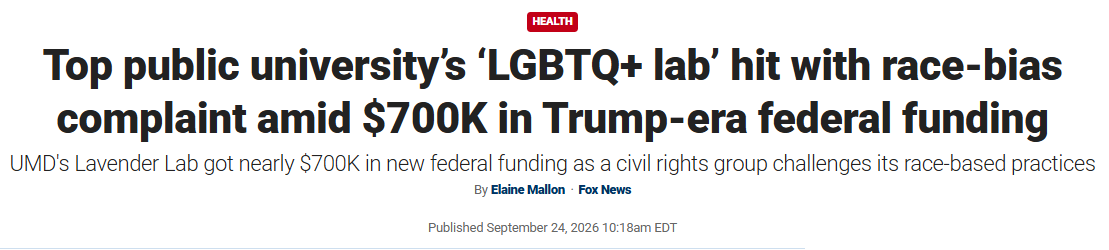
Fox News covered the filing including interviewing me (video at bottom of post):
A University of Maryland research lab that received nearly $700,000 in additional federal funding from the Trump administration this year is facing a civil rights complaint alleging that it uses race and ethnicity to determine access to some research-related opportunities.
The Equal Protection Project (EPP) filed the complaint with the Department of Health and Human Services’ Office for Civil Rights against UMD’s Lavender Lab, a National Institutes of Health (NIH)-funded lab that studies suicide, substance use and other health outcomes among LGBTQ+ people and Black, Indigenous and People of Color.
EPP is asking HHS to investigate whether the lab’s LGBTQ+ Teens of Color Advisory Board and its research assistant selection practices give priority to non-White applicants.
“Some people may ask what is wrong with prioritizing non-whites in a program which is designed to study non-whites,” EPP founder William Jacobson told Fox News Digital. “When you receive federal funding, you cannot discriminate in the administration of your programs.”
“You do not need to have an advisory board, you do not need to hire research assistants based on race to fulfill the purposes of this grant,” Jacobson continued.
The complaint comes as the Lavender Lab continues receiving millions of dollars through the NIH for research examining alcohol and drug use among “sexual minority adolescents of color.”
One of the lab’s principal projects, titled “Long-Term and Daily Associations Among Intersectional Minority Stress, Structural Oppression, and Alcohol Use and Misuse Among Sexual Minority Adolescents of Color,” began in May 2022 and is scheduled to run through April 2027. The complaint cites approximately $3.6 million in total federal obligations and roughly $2.2 million in outlays at the time of its filing.
NIH records cited in the complaint show the National Institute on Alcohol Abuse and Alcoholism provided another $695,192 for the project for fiscal year 2026.
The complaint points first to the lab’s LGBTQ+ Teens of Color Advisory Board, which said it was “specifically looking for teens in the US who identify as both LGBTQ+ and Black, Indigenous, and People of Color (BIPOC) to join our board” in an Instagram post.
According to the complaint, board members are paid to help review research, provide feedback and participate in professional-development activities, with some also receiving leadership opportunities.
EPP also targeted the Lavender Lab’s research-assistant program, which offers positions to undergraduate and master’s-level students.
Although the positions are generally unpaid, the complaint stated that undergraduate research assistants may receive academic course credit, and some students may be able to participate through federal work-study. Research assistants generally commit to at least two semesters and a minimum of eight hours per week.
The lab stated it “especially encourage[s] and invite[s] candidates from traditionally marginalized backgrounds” to apply and that applicants with experience conducting research involving “LGBTQ and BIPOC communities” through “cultural humility, intersectionality, and social justice approaches” will receive the “strongest consideration.”
“Discrimination based on race or ethnicity at institutions receiving federal funding is unlawful regardless of which group is targeted or benefits,” Jacobson said. “Treating individuals as avatars of their demographic identity rather than as individuals with unique merits and circumstances undermines fairness, merit, social cohesion, and the rule of law.”
EPP alleges that the language indicates race or ethnicity may play a role in the selection process. The complaint asks HHS to investigate whether the practices violate Title VI of the Civil Rights Act, which prohibits discrimination based on race, color or national origin in federally funded programs, as well as the Affordable Care Act.
“Because the Lavender Lab is operating under an HHS health care related grant, the non-discrimination provisions of the Affordable Care Act must be adhered to, and HHS has authority to enforce those provisions,” Jacobson said.
EPP’s complaint also questions federal funding for research focused on intersectionality, which the Lavender Lab says guides its work. The lab studies how sexual-minority status, race, ethnicity and what it calls “structural oppression” affect health outcomes.
“The conduct at the Lavender Lab calls into question whether HHS should be funding intersectionality-focused research at all,” Jacobson said. “Intersectionality is a race- and ethnicity-focused group-identity approach. It is no surprise that where the focus is racial identity that programming could cross the line into civil rights violations.”
Jacobson said EPP has found federal dollars going to programs that use intersectionality and is calling for tighter rules on that funding.
“We have identified hundreds of millions of dollars of federal funding for programs that incorporate intersectionality,” Jacobson said. “Given the civil rights danger from an ‘intersectional’ approach, we call on the administration to issue a new executive order and agency guidance closing the ‘intersectionality loophole’ by including intersectionality in the ban on unlawful discriminatory DEI practices in federal grantmaking.”
Fox News Digital reached out to the University of Maryland, HHS and the White House for comment.
Reminder: we are a small organization going up against powerful and wealthy government and private institutions devoted to DEI discrimination. Donations are greatly needed and appreciated.
Donations tax deductible
to the full extent allowed by law.