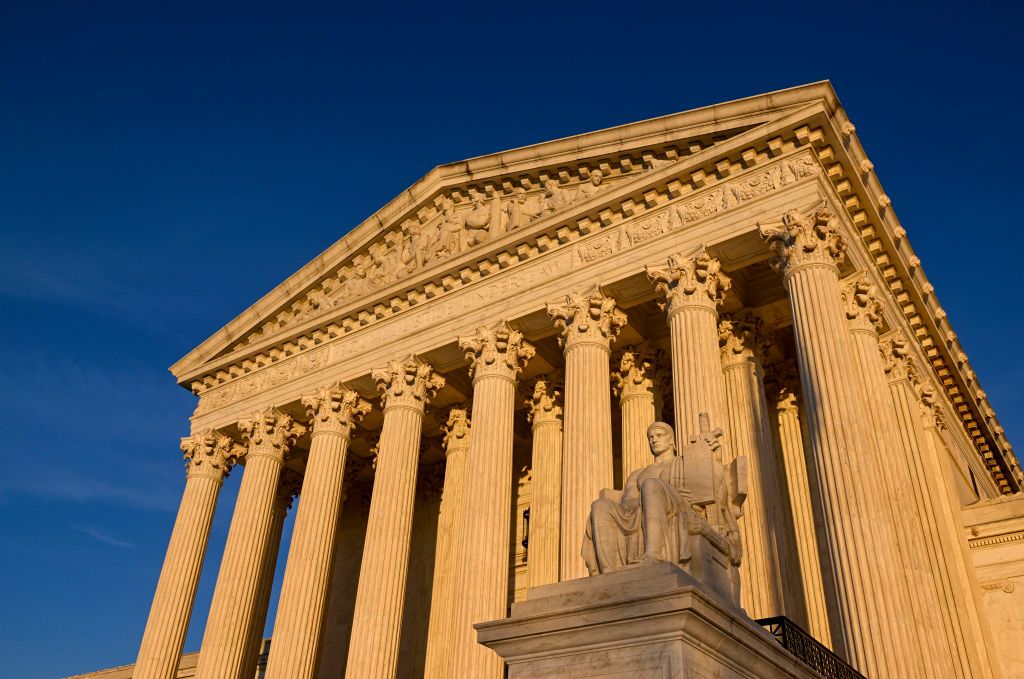
The Supreme Court’s decision to allow President Donald Trump to demolish the East Wing of the White House and build a huge ballroom is troubling enough. But it could also have long-term consequences by making it much harder for plaintiffs to sue to enforce something even more important: federal environmental laws. For over 50 years, the court has consistently allowed plaintiffs to have standing to sue in federal courts based on claims that they have suffered an aesthetic harm. In the ballroom case, the court rejected this claim as insufficient for standing. The court did not overrule its earlier decisions, but it left in doubt when claims of aesthetic injuries – which are pivotal to bringing some environmental harm claims against the federal government – will be sufficient to allow plaintiffs to sue.
The precedents
By way of background, a plaintiff must have what is known as standing to sue in federal court. Traditionally, there are three requirements that must be met to show that one has standing: the plaintiff must be injured or imminently likely to be injured; the injury must be caused by the defendant; and a favorable court decision must be likely to remedy the harm suffered. As for the first standing requirement, injury, the court has found many different kinds of harms sufficient to allow a person to sue in federal court. One of them is an aesthetic harm or injury.
An initial case was 1972’s Sierra Club v. Morton. The Sierra Club challenged a proposed Walt Disney ski resort development in the Mineral King Valley of the Sequoia National Forest, alleging that the project would destroy the area’s scenic beauty. The court said that claims of aesthetic and environmental harm are sufficient for standing. It explained that “aesthetic and environmental well-being, like economic well-being, are important ingredients of the quality of life in our society, and the fact that particular environmental interests are shared by the many, rather than the few, does not make them less deserving of legal protection through the judicial process.” Nevertheless, the court denied standing because the plaintiffs in the case had not alleged that they actually used Mineral King Valley.
A year later, in United States v. Students Challenging Regulatory Agency Proceedings, the Supreme Court upheld the standing of a group of students to seek review under the Administrative Procedure Act of an Interstate Commerce Commission decision to increase freight rates. Specifically, the group of law students at George Washington University Law School contended that the hike in railroad freight rates would discourage the use of recycled goods because of the extra cost of shipping them, and that a decrease in recycling would lead to more use of natural resources and thus more mining and pollution. The students maintained that their enjoyment of the forests, streams, and mountains in the Washington, D.C., area would be lessened as a result. The Supreme Court upheld the group’s standing, concluding that environmental and aesthetic injuries are sufficient for standing so long as the plaintiff claims to suffer the harm personally.
In many subsequent cases the court reaffirmed that claims of aesthetic injuries are sufficient for standing. In 1986’s Japan Whaling Association v. American Cetacean Society, for instance, the court found that a whale conservation society had standing to challenge the secretary of commerce’s failure to certify Japan’s whaling practices because whale watching by the society’s members would be adversely affected by continued whale harvesting. The court explained that aesthetic enjoyment of wildlife – including observing animals in their natural habitat – constitutes a cognizable interest for standing purposes.
The court subsequently, and often, repeated that claims of aesthetic injuries are sufficient for standing. In 1992’s Lujan v. Defenders of Wildlife, the court, in an opinion written by Justice Antonin Scalia, declared: “Of course, the desire to use or observe an animal species, even for purely esthetic purposes, is undeniably a cognizable interest for purpose of standing.” In Friends of the Earth, Inc. v. Laidlaw, decided in 2000, the court also held that plaintiffs have standing based on claims of aesthetic injuries, even without proof of actual environmental harm. In 2009’s Summers v. Earth Island Institute, the court, in another opinion by Scalia, reaffirmed this and declared: “While generalized harm to the forest or the environment will not alone support standing, if that harm in fact affects the recreational or even the mere esthetic interests of the plaintiff, that will suffice.”
National Park Service v. National Trust for Historic Preservation of the United States
Without any congressional approval or congressional appropriation of funds, Trump demolished the East Wing of the White House, including to build a 90,000 square foot ballroom.The law is clear that Congress is in charge of federal property and needs to authorize this change. As the U.S. Court of Appeals for the D.C. Circuit explained: “Congress has not ceded unfettered authority to the Executive Branch to dramatically redesign, reshape, and reconstruct the White House—the People’s House—to fit a particular President’s desires.”
Additionally, it is estimated that this project will cost about $600 million and while some of the money will be privately raised, there will be significant cost to the federal treasury. Congress, which exclusively holds the power of the purse, has approved no funds for this.
The National Trust for Historic Preservation in the United States, a congressionally chartered organization that seeks to preserve and promote the United States’ architectural and cultural heritage, brought a lawsuit challenging the demolition of the East Wing and the construction of the ballroom. Under well-established law, for an organization to sue it must allege, among other things, that one of its members would have standing.
The complaint in the case identified Professor Alison Hoagland, an architectural historian and professor emerita in historic preservation. In her declaration, she said that she has been a member of the National Trust for over 40 years and is currently a trustee serving on its executive committee. She said that she routinely walks in front of the White House and in Lafayette Square directly across from the White House, and she “intend[s] to continue” doing so. Hoagland said that the demolition of the East Wing and the construction of the ballroom will substantially change for the worse the aesthetics of that area.
The federal district court concluded that this was sufficient for the National Trust to have standing to sue and found that the demolition and construction of the East Wing was illegal and unconstitutional. Federal district court Judge Richard Leon ruled that the construction of an underground bunker, which Trump said is needed for national security, could continue. But the above-ground demolition and construction had to stop until there was congressional approval.
The D.C. Circuit agreed. It pointed out that the Supreme Court many times had said that claims of aesthetic injury are harms sufficient to allow standing to sue. The circuit court said that under the Trump administration’s “cramped standing theory . . . no one [would be] injured by a decision to raze the Statue of Liberty, to obscure the names on the Vietnam War Memorial, or to install a political billboard atop Mount Rushmore.”
But the Supreme Court, in a 5-4 ruling, reversed the lower courts. The majority was comprised of Justices Clarence Thomas, Samuel Alito, Neil Gorsuch, Brett Kavanaugh, and Amy Coney Barrett. The court concluded that no one was injured by the president’s actions and stated that “we have repeatedly held that mere offense, disagreement, or distaste does not qualify as a concrete or particularized injury under Article III.” The majority then contended that the earlier environmental cases had plaintiffs whose “injuries involved more than mere offense.”
But this conclusion ignores both the plaintiff’s complaint and the law. The plaintiff does not allege a claim based on “offense, disagreement, or distaste.” Rather, the plaintiff alleges an aesthetic injury – and the majority barely attempts to distinguish this from those alleged in its many prior aesthetic injury cases. As Chief Justice John Roberts, joined by Justices Sonia Sotomayor, Elena Kagan, and Ketanji Brown Jackson, pointed out in dissent, “[o]ur precedents . . . have noted that an injury to a plaintiff’s mere ‘esthetic interests’ can qualify as ‘concrete and particularized’” and are therefore sufficient for standing.
Roberts succinctly explained that “Hoagland’s injury suffices for standing. A historic preservations such as Hoagland can be aesthetically injured in a concrete, particularized way by a transformation of a historic building that she frequently enjoys, just as an environmentalist can sustain a concrete, particularized aesthetic injury from the extinction of a particular animal or the transformation of a particular forest or river that he regularly enjoys.”
What does this mean for environmental litigation?
The Supreme Court did not overrule its many earlier decisions establishing that claims of aesthetic injury are sufficient for standing. But in every case where aesthetic injury has been recognized, it could be said that the plaintiff’s injury was just “offense, disagreement, or distaste.” Indeed, “offense, disagreement, or distaste” is the very essence of an aesthetic injury. As a result, the court’s attempt to draw a distinction is incoherent and adds great confusion to the law.
Nevertheless, the court, without explanation, said that the earlier cases involved “more than mere offense.” But no prior case suggested that more than a claim of an aesthetic injury was sufficient. Nor did the court give any indication of what “more” now will be needed for standing.
In this way, the court’s decision is not only in direct conflict with over 50 years of clear precedent but serves as a serious threat to environmental protection litigation. It also gives a sense of how far some of the court’s conservative majority is willing to go to defer to Trump. Not a single justice in the majority questioned that Trump’s actions in demolishing the East Wing and building the ballroom are illegal and unconstitutional. But the effect of the court’s ruling is that likely no one will have standing to sue to challenge them – or even more serious environmental harms committed by this administration moving forward.