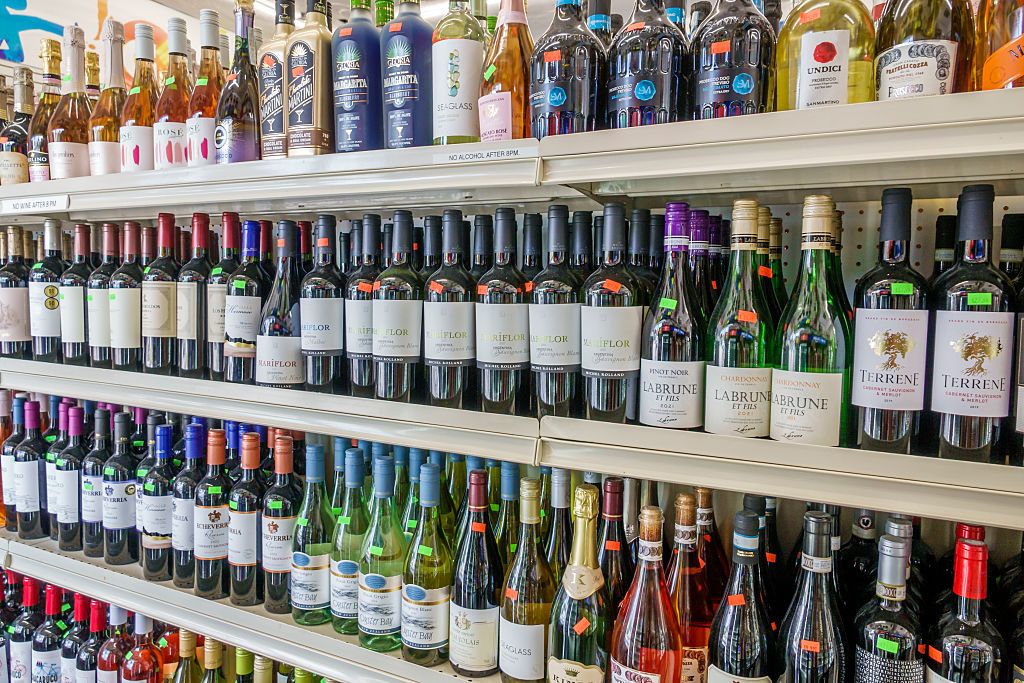
During the 2025-26 term, the justices pondered the Founding Fathers’ drinking habits as they considered a law barring habitual drug users from possessing guns. In the term ahead, they may return to the topic of alcohol in early America if they take up a case on a 19th-century law prohibiting at-home production of distilled spirits. Indeed, the court and alcohol have a long history: Here’s a brief overview of some of the court’s most notable alcohol-related rulings.
Prohibition cases
The country’s most famous drinking law, the 18th Amendment, took effect in January 1920. It barred “the manufacture, sale, or transportation of intoxicating liquors within” the United States, as well as the importation and exportation of alcohol.
During the Prohibition period, which spanned from 1920 until 1933, the Supreme Court decided several cases related to the 18th Amendment. For example, in the National Prohibition Cases, the court considered seven lawsuits brought by states and brewing companies over the constitutionality of the 18th Amendment and the Volstead Act, a law passed by Congress to enforce the amendment. The court held that Congress had the authority to pass the amendment and act, and rejected, among other things, challenges to Congress’ voting process, holding that the two-thirds vote needed to propose a constitutional amendment is satisfied as long as “two-thirds of the members present” support the proposal, rather than “two-thirds of the entire membership.” The 18th Amendment, wrote Justice Willis Van Devanter, “must be respected and given effect the same as other” amendments before it.
The court also addressed the methods that police officers used to enforce Prohibition, including the circumstances under which they could search cars or fields surrounding a private residence for alcohol without a warrant. The court’s rulings allowing for such warrantless searches continue to influence Fourth Amendment jurisprudence today, according to the Federal Judicial Center.
One more memorable case from this era was United States v. Sullivan, in which the Supreme Court held that “[g]ains from illicit traffic in liquor are subject to the income tax.” The justices unanimously agreed that the Fifth Amendment, which protects against forced self-incrimination, did not protect bootleggers from having to report their income from illegal alcohol sales. According to Politico, Sullivan “formed the basis for the government’s 1931 conviction of Al Capone, who led a Chicago-based Prohibition-era crime syndicate, of income tax evasion.”
Alcoholism and the Eighth Amendment
In 1933, Prohibition – and the associated legal battles – came to an end with the ratification of the 21st Amendment, which repealed the 18th Amendment and empowered states to regulate alcohol access. This development opened the door to new disputes over restrictions on alcohol sales and consumption, including bans on public intoxication.
One such ban in Texas led to 1968’s Powell v. Texas, in which the court considered whether it was constitutional to apply restrictions on public intoxication to those struggling with chronic alcoholism. Specifically, the justices weighed whether an alcoholic’s conviction for public intoxication violated the Eighth Amendment’s prohibition on “cruel and unusual punishments.”
In a complicated 5-4 ruling, the court held that such a conviction is constitutional. Justice Thurgood Marshall explained, in an opinion joined by three other justices, that public intoxication laws punish “being in public while drunk on a particular occasion,” not the status of being “a chronic alcoholic.”
Justice Hugo Black concurred, writing that a ruling preventing alcoholics from being convicted of public intoxication could open the door to a case that recognized an “‘irresistible impulse’ as a complete defense to any crime.”
Justice Byron White did not join Marshall’s opinion but agreed with the result that the court reached. He distinguished between punishing an alcoholic for being drunk, which he believed would be unlawful, and punishing them for “being drunk in a public place,” a situation which could be avoided by drinking at home.
Justice Abe Fortas wrote a dissenting opinion, which was joined by three other justices. He asserted that convicting a chronic alcoholic violates the Eighth Amendment, because an individual who “cannot resist the ‘constant excessive consumption of alcohol’ … does not appear in public by his own volition, but under a ‘compulsion’ which is part of his condition.”
The national drinking age
As noted above, the 21st Amendment gave states control over alcohol regulations. However, it did not end federal efforts to influence such policies. Indeed, in 1984, Congress enacted the National Minimum Drinking Age Act, which aimed to establish 21 as the national drinking age by withholding federal highway funds from states that continued to allow younger people to purchase or possess alcohol.
South Dakota, which permitted 19- and 20-year-olds to purchase certain types of beer, challenged the federal drinking age law in court, claiming that Congress had exceeded its authority and violated the 21st Amendment. The Supreme Court heard the case, South Dakota v. Dole, in 1987, considering whether Congress may assert indirect control over alcohol regulations by attaching conditions to federal funding programs.
In a 7-2 ruling, the court upheld the federal law, determining that it was a lawful expression of Congress’ spending power. Writing for the majority, Chief Justice William Rehnquist explained that the law “offered relatively mild encouragement to the States to enact higher minimum drinking ages than they would otherwise choose,” but did not prevent states from choosing to enforce a younger drinking age. Moreover, he continued, the funding policy served “the general welfare” by reducing the likelihood that young people would drive to another state to drink and then get back behind the wheel while drunk.
Justices William Brennan and Sandra Day O’Connor wrote dissenting opinions. They both concluded that the law was “an attempt to regulate the sale of liquor” and therefore violated the 21st Amendment.
Limits on state power
In a more recent case, 2019’s Tennessee Wine & Spirits Retailers Association v. Thomas, the Supreme Court considered the scope of states’ authority to regulate alcohol sales under the 21st Amendment. Specifically, the justices weighed whether Tennessee could refuse retail liquor store licenses to applicants who had lived in the state for fewer than two years or if such a rule instead violated the Constitution’s commerce clause by harming out-of-state economic interests.
In a 7-2 ruling, the court held that Tennessee’s residency requirement “violate[d] the Commerce Clause and is not saved by the Twenty-First Amendment.” In his opinion for the court, Justice Samuel Alito explained that states do not have the authority under the 21st Amendment to impose regulations aimed at shielding state residents from out-of-state competition. The amendment “allows each State leeway to enact the measures that its citizens believe are appropriate to address the public health and safety effects of alcohol use and to serve other legitimate interests, but it does not license the States to adopt protectionist measures with no demonstrable connection to those interests,” Alito wrote.
Justice Neil Gorsuch wrote a dissenting opinion, joined by Justice Clarence Thomas. He argued that, throughout U.S. history (and many different debates over alcohol restrictions), “one thing has always held true: States may impose residency requirements on those who seek to sell alcohol within their borders to ensure that retailers comply with local laws and norms.” Such requirements may lead to “[r]educed competition and increased prices,” but those “were consequences the people willingly accepted” when the 21st Amendment was ratified, according to Gorsuch.
The next alcohol case?
In the coming term, the court may face yet another case involving alcohol. The federal law at issue, enacted in 1868, prohibits at-home production of distilled spirits, and is at the center of two petitions for review that were filed this summer.
The first petition comes from a man, John Ream, who has been homebrewing beer for years and wants to take up home distilling. He contends that the home distilling ban, which was passed as part of an effort to ensure that taxes would be paid on all distilled spirits produced in or imported to the United States, exceeds Congress’ taxing power. Earlier this year, the U.S. Court of Appeals for the 6th Circuit upheld the ban. It relied on the Constitution’s necessary and proper clause, which states that Congress may “make all Laws which shall be necessary and proper for carrying into Execution” its enumerated powers.
The second petition for review comes from the federal government, which is appealing its loss in a very similar case. Unlike the 6th Circuit, the U.S. Court of Appeals for the 5th Circuit struck down the ban on home distilleries, rejecting the government’s argument that the ban is a “necessary and proper” way to ensure that taxes are paid on all distilled spirits produced in the U.S. The government pointed to both rulings in its petition for review, and urged the justices to resolve the disagreement between the federal appeals courts, known as a circuit split.
The justices will likely consider both petitions for review on the home distilling ban in October or November. If the court agrees to hear arguments, the case will become only the latest entry in a long line of disputes over alcohol regulations.