California has spent recent years enacting stricter environmental and regulatory rules that have pushed refiners like Phillips 66 and Valero to shutter major in-state facilities, shrinking the state’s refining capacity by roughly 20-30% and helping drive gasoline prices to among the highest in the nation.
Against this backdrop of rising fuel costs, the state’s latest move to “help” consumers is to create the first-in-the-nation mandate requiring replacement car tires to match the energy efficiency of new tires.
In other words, our eco-activist bureaucrats say they plan to soften the pain at the pump by controlling what tires we purchase… rather than expanding fuel supply.
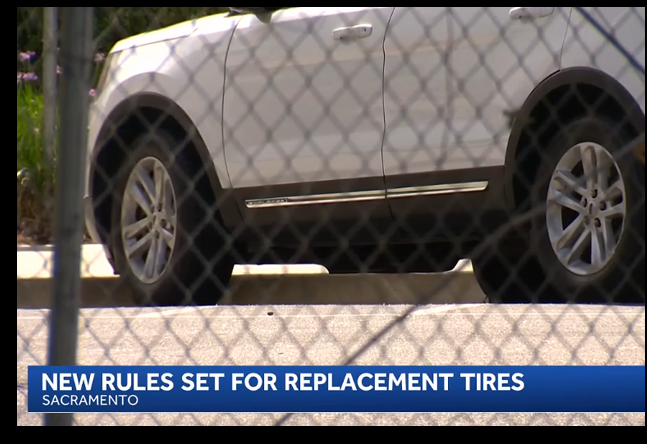
California just became the first state in the nation to require that replacement car tires be as energy-efficient as new ones, a move the state says will save drivers a billion dollars annually while reducing gasoline and electricity demand.
“This is a time where there’s great economic pressure on a lot of working people across the country,” California Energy Commission chair David Hochschild said, right before the agency voted Monday to pass the rule that the legislature mandated more than 20 years ago. “I see this decision as sheltering the public from higher costs long term.”
Tires on brand new cars have low “rolling resistance,” meaning they generate less heat as they bounce against the road and lose less of the energy that otherwise would keep the car in motion. That boosts a car’s overall miles per gallon.
Replacement car tires typically have higher rolling resistance, but under California’s new rule, they will have to at least match the energy efficiency of the average new car tire by 2033. On the way there, an interim target goes into place in 2029.
The tradeoff is stark: while California works to curb the very refining industry that keeps gas affordable, it’s simultaneously asking consumers to squeeze more miles out of every gallon through incremental efficiency gains in something as ordinary as tire rubber.
This action stems from a bill state lawmakers approved in 2003 (AB 844) that directed the California Energy Commission to explore rules around tire efficiency. It sat idle up until this year.
Commissioner Nancy Skinner (a former state senator and environmentalist appointed by Gov. Gavin Newsom) was asked why the commission didn’t act sooner. She responded, “There may not have been those cost pressures.”
The California Energy Commission dusted off a 20+ year old bill to pass new rules restricting tire sales in the state.
The CEC has not regulated tires before.
I asked Commissioner (former State Sen) Nancy Skinner if she pushed it & why this sat dormant until now. pic.twitter.com/Th8zpvHTtl
— Ashley Zavala (@ZavalaA) August 18, 2026
Actual tire experts disagree about the likely consequences of these new rules.
Bret Gladfelty, on behalf of Goodyear, told the commission that this will increase costs for consumers and said the commission had yet to resolve technical and legal issues with the rules.
In a letter to the CEC, Gladfelty had questioned the data the CEC released to the public about the cost of new tires, noting that while the commission says the price increases average about $6.50 per tire in phase 2, Gladfelty warned increase costs could actually end up being in the several hundreds of dollars.
Gladfelty told KCRA 3 this new rule will eliminate an estimated 70% of the tires currently sold in California by 2033.
Other tire manufacturers such as Bridgestone and Michelin were concerned about how exactly the CEC would enforce the rules that could create an uneven playing field that could negatively impact the larger manufacturers.
These requirements will have other consequences. Some beneficial…to out-of-state tire suppliers.
California gas is already about $2 more per gallon than much of the country.
Now California regulators want to decide which replacement tires you’re allowed to buy—eliminating many popular tires because they aren’t deemed “energy efficient” enough.
This is California politics… pic.twitter.com/nhGVzMG2kv
— Jon Stoddard (@JonMStoddard) August 18, 2026
Others, less so. There will likely be safety repercussions that the CEC clearly did not consider.
Removing 70% of the tires sold in California will create a monopoly for the remaining 30%. The Demand will be high, and they will charge whatever they want.
People will delay replacing worn tires, making roads more dangerous.
Oh, the black market will be off the hook. https://t.co/wABsvHq5nT
— Apu (@Sharmadn916) August 18, 2026
But the bureaucrats can feel good about reducing the state’s carbon footprint.
The standards are also expected to reduce carbon dioxide emissions by about 2 million metric tons each year. The CEC says that is equivalent to taking about 400,000 gas-powered cars off California roads.
California’s tire mandate is a perfect example of toxic bureaucracy: Strangle supply, then micromanage demand, and call it consumer relief.
Sacramento has spent years squeezing refiners out of the state, and now it’s squeezing tire manufacturers, all while insisting each new mandate is somehow a gift to drivers and taxpayers.
If California’s leaders truly wanted to lower costs at the pump, they’d start by getting out of the way of refining capacity instead of dictating the chemistry of your tire rubber.
Donations tax deductible
to the full extent allowed by law.