The Gujarat High Court Arbitration Centre (Domestic & International) (GHAC), in collaboration with the Gujarat High Court, is holding the GHAC Arbitration Week 2026, a three-day programme dedicated to strengthening Gujarat’s institutional arbitration ecosystem and promoting the State as a leading destination for efficient, credible and institutionally driven dispute resolution.
Read more about the conference here: GHAC Arbitration Week 2026: A pivotal step towards building Gujarat’s Institutional Arbitration ecosystem
The opening ceremony was held on 3 September 2026, ahead of the main three-day programme running from 4 September to 6 September 2026 at the prestigious GIFT City Club, Gandhinagar, on the theme “Building Gujarat’s Institutional Arbitration Ecosystem”. The event is envisaged as a significant platform for dialogue, professional engagement and knowledge exchange among the judiciary, legal profession, business and industry community, arbitrators and arbitral institutions.
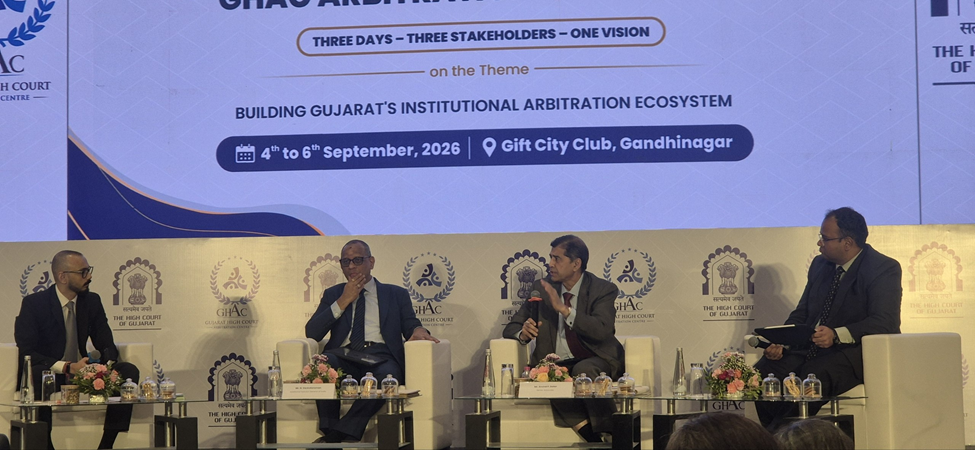
On Day 2 of the event, Senior Advocate Mr. N. Venkataraman, Additional Solicitor General of India and Senior Advocate Mr. Arvind P. Datar engaged in an enriching discussion on the topic “An Introduction to Investment Treaty Arbitration, BIT, Future of ISDS”. The discussion examined whether India’s cautious approach towards tax carve-outs and Investor-State Dispute Settlement (ISDS) should be viewed as an impediment to foreign investment or as part of a broader global movement towards preserving sovereign regulatory space. The speakers also considered the implications of retrospective taxation, the role of domestic courts, the absence or limitations of appellate mechanisms in investment arbitration, third-party funding, resource asymmetry and the possibility of creating a new institutional framework for international investment disputes.
SPEECHES
India and BITs- A tricky balancing act: Mr. Arvind Datar
Starting his address on a humorous note regarding his personal connection to Gujarat, Mr. Datar earmarked the topic of his address, i.e., the importance of BITs and their role in making the dream of ‘Make in India’ come true.
What is a BIT?
At the outset, he explained the difference between a BIT and a free trade agreement (FTA). The former is a treaty wherein the parties intend to protect each other’s investors, and the latter is a cooperation agreement providing two countries easy market access to each other via reduced tariffs, easier customs clearances, etc. BITs are comparatively recent: the model BIT was adopted in 1993, and the first BIT was signed in 1994 with the UK. By 2010, India had BITs with 80 countries. He added that a BIT allows an investor to sue the State they are investing in, and this type of dispute resolution is called an Investor-State Dispute Settlement (ISDS).
On whether BITs drive foreign investments, Mr. Datar stated that though there was no evidence to demonstrate that a good BIT automatically leads to foreign direct investment (FDI), it is still an essential component of the economic ecosystem of a country. The statistics show that in 2000, for example, the total FDI was 4 billion, and by 2010 it became 55 billion. Thus, there was a correlation: investors were confident that if you came to India, your investments would be somewhat protected.
Unfortunately, he added, cases like White Industries Australia Limited v. The Republic of India entailed decisions against India. Due to such adverse rulings, India terminated 58 BITs, which, in his opinion, might not have been the correct decision, as those few adverse verdicts only cost a few billion dollars and they were not worth unilateral termination of so many BITs.

Pre-2016 versus 2016 Model BIT:
In 2016, Mr. Datar continued, after terminating the BITs, India did not exit the BIT system; instead, it proposed a new model BIT, the 2016 Model BIT. The pre-2016 Model BIT contained two important clauses: expropriation and fair and equitable treatment. Article 5 stated that each country shall treat the investment of another country of the other country, fairly and equitably. Article 7 stated that investments cannot be expropriated.
The 2016 Model BIT, on the other hand, was longer, with 38 clauses and riddled with complications, in his opinion, which are as follows:
-
In the previous model BIT, investment meant that any economic asset of the foreign party was protected, but the newer definition made the interpretation narrower. It stated that the investment should be made in good faith, for a sufficiently long period of time, and should result in significant economic development of India, etc.
-
The model BIT excluded tax disputes and compulsory licensing from its scope.
-
The most favoured nation (MFN) clause was removed.
-
The provision of exhaustion of local remedies was added, which meant that the investor must first file a suit in India, and if there is no result for five years, only then can they institute proceedings wherein the arbitration notice is sent to the President of India.
Mr. Datar stated that the 2016 treaty, unlike its predecessor, only saw 6 entries upon its introduction, i.e., only 6 countries signed BITs with India, with only four formal partners. Most of the major trading countries like Germany, Japan, etc., did not sign with India then or now.
Noting this, he opined that having a proper BIT did not mean that money would flow in, but money would not flow in sufficient quantities in the absence of one.
Also read what the Patron-In-Chief said at the opening ceremony: Three days, three stakeholders, one vision: GHAC Arbitration Week 2026 begins with illustrious speeches at the opening ceremony
Make in India: Ambitious or possible?
Coming to the “Make in India” dream, Mr. Datar stated that although a 7.4 percent GDP growth was a great achievement, there were other important parameters like per capita income, GST received from key sectors like manufacturing and services, amount of imports, etc. Furthermore, he added that in the last 12 years, India had received $700 billion in FDI, but only 24 percent of that went into the manufacturing sector, unlike Vietnam, wherein 74-83 percent went towards manufacturing. Thus, to fulfill the Make in India dream, India had to spend most of the FDI in the manufacturing sector.
Furthermore, he spoke about the increase in Chinese imports every year due to manufacturing becoming difficult in India. He stated that this was partly because investment in the service sector had easier exits, but investments in plant and machinery required a long-term commitment of 10-20 years. Thus, he argued that India must figure out what would attract investments, and one such factor could be having an attractive BIT model.

Taxation:
Regarding taxation clauses in BITs, Mr. Datar reflected on the cases of Cairn Energy PLC and Cairn UK Holdings Limited (CUHL) v. Republic of India (I)1 and Sergei Paushok, CJSC Golden East Company and CJSC Vostokneftegaz Company v. The Government of Mongolia, to argue that retrospective taxation was violative of BITs. Every country had the sovereign right to tax prospectively.
On double taxation avoidance agreements (DTAAs), he explained that there are two types of taxes: source taxation and residence taxation. The former is a tax charged on the source of income in the country where it is generated, and the latter is a tax charged on a country’s resident wherever they might be in the world. Double taxation occurs when a resident of one country has an income source in another country, which makes the same income taxable by two countries. Thus, a DTAA allows both countries to mutually agree on what kind of taxes they would each take.
He cautioned against the exclusion of taxation clause and exhaustion of local remedies clause in BITs as it made investors uncertain of the future, and thus, not invest in India. Referring to the decision in Vodafone International Holdings BV v. Government of India [I]2, he stated that after that decision there was an economic boom in India, but it was curtailed by retrospective taxation. He added that investors wanted certainty and clarity to make their decisions, and a constantly changing stance of the government risked potential investments.
In conclusion, he argued that India had immense potential and could do far better, remarking that “nothing changes if nothing changes”.
Also read Justice R.F. Nariman’s keynote speech: Justice R.F. Nariman calls for greater certainty and accuracy in India’s arbitration regime at GHAC Arbitration Week 2026
India’s approach to tax carve-outs and ISDS: Mr. N. Venkatraman
Mr. N. Venkataraman commenced his address by questioning whether India was truly an outlier in its reluctance to submit taxation matters to international investment arbitration and in its withdrawal from or reconsideration of the traditional BIT regime. He argued that India’s approach, in the light of approaches taken by other nations, was not necessarily as detrimental to investment as it was sometimes portrayed.
Referring to the development of GIFT City, he noted that it had developed significant financial assets within a relatively short period and had its own banking and insurance ecosystem. He highlighted that Indian borrowers could increasingly access substantial financing within India rather than approaching international markets.
He stated that the broader objective should be to create capacity within India and move towards self-sufficiency, rather than viewing investment merely through the lens of foreign capital entering the country. Arbitration and BITs were components of a much larger policy framework, which sought to make things in India, rather than borrowing money from outside to manufacture in India.
Global retreat from ISDS and India’s sovereign right to tax:
Mr. Venkataraman referred to the experience of several countries and argued that there had been a notable international movement towards reconsidering ISDS mechanisms. In this regard, he referred to the termination of numerous intra-EU BITs.
Turning specifically to taxation, he discussed the evolution of Indian judicial jurisprudence and referred to the long history of judicial consideration of anti-avoidance principles. He also referred to Vodafone (supra) and other investment structures routed through jurisdictions such as Mauritius, which were being used by investors to insulate themselves from taxation.
According to him, investment structures could themselves factor in potential tax liabilities at the time of making or exiting an investment. Where investors had anticipated potential capital gains taxation and structured their transactions accordingly, subsequent disputes concerning the allocation of taxing rights were assessed against that contractual and commercial background.
He further discussed the Cairn (supra) and Authority for Advance Rulings v. Tiger Global International II Holdings, 2025 SCC OnLine SC 394, stating that the previous BITs allowed even shell companies to be protected due to their ambiguous phrasing of the investment definition. This was why the definition was amended in the 2016 Model BIT.
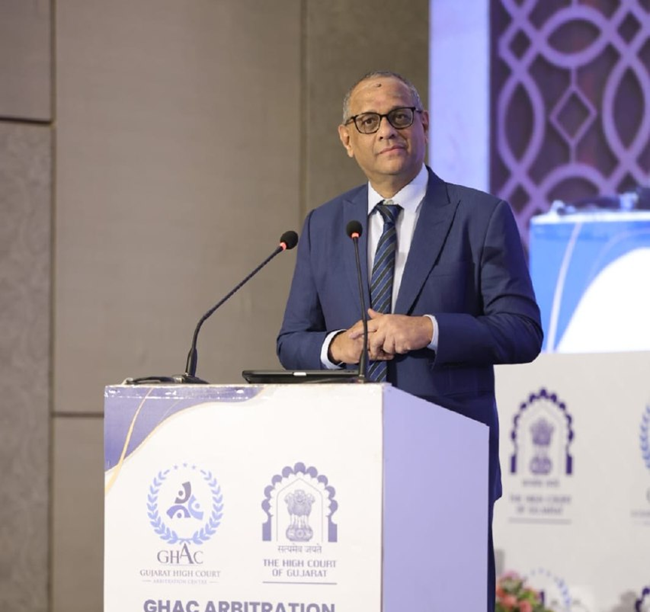
Mr. Venkataraman’s central concern was that an investor who had already litigated a taxation issue through the Indian judicial system, including before the Supreme Court, should not necessarily be permitted to commence a “second innings” before an investment tribunal seeking review of the domestic judgment. He drew attention to Article 141 of the Constitution, emphasising that a domestic investor is bound by the final determination of the Supreme Court. He questioned whether a different standard should apply merely because the investor was foreign.
He also pointed out that taxation disputes could be subject to mechanisms contained in DTAAs, including mutual agreement procedures, thereby providing States with an avenue to resolve cross-border taxation disputes.
“We have to be aligned with the world. We should also be smart. We should also be correct. And we should also serve the interests of our people.”
Mr. Venkataraman also drew an important distinction between surrender of taxing rights and allocation of taxing rights. He explained that when India enters into a tax treaty or DTAA with another country, it does not simply surrender its sovereign taxing power. Rather, the treaty involves an allocation of taxing rights between the contracting States. This distinction is particularly significant in the context of international taxation.
Referring to the discussions surrounding the G20 global tax framework, he noted that India had resisted proposals which, in his opinion, would excessively constrain India’s taxing capacity. He argued that taxation policy had to be viewed in light of a country’s economic position, resources, and geopolitical circumstances.
Retrospective amendments and regulatory uncertainty
Mr. Venkataraman then addressed the issue of retrospective taxation, acknowledging that retrospective amendments could create uncertainty for investors but arguing that the issue could not be considered without reference to the practical consequences for governance and public revenue.
He referred to a dispute concerning the authority of different income-tax offices to undertake certain stages of assessment proceedings. According to him, different High Courts had taken differing views on the issue, with several High Courts taking one position while the Delhi and Gujarat High Courts had subsequently taken a view favouring the Revenue. Mr. Venkataraman stated that the dispute had enormous practical consequences. Approximately 8.5 lakh notices were affected, involving a potential tax impact of approximately ₹20 lakh crore, excluding interest and penalties. He explained that the Government had been confronted with the difficult choice of allowing potentially significant revenue to remain unassessed or introducing legislative clarification when the Income Tax Act, 1961, was itself approaching replacement. He acknowledged that the Government had not always presented all relevant notifications and material before courts and accepted that this had contributed to the litigation.
Also read what Supreme Court Judges said at the GHAC Arbitration Week 2026: Strengthening confidence, reviving purpose: Perspectives on the evolving arbitration ecosystem from Justices V.M. Pancholi and N.V. Anjaria at GHAC Arbitration Week 2026
“Easy to say, give up your 20 lakh crores. Very easy to say, if you are not part of the governance. If you are part of the governance, you will not be able to say that, in the interest of your own people. So, it’s not that we do mindless retrospective amendments.”
Mr. Venkataraman further referred to another issue concerning the computation of assessment periods in international taxation and stated that approximately 15,000 assessments involving ₹16 lakh crore of income had been affected by the uncertainty. He argued that the size and complexity of India’s tax administration had to be considered when assessing the consequences of judicial decisions and legislative amendments.
He cautioned against assuming that every retrospective amendment was necessarily arbitrary or motivated by an intention to undermine investors. According to him, retrospective legislative intervention could, in appropriate circumstances, be based on legitimate sovereign interests.
Why did ISDS emerge?
Turning to the origins of ISDS, Mr. Venkataraman opined that ISDS was introduced primarily to:
-
Depoliticise investment disputes;
-
Prevent States from participating; and
-
Provide investors with an enforceable treaty-based mechanism.
However, he argued that the international community had increasingly begun to question whether these objectives continued to justify existing architecture. Countries like Brazil, Canada, the US, Tanzania, South Africa, etc., had exited ISDS. Explaining India’s unique environment, he remarked, “We can’t go the China way. If they plan, put an infrastructure of a railway, it happens in three years. For us, there is a land acquisition dispute that will go on for 15 years: multiple courts, fourth notice, sixth notice, principal notice; 15 years it takes. By that time, technology itself will change.”
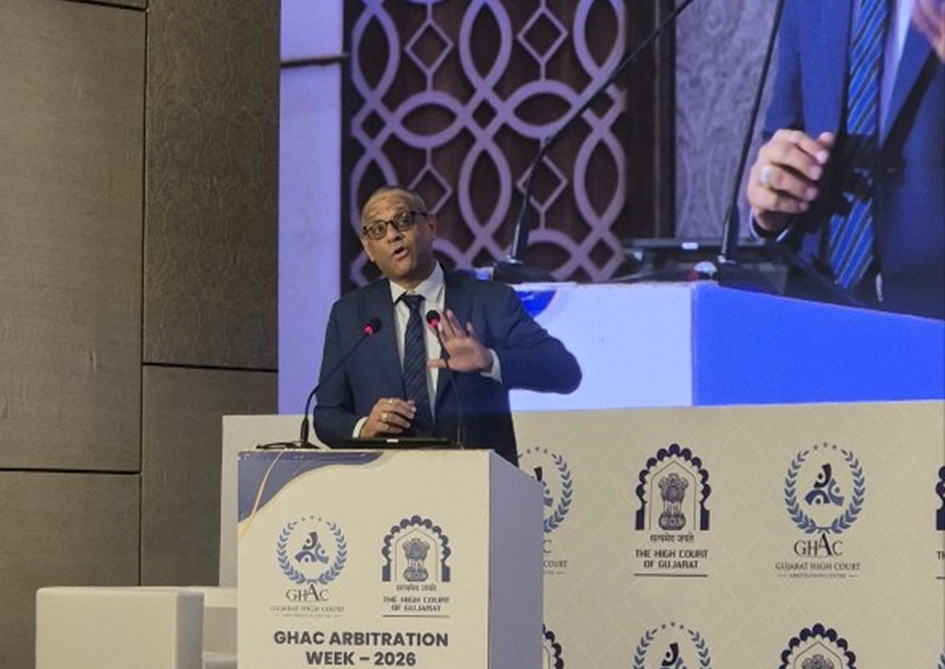
He added that every country had its own distinct investment advantages, which an investor assesses. The investment advantage is understood by an investor very differently from the consultant or the lawyer who fights that investment. India’s large domestic market, uniform taxation framework, and GST regime could themselves provide significant investment advantages. He emphasised that an investor might look at India as one market rather than having to negotiate independently with numerous States, unlike the EU. According to him, these factors were often more significant determinants of investment decisions than the mere existence of a BIT.
He identified several concerns surrounding ISDS, including the potential interference with sovereign and constitutional issues, the absence of a meaningful appellate mechanism, inconsistent decisions by the international arbitration system, excessive and unpredictable costs, confidentiality-related concerns surrounding fraud and corruption, and significant resource asymmetry between States and investors.
Western dominance and India’s opportunity to become an arbitration hub
Mr. Venkataraman also identified the dominance of Western arbitrators in international investment arbitration and argued that it could be a field where India could potentially develop greater representation.
He cautioned, however, that India should not attempt to compete immediately with the established
international arbitration centres on their own terms. Instead, he suggested that India should engage more closely with countries in Africa and South America, create confidence in India’s arbitral institutions and demonstrate that Indian arbitration could be reliable, cost-effective, and efficient.
According to him, India should build its reputation gradually rather than attempting to displace established international arbitration centres overnight. He suggested that the process could take a decade but that once India demonstrated a consistent record of delivering trustworthy results, its credibility as an international arbitration destination could grow organically.
<0 style=”font-weight: bold;”>Third-party funding and resource asymmetry
Mr. Venkataraman further criticised the growing role of third-party funding in international arbitration, particularly from the perspective of developing countries. He argued that resource asymmetry could become substantial where a comparatively poorer State faced an investor backed by significant funding.
According to him, once litigation became heavily funded, it risked acquiring characteristics of an industry rather than remaining purely a dispute-resolution mechanism. He also highlighted situations in which sanctions, territorial disputes, national security issues, and cross-border enforcement could transform investment arbitration into an instrument of geopolitical pressure.
<0 style=”font-weight: bold;”>Government’s response to investor concerns
Mr. Venkataraman also sought to assure the audience that the Government was not unaware of investor concerns. Referring to the Tiger Global case, he stated that significant communication had taken place within the Government, including numerous communications to the PMO and the Department of Economic Affairs, followed by extensive internal discussions. He stated that Government officials were actively engaging with other countries concerning investment opportunities even without necessarily relying upon an underlying BIT. He maintained that India’s policy approach was not one of isolation but of carefully determining what arrangement would best serve the country’s interests.
Concluding his address, he urged people to understand the larger picture and thanked the organizers for inviting him.
Also read what Supreme Court Judges said at the conference: From Judicial Restraint to Institutional Reform: Key messages from Justices K.V. Viswanathan and P.S. Narsimha at GHAC Arbitration Week
PANEL DISCUSSION
1. Investor protection and retrospective taxation
Following Mr. Venkataraman’s speech, the discussion moved to questions concerning the precise scope of tax exclusions in BITs and whether a complete exclusion of taxation disputes was compatible with adequate investor protection.
While Mr. Datar stated that the 2016 Model BIT included retrospective taxation’s exclusion as well, Mr. Venkatraman addressed whether a more relaxed provision could act as a middle ground. He referred to a case he is part of wherein his team argued a mutually agreed contract for three days despite a clear arbitration clause. He argued that lawyers carve out ways to interpret contracts in their favour. He stated that such arbitrations should occur between States rather than investors and States.
2. Tax insurance and investment uncertainty
Answering a question on whether expressly barring retrospective taxation addresses the investment issue, Mr. Datar stated that retrospective taxation is particularly harmful from the perspective of foreign investors and stated that clients were concerned not merely about the quantum of tax but about uncertainty regarding what their eventual tax liability would be.
According to him, investors could accept a high tax rate if they knew the rate in advance. The greater difficulty arose when the tax regime changed retrospectively after an investment had already been made. He referred to the Vodafone and Tiger Global disputes as examples of the uncertainty that could emerge when domestic taxation policy interacted with international investment protection. He added that clients increasingly sought clarity and predictability regarding taxation rather than necessarily demanding low taxation first and later increasing it.
Mr. Datar referred to the emergence of tax-insurance arrangements for investments, suggesting that such behaviour reflected the degree of uncertainty that some investors perceived regarding India’s future tax treatment. He gave the example of Nokia’s former manufacturing operations in Tamil Nadu. Nokia had established a plant in Tamil Nadu and exported to numerous countries, but a substantial tax demand was subsequently raised on the basis that its export sales should be treated as inter-State sales. According to Mr. Datar, the demand ultimately contributed to Nokia shutting down its operations, with the result that investment from Finland did not continue. A similar issue happened with BMW as well.
According to Mr. Datar, the central concern was not simply whether India had the sovereign power to tax, but whether the manner in which that power was exercised generated sufficient certainty for businesses making long-term investment decisions.
Regarding domestic tax administration, he highlighted situations where tax demands could be disproportionately great compared with the turnover of an enterprise, especially smaller businesses. He emphasised that ease of doing business required not merely protection of Government revenue but also protection of the taxpayer and survival of the business enterprise.
Responding to concerns regarding tax administration, Mr. Venkataraman acknowledged that mistakes could occur in a country of India’s size and complexity but stated that the Government did not wish to become an impediment to legitimate business operations. He referred to instances where substantial tax notices had been withdrawn after the Government determined that they were not sustainable. At the same time, he stated that where a tax demand was legally due, the Government could not simply abandon its revenue claim.
He stated that the Government’s position was that it did not seek to collect “one rupee” that was not due but equally could not leave revenue legally payable to the State. He further stated that frequent internal enquiries were conducted by Government officials, without being publicised through the media.
3. Domestic remedies, judicial delay and the cooling-off period
On the issue of mandatory domestic remedies under BITs, judicial delay, and the appropriate cooling-off period, Mr. Venkatraman referred the audience to the judgment in Sanofi Pasteur Holding SA v. Department of Revenue, (2013) 354 ITR 316, urging young lawyers to study the decision for its discussion of how treaties are negotiated and shaped. He emphasised that entering into an international treaty was fundamentally a process of negotiation and bargaining as a nation, and States should take precautions while entering into such agreements.
According to him, the difficulty with BITs was that the investor, rather than the State that negotiated the treaty, could ultimately bring a claim against the State. This created a structural conflict between an individual investor and a sovereign State.
4. Can State-to-State arbitration replace ISDS?
The discussion then turned to whether State-to-State dispute resolution could serve as a substitute for ISDS. Mr. Datar disagreed with the proposition that State-to-State arbitration could provide an adequate substitute for ISDS. According to him, an investor could be left without an effective remedy where the investor’s home State was unwilling to initiate proceedings against another State for geopolitical or diplomatic reasons.
He referred to a possible alternative being discussed within UNCITRAL Working Group III, i.e., the creation of an institutional international taxation tribunal or similar permanent mechanism involving members from different States. He suggested that such a model could potentially provide an institutional alternative to ad hoc ISDS. At the same time, he cautioned that completely denying a foreign investor any remedy beyond domestic taxation proceedings could impact investment.
5. Role of Indian courts in BIT disputes and enforcement
Regarding the role of Indian courts in BIT arbitration, Mr. Venkataraman stated that Indian courts had a role in enforcement, but not in the BIT proceedings themselves.
Mr. Datar supplemented the discussion by referring to Cairn (supra), wherein appellate proceedings were brought before Dutch courts and enforcement measures concerning Indian assets became involved. He explained that even where an appellate remedy technically existed, the scope of appellate review could remain narrow because courts often did not undertake a substantive reconsideration of the merits of an arbitral award.
Mr. Venkataraman added that once a State enters an arbitration framework, it effectively exposes itself to a dispute being decided in a single principal forum, with limited opportunities for substantive review.
6. Domestic remedies and ISDS: Separate “buckets”
Mr. Datar was asked whether domestic remedies and an effective ISDS mechanism could coexist without making treaty protection commercially unattractive. He responded that domestic remedies and ISDS belonged to two different “buckets”.
Referring to the Vodafone and Cairn disputes, he explained that investors might choose ISDS where domestic remedies were ineffective or insufficient. However, where domestic remedies were faster and more effective, an investor could independently decide to pursue them rather than resort to ISDS.
7. Most-Favoured-Nation clause and India’s treaty policy
Regarding the exclusion of the MFN clause from India’s 2016 Model BIT, Mr. Datar explained that MFN treatment essentially concerns extending benefits given to one treaty partner to other treaty partners. He referred to the Supreme Court’s position that benefits under one treaty do not automatically become applicable to other treaty partners unless specifically notified.
Mr. Datar stated that, although he did not agree with the judicial position, the exclusion of MFN treatment could nevertheless be justified from India’s geopolitical perspective. India might, depending on its strategic considerations, wish to offer particular advantages to one country without automatically extending them to every other treaty partner.
Mr. Venkataraman explained how questions concerning tax credits and dividend taxation could result in substantial financial consequences for India. He further referred to ongoing disputes concerning dividend distribution tax and argued that litigation could sometimes continue despite the positions adopted by the States concerned.
8. Unilateral termination of BITs and sunset clauses
The moderator then asked Mr. Venkataraman about the implications of unilateral termination of BITs, particularly in relation to investments made before termination and the operation of sunset clauses. He explained that different States had adopted different approaches, including unilateral termination without sunset clauses. He contrasted this with India’s approach, under which a ten-year sunset period had been provided.
According to him, the disputes arising during such sunset periods demonstrated why States needed to carefully consider the long-term economic consequences of treaty commitments. He stressed that the consequences were not merely legal but also economic and commercial. An investor, he stated, would factor in potential delays, litigation costs and regulatory uncertainty into the cost of doing business. Consequently, a treaty could itself become an economic variable in the investor’s decision-making process.
Mr. Datar, however, emphasised that India’s position as a net capital-importing country had to be considered. He pointed out that Indian companies were themselves investing abroad and that BIT protection could benefit Indian investors as well.
Nevertheless, he maintained that India still needed significant foreign investment and that greater investment certainty could substantially increase FDI. He expressed that with sufficient investment certainty, India could potentially outperform countries such as Vietnam and Thailand in attracting foreign investment.
The session concluded with a small questions-and-answers segment and final remarks.