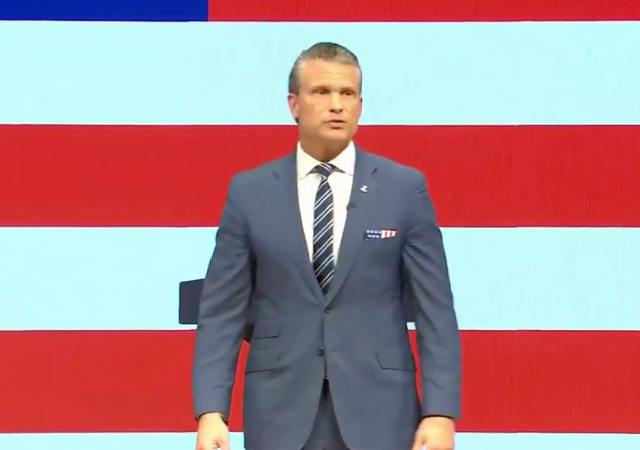
Secretary of War Pete Hegseth announced the creation of Autonomous Warfare Command, or AutoWarCom, “a functional combatant command that will lead the Joint Force in unmanned and autonomous warfare.”
AutoWarCom will change how the department handles drones.
“Warfare, however, has changed dramatically and suddenly,” according to Hegseth’s memo. “Advanced computing now enables precise, low-cost weapons to be produced at massive scale. These systems increasingly threaten our costly legacy platforms and disrupt our force projection. Urgent change is required.”
Hegseth said at the U.S. Marine Corps Base:
Today, at my direction, we are announcing the creation of Autonomous Warfare Command, or Auto War Com, a new four-star combatant command with service-like authorities built to scale autonomous and robotic capabilities across the joint force in the fastest peacetime shift in modern military history.
Drone warfare supercharged by SI [super intelligence]-enabled targeting is the biggest battlefield revolution in generations. You already know that. Yet when I was sworn in at the Department of Defense, there was scant urgency in this domain. That changed as soon as we took the helm. We immediately launched the drone dominance program to cut through red tape and move authorities out of the Pentagon and place it with commands.
And we established Task Force 401, led by Army Brigadier General Matt Ross, a phenomenal leader, now the leading counter-drone unit across the entire government to accelerate purchasing and fielding of these technologies.
We fused the Defense Innovation Unit (DIU) with a direct report program manager called ADERPOM. That team has shipped thousands of autonomous systems of drones to the Middle East and around the world, delivering lethal capabilities and outcomes in days and weeks rather than months or years.
That’s the normal speed of the Pentagon: months or years. It’s a good start, but it’s certainly not enough. The pace of war is changing faster than the process to support it. Cheap compute, super intelligence, and advanced commercial manufacturing have enabled the proliferation of low-cost, high-precision strike.
.@SECWAR “Today, at my direction—we are announcing the creation of Autonomous Warfare Command, or AutoWarCom:
A new 4-star combatant command—with service-like authorities—built to scale autonomous and robotic capabilities across the Joint Force in the fastest peacetime shift in… pic.twitter.com/kYWBxy6Dij
— DOW Rapid Response (@DOWResponse) September 30, 2026
Hegseth told the audience that Ukraine’s response to Russia helped spur AutoWarCom.
“Ukraine’s lesson is not that one type of drone wins wars, but rather the need for a purpose-built system that maximizes the ability to adapt,” explained Hegseth. “We will fuse procurement with operations at scale, and then allow warfighters and engineers and entrepreneurs to learn, adapt, and rapidly iterate on their domain and their mission.”
Hegseth directed the Direct Reporting Portfolio Manager for Unmanned
Systems (DRPM-UxS) to lead Project Agincourt.
DRPM-UxS will first form a pathway to AutoWarCom, which consists of directing “manpower, budget, acquisition authorities and create dedicated military career pathways for Officers and Enlisted personnel.”
DRPM-UxS will also work with Congress to secure proper legislation.
Hegseth hopes to establish AutoWarCom by October 1, 2027.
Owen West, a former Marine and assistant defense secretary, and Max Strasiser, a Navy SEAL, will lead AutoWarCom:
To supercharge the testing, purchasing and fielding of unmanned systems, West plans to expand on a series of industry competitions that his organization established over the past year under the military’s Drone Dominance Program.
For each competition, known as a “gauntlet,” dozens of companies are invited to put their commercial drones to the test, flying realistic missions created and piloted by the military. Top-performing companies receive orders within weeks of the final results, which are posted on a leaderboard for transparency.
At a recent gauntlet in Colorado, quadcopters were dispatched to attack vehicles, fly through tunnels and navigate buildings that resembled an embassy complex to hunt targets. The drones were required to cost less than $4,000 and be built in the U.S. with mostly American components.
Donations tax deductible
to the full extent allowed by law.