The inaugural session of the India Digital ADR Summit 2026 was organised by the School of Law, Forensic Justice and Policy Studies, National Forensic Sciences University (NFSU), Gandhinagar, through the International Digital Dispute Resolution Centre (IDDRC), at the NFSU campus in Gandhinagar, Gujarat, on September 12, 2026.
The inaugural session, titled “Artificial Intelligence in Arbitration: Enhancing Decision-Making Without Replacing Human Judgment”, was attended by:
-
Justice N. V. Anjaria, Judge, Supreme Court of India;
-
R. Venkataramani, Attorney General for India;
-
Justice Sunita Agarwal, Chief Justice, High Court of Gujarat;
-
Justice M. R. Shah, Former Judge, Supreme Court of India;
-
Justice Rajesh Bindal, Former Judge, Supreme Court of India;
-
Professor Dr. S. O. Junare, Campus Director, NFSU Gandhinagar; and
-
Professor Dr. Purvi Pokhariyal, Dean, School of Law, Forensic Justice and Policy Studies, NFSU and Campus Director, NFSU Delhi.
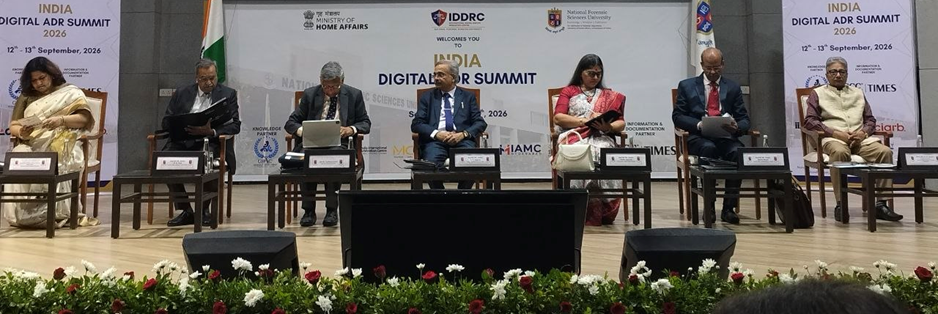
[In picture left to right: Prof. Dr. Purvi Pokhariyal, Justice N. V. Anjaria, R. Venkataramani, Justice M. R. Shah, Chief Justice Sunita Agarwal, Justice Rajesh Bindal and Prof. Dr. S. O. Junare]
Chief Justice Sunita Agarwal: AI can improve efficiency, but adjudicative judgment must remain human
Addressing the gathering, Chief Justice Sunita Agarwal thanked the organisers for collaborating with the GHAC and for giving her the opportunity to participate in the India Digital ADR Summit 2026. She congratulated NFSU and the IDDRC for convening the gathering to discuss the evolving relationship between technology and dispute resolution.
Chief Justice Sunita Agarwal observed that technology had become an indispensable part of modern dispute resolution and that strengthening dispute-resolution mechanisms would, to an extent, depend on the ability to understand and harness technology. Referring to the establishment of the NFSU IDDRC, she said the theme of the inaugural session appropriately captured the need to define the role of artificial intelligence in arbitration.
She noted that as commercial transactions had become more complex and increasingly digital, arbitrators were required to examine increasingly voluminous material, including multiple contracts, financial records, technical data and communications. While technology had already assisted lawyers and arbitrators in searching, organising and managing such material, she said artificial intelligence represented a more significant development.
According to Justice Sunita Agarwal, AI could identify patterns, synthesise large volumes of material, generate summaries, assist with research, test calculations and produce analysis in a manner that resembles human reasoning. Given arbitration’s emphasis on speed and efficiency, she said this capacity presented an opportunity to make arbitration faster and more efficient.
She, however, drew a distinction between assisting with information and influencing adjudicative judgment. In her view, AI could relieve lawyers and arbitrators of extensive but essentially mechanical tasks, allowing more time and attention for matters requiring critical thinking and adjudicative judgment. She said the central question was where technological assistance ends and human judgment begins.
Chief Justice Sunita Agarwal said the appropriate approach was neither to resist AI nor to embrace it uncritically. Instead, AI should be used to strengthen arbitration through greater speed and efficiency while preserving independent decision-making, procedural fairness and human accountability for the outcome.
She stressed that AI should not be allowed to assist in adjudication because adjudication involves more than the processing of information. An arbitrator must hear competing claims, interpret contracts, weigh evidence and apply the governing law. Where more than one tenable view is possible, the arbitrator has to determine which view should prevail in the circumstances of the case.
Chief Justice Sunita Agarwal said such judgment requires wisdom, including the ability to appreciate context, balance competing perspectives, remain composed in uncertainty and determine a course where there is no predetermined answer. She also stressed the importance of integrity and said these qualities are formed through experience, self-reflection and accumulated understanding rather than data.
She further linked this to arbitral independence, stating that an arbitrator must reason independently, guided by the agreement, applicable rules and principles of fairness. According to Justice Sunita Agarwal, allowing AI to shape that reasoning, even subtly, could affect the independence of the arbitrator’s judgment.
Concern over complacency and impact on young lawyers
Chief Justice Sunita Agarwal identified complacency as another risk. She said the concern was not only that AI might produce a wrong answer, but that consistently satisfactory answers could make users less inclined to question or verify its output. Over time, she said, such complacency could erode critical-thinking ability.
She said the issue had particular significance for young lawyers, judges and arbitrators because some professional tasks were not merely tasks to be completed but were part of the process through which professional skills developed. She referred to drafting as an example, noting that drafting requires detailed knowledge of the facts, identification of the heart of the case, anticipation of opposing arguments and questions from the judge, and decisions on how best to present the case.
According to Justice Sunita Agarwal, the discipline of drafting develops precision, analytical judgment, command over language and persuasive skills. AI could assist by improving the structure, language or clarity of an existing draft, but allowing it to take over the substantive work could result in the loss of an important part of learning the craft of lawyering.
She made a similar distinction in relation to reading and researching judgments. While an AI-generated summary may explain what a judgment decided, she said reading the complete judgment provides an understanding of why the decision was reached, how facts were assessed, how arguments were weighed, how authorities were distinguished and how legal principles were applied. An AI summary could save time, but could not replace that experience.
Chief Justice Sunita Agarwal clarified that she was not suggesting that AI should not be used in legal work. Rather, she said the pursuit of speed and efficiency should not result in AI replacing the professional disciplines through which legal skills are developed.
Rule-based and administrative functions identified as suitable for AI
Chief Justice Sunita Agarwal said AI could make its greatest contribution in arbitration in processes that are rule-based, repetitive and high in volume, particularly where consistency, organisation and speed are important and the task does not require discretion.
She gave the example of a large commercial dispute generating thousands of documents, including emails and financial records. AI could, she said, assist in organising and indexing these materials, extracting dates and contractual provisions, identifying duplicates, comparing documents and making the record searchable.
She added that arbitral institutions could use AI for administrative functions such as first-level filing scrutiny, organising case information, tracking procedural timelines, assisting with hearing schedules and identifying administrative bottlenecks. At hearings, AI could also provide real-time transcription, translation and time-stamping, creating a searchable record of proceedings.
Chief Justice Sunita Agarwal congratulated the IDDRC at NFSU for the launch of SAMYAK, describing it as an online dispute resolution platform extending from the first claim to the final award.
Chief Justice Sunita Agarwal sets out five principles for AI use in arbitration
She said legal institutions would need rules drawing a clear line between functions in which AI could be involved and those that must remain within the domain of human judgment and decisions. She referred to the Gujarat High Court’s policy on the use of Artificial Intelligence, which, according to her, expressly extends to the Gujarat High Court Arbitration Centre.
She said the policy recognises that AI can improve productivity, reduce administrative burdens and enhance access to justice while preserving human responsibility in adjudication. She noted that it permits defined uses including legal research, translation and transcription, scheduling, metadata-based administrative functions and other preparatory work.
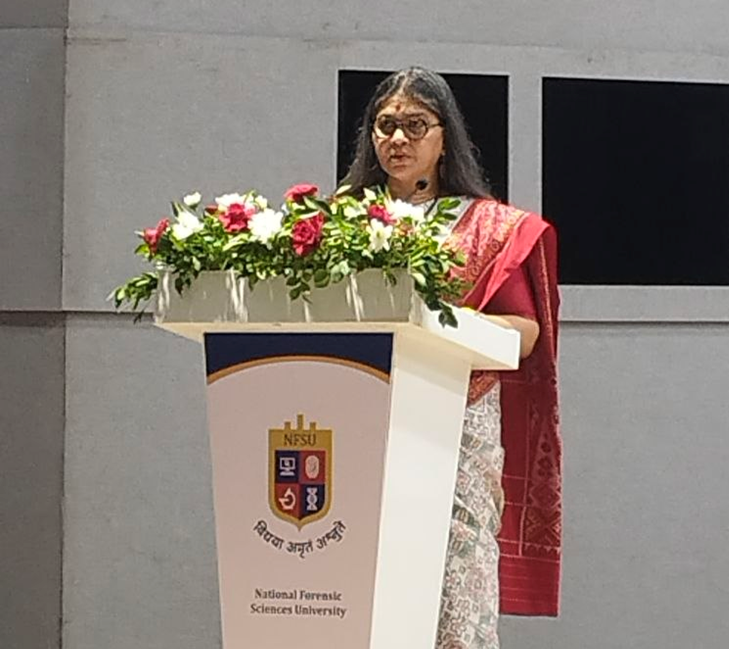
Against this background, Chief Justice Sunita Agarwal set out five principles to guide the use of AI in arbitration.
First, proportionality. She said not every use of AI carries the same degree of risk and that safeguards should correspond to the nature of the task and its potential consequences. She distinguished between using AI to locate a particular document in a large record and using it to generate a transcript of proceedings. While the former may require relatively little oversight, the latter should be reviewed by a human before being relied upon. She expressly stated that analysis of evidence is territory in which AI would have no role at all.
Second, reliability. She said AI could process information rapidly, but speed did not guarantee accuracy. Its output could be incomplete, inaccurate or fabricated. She therefore described the human-in-the-loop principle as essential and said AI-generated output should not be acted upon without meaningful human review. Referring to instances of lawyers, tribunals and courts relying on apparently genuine but non-existent legal authorities generated by AI, she stressed that human review must involve checking the output against the underlying source.
Third, transparency. Chief Justice Sunita Agarwal said that where AI is used in a manner that may materially affect the conduct of an arbitration, those involved should know that it has been used. She considered disclosure particularly important where an arbitrator uses AI in carrying out a permitted function, or where counsel or a party uses it in preparing material for proceedings. At the same time, she clarified that every incidental use need not be disclosed, including routine uses for grammar or formatting. The relevant consideration, she said, should be the materiality of the use and its potential bearing on the proceedings.
Fourth, confidentiality and data protection. She noted that arbitration depends on the ability to place sensitive commercial information before the arbitral process without losing confidentiality. The use of AI, however, raises questions about who may access information entered into an AI system, how it is stored and what may be done with it. She said users should understand the protections governing an AI tool and determine whether those protections are sufficient before uploading personal or confidential information. In her view, confidentiality cannot be preserved merely by trusting technology and requires institutional governance, including clear rules on permitted tools, information that may be entered and applicable safeguards.
Fifth, accountability. Chief Justice Sunita Agarwal said AI may assist a person in carrying out a task, but cannot assume responsibility for the result. Responsibility remains with the person who chooses to use the AI output and acts upon it. She emphasised that a person cannot disclaim responsibility by saying that an error originated with an AI tool.
Concluding her address, Chief Justice Sunita Agarwal said the responsibility attached to the use of technology would become more important as AI continued to evolve. She observed that the technology and its use would advance, but the relevant question should not be merely what AI is capable of doing; rather, it should be what institutions and practitioners consider appropriate to entrust to it. She concluded that AI could become a valuable part of the future of arbitration where it is being used carefully, while preserving the nature and responsibility of the arbitral function.
Justice M. R. Shah: ADR should lead to speedy and affordable resolution of disputes
Addressing the gathering, Justice M. R. Shah congratulated the NFSU and the IDDRC for organising the summit. Referring to the recent launch of the IDDRC and the Gujarat High Court Arbitration Centre (GHAC) Arbitration Week, he described the India Digital ADR Summit 2026 as one of the first such summits organised by NFSU in partnership with GHAC and other institutions.
Justice M. R. Shah reflected on the meaning of Alternative Dispute Resolution (ADR), observing that it was intended to assist in securing justice and resolving disputes at the earliest. Drawing an analogy with choosing an alternative route when a road is blocked, he said different disputes may require different methods of resolution. He referred to mediation, conciliation and arbitration as available mechanisms and said the ultimate destination was early resolution of disputes.
He stressed that early resolution should not itself become lengthy or costly. Institutions such as mediation centres, arbitration centres and other dispute-resolution bodies, he said, serve this purpose. He added that dispute resolution should be speedy and time-saving, while remaining affordable so that people continue to have faith in the justice delivery system.
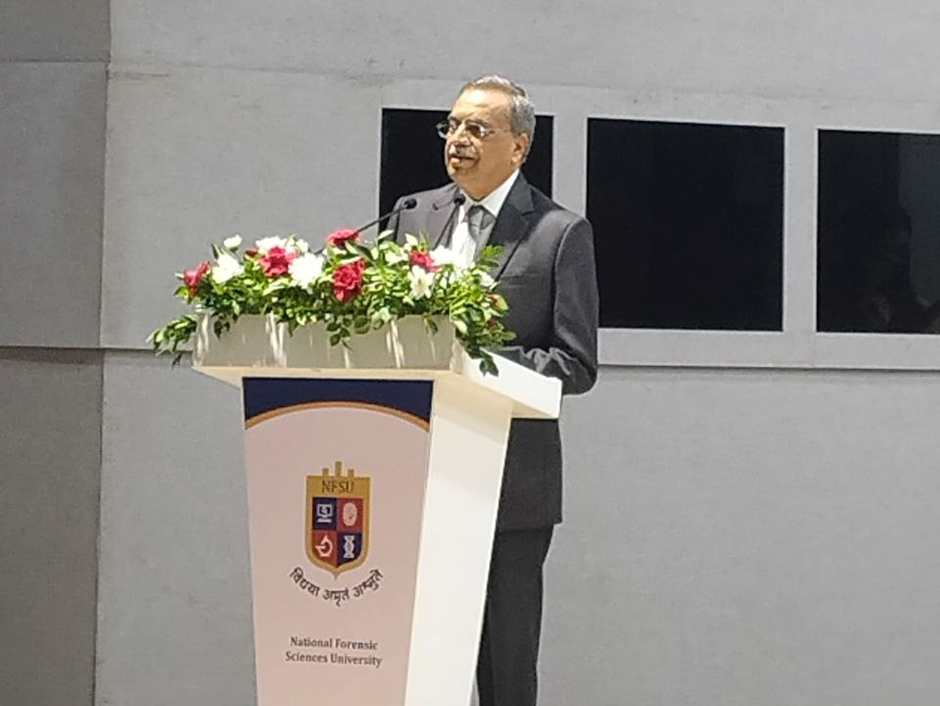
Turning to AI, Justice M. R. Shah said the summit would consider its use in digital dispute resolution. He observed that artificial intelligence was increasingly influencing different fields and careers and said those who wished to progress would have to adapt to technological change. Referring to examples of AI being used in warfare as well as in the development of cancer vaccines, he said there could be both uses and misuses of the technology.
Justice M. R. Shah cautioned that AI should not control its users and should be employed “with great care and caution”. He said users should not be guided solely by AI or mechanically adopt whatever it produces. Referring to the use of AI-generated material in a judgment, he stressed that the use of AI should not mean that people stop using their “human brain”.
He said human beings should instead develop the ability to use AI in a manner that facilitates earlier disposal of disputes. At the same time, he acknowledged that challenges would arise and said these would have to be addressed as the use of the technology expanded.
Justice M. R. Shah connected the discussion to the purpose of the IDDRC, observing that the Centre’s focus on a digital platform could assist in resolving different categories of disputes, including commercial, family, partnership and corporate disputes. He said the use of AI would be required to achieve the objective of resolving such disputes through the digital platform and expressed confidence that the summit would examine the challenges associated with its use.