The Indian Mediation Federation (IMF) was formally launched at the PACT-Poovayya Commercial Mediation Conclave India 2026, held on 18 September 2026 at the India International Centre, New Delhi. The conclave was organised around the theme “Making Mediation Mainstream”, with participation from mediators, judges, in-house counsel, disputes and corporate lawyers, senior advocates, policymakers, trainers and students.
The Indian Mediation Federation (IMF), also the Chief Networking Partner of the Conclave, describes itself as a unified platform bringing together mediators, legal professionals, institutions, businesses, academia and communities to promote mediation across India as a first port of call for amicable dispute resolution.
IMF seeks to connect stakeholders across India’s mediation ecosystem. The Brochure details that the IMF has been conceived as a collective voice for mediation in India, intended to connect practitioners, organisations and policymakers around a shared commitment to peaceful, practical and relationship-preserving dispute resolution.
The Federation states that it seeks to serve as a bridge between the mediation community and the broader legal, business and public landscape. Its stated objectives include creating greater awareness of mediation, encouraging collaboration between institutions and practitioners, and supporting the development of practices and standards for the mediation ecosystem.
The brochure states that the IMF aspires to be the national conscience of Mediation in India and, through awareness and advocacy, intends to bring together institutions and practitioners in India and globally, promote best practices in non-adversarial dispute resolution and contribute to a culture rooted in dialogue, trust and constructive resolution.
Six areas identified by IMF
There have been set out six areas through which the Federation proposes to contribute to the development of mediation in India.
Unifying the Ecosystem involves connecting mediators, institutions, legal professionals, businesses and public bodies into a stronger national network.
Driving Awareness focuses on increasing understanding of mediation among citizens, organisations, institutions and decision-makers.
Through Creating Standards, the IMF proposes to support ethical, professional and operational standards to help mediation develop with consistency and trust.
Under Supporting Policy, the Federation proposes to contribute insights and advocacy towards strengthening the policy and regulatory environment for mediation in India.
Expanding Adoption is directed towards encouraging broader use of mediation across civil, commercial, workplace, institutional and community settings.
The sixth area, Elevating the Profession, focuses on building recognition, capability and professional development for mediators across the country.
The Federation states that these initiatives are intended to support greater visibility, trust and use of mediation as a dispute resolution mechanism.
Vision and mission of the Federation
The IMF’s stated vision is to establish India as a leading mediation jurisdiction, recognised for trust, accessibility, professional excellence and international engagement.
Its mission is to serve as the national federation and thought leader for mediation by strengthening institutions, advancing standards, developing capability, and fostering domestic as well as international collaboration.
The brochure further states that the IMF seeks to position mediation as an essential etiquette of a civilised society and as a mainstream means of resolving disputes. It identifies greater awareness and advocacy among students, businesses and society at large as two of its objectives.
Mediation as a mainstream dispute resolution mechanism
The Federation’s objectives are in the context of the Mediation Act, 2023, stating that the enactment has been a transformative step towards institutionalising mediation as a recognised, enforceable and independent mechanism for dispute resolution.
The Brochure states that mediation is no longer viewed merely as an alternative but is becoming a preferred pathway for resolving disputes. The brochure also describes mediation as reflecting a culture in which dialogue prevails over dispute and resolution over confrontation.
The IMF’s stated aspiration is to create a culture where “Mediation is chosen, not imposed”; “Dialogue is natural, not exceptional”; “Resolution is efficient, not adversarial”; “Relationships are preserved, not destroyed”; and “Trust is restored, not compromised.”
Advisory Board of IMF
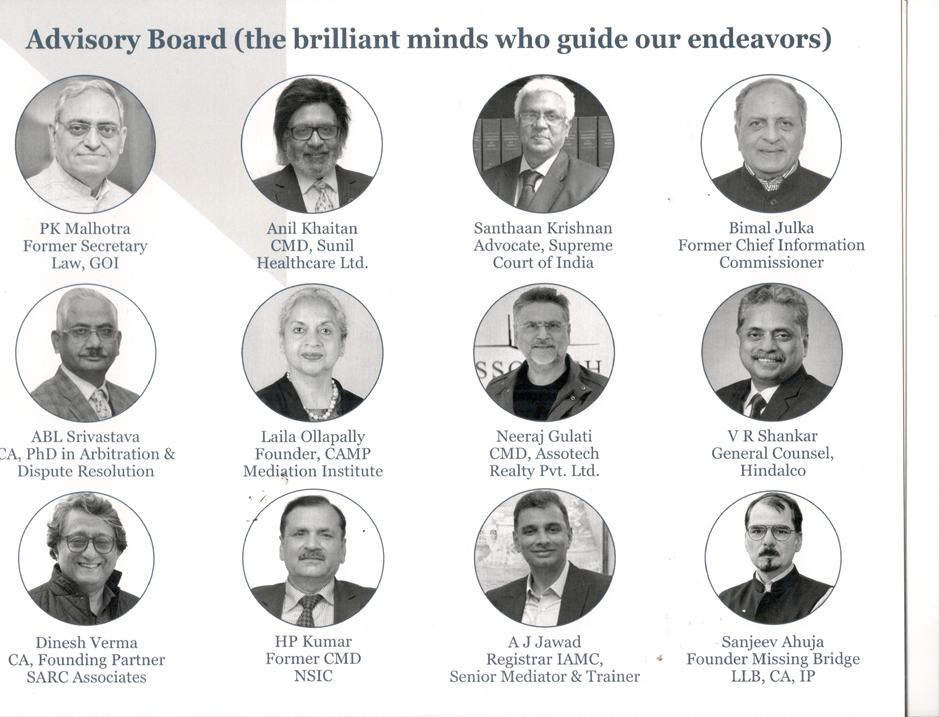
IMF’s Advisory Board comprises professionals from the legal, corporate, government, accountancy and mediation fields.
The members listed are PK Malhotra, Former Secretary, Law, Government of India; Anil Khaitan, CMD, Sunil Healthcare Ltd.; Santhaan Krishnan, Advocate, Supreme Court of India; Bimal Julka, Former Chief Information Commissioner; ABL Srivastava, CA, PhD in Arbitration & Dispute Resolution; Laila Ollapally, Founder, CAMP Mediation Institute; Neeraj Gulati, CMD, Assotech Realty Pvt. Ltd.; V R Shankar, Senior President and Chief Law Officer, , Hindalco; Dinesh Verma, CA, Founding Partner, SARC Associates; HP Kumar, Former CMD, NSIC; A J Jawad, Registrar, IAMC and Senior Mediator & Trainer; and Sanjeev Ahuja, Founder, Missing Bridge, LLB, CA, IP.
IMF outlines a long-term role for mediation
IMF intends to play a catalytic role in shaping how mediation is understood, supported and adopted across India. It proposes to do so by aligning stakeholders around common goals and long-term development.
The Federation states that, through its initiatives, it aims to make mediation more visible, trusted and widely used as a mechanism for dispute resolution.