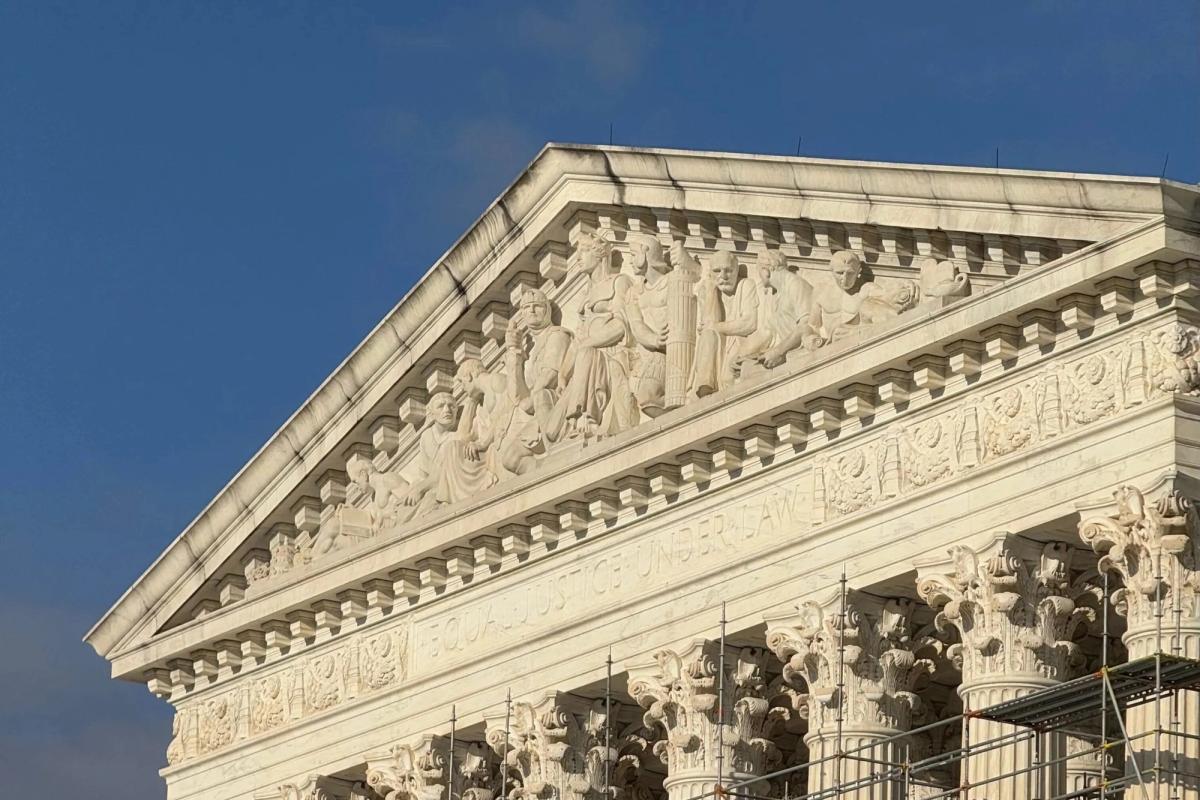
By several measures, Justice Alfred Moore drew the short end of the stick. He lost a U.S. Senate seat by a single vote, wrote exactly one opinion during his fewer than four years as a justice, and was too ill to hear arguments in the most famous case of his tenure, Marbury v. Madison. However, the 12th justice left behind “moore” than that ledger suggests (sorry).
Moore was born in May 1755 in Brunswick County, North Carolina, into a family that had built much of the Lower Cape Fear. His grandfather founded Brunswick, while his granduncle owned the Orton plantation and, with 250 enslaved people, was the “largest slaveholder … in colonial North Carolina.” Moore’s father was a colonial judge whose widely read essay denying Parliament’s power to tax unrepresented colonists through the Stamp Act cost him his judgeship. Sent to Boston for school at age nine after his mother’s death, Alfred returned to North Carolina to read law with his father and joined the bar in 1775 at age 20.
His timing coincided with the Revolutionary War. Five months after joining the bar, Moore took a captain’s commission in the First North Carolina Continental Regiment, commanded by his uncle, James Moore. The war would take the lives of his brother, father, and uncle: Moore’s brother was killed at Brunswick Town in early 1776, and in January 1777 his father and uncle died of illness at the same place on the same day. Moore then resigned to take over the family’s holdings but kept fighting as a militia colonel, causing enough difficulties for the British around Wilmington that a British major retaliated by looting the family plantation. The major promised amnesty (and the return of everything he had taken) if Moore quit his efforts for the colonies, but Moore refused.
Following this, Moore led a relatively long public career, rising to state senator from Brunswick County in 1782 and, once James Iredell stepped aside, attorney general. The work was mostly political prosecution (the assemblies of the 1780s treated punishing former loyalists as a security matter) and it ran into a practical wall given that juries were reluctant to convict their neighbors of anything serious. Moore adapted to this by charging these individuals for lesser offenses. He resigned in January 1791 after the legislature created a solicitor general’s office matching his in authority and pay, which Moore considered to be an infringement on his own role.
Moore joined the North Carolina legislature in 1792, having earlier pushed to ratify the Constitution following North Carolina’s initial refusal to do so. He also served as one of the University of North Carolina’s original founders (he gave the new university $200 and a pair of globes, its first teaching equipment). Shortly after, he lost a Senate race to Timothy Bloodworth by one vote and then lost a second Senate race four years later. He subsequently took a superior court judgeship in 1798.
When Iredell died, Adams appointed Moore to the Supreme Court, and the Senate confirmed him by voice vote in December 1799. Moore took the judicial oath the following April.
Moore’s lone opinion of five paragraphs came in the 1800 case of Bas v. Tingy, which asked whether France qualified as an “enemy” under a salvage statute after an American vessel taken by the French was won back (an act of 1798 gave those who recaptured an American ship one-eighth of its value, while an act of 1799 gave them one-half if the ship had been retaken “from the enemy” after more than 96 hours in hostile hands). Moore concluded that “the honor and dignity of both nations” required “that they should be called enemies, for it is by that description alone that either could justify or excuse the … confiscation which has unhappily occurred.” (The Federalists approved of this, while the Republicans did not). Roughly three years later Moore missed the arguments in Marbury v. Madison due to illness (the reason given by most, but not all sources), and took no part in the decision. Some criticized Marshall for not postponing the arguments in Marbury, since Justice William Cushing was also absent. (Moore, too, might have had interesting arguments to add since as attorney general he had argued the losing side of Bayard v. Singleton, an early test of judicial review.)
Ill health forced Moore to resign from the court in January 1804, and William Johnson took his seat. Moore died at 55 on Oct. 15, 1810, at his son-in-law’s plantation in Bladen County, and he was buried with military honors. He was later moved to St. Philips churchyard at Brunswick Town. Moore County is named after the justice, and more than 200 years later, he is still the last North Carolinian to sit on the court.
Presenting Moore’s portrait to the North Carolina Supreme Court in 1899, Junius Davis put him at “scarce five feet four inches in height, neat in dress, graceful in manner, but frail of body,” with a “keen sense of humor, a brilliant wit, a biting tongue, a masterful logic [that] made him an adversary at the bar to be feared.”