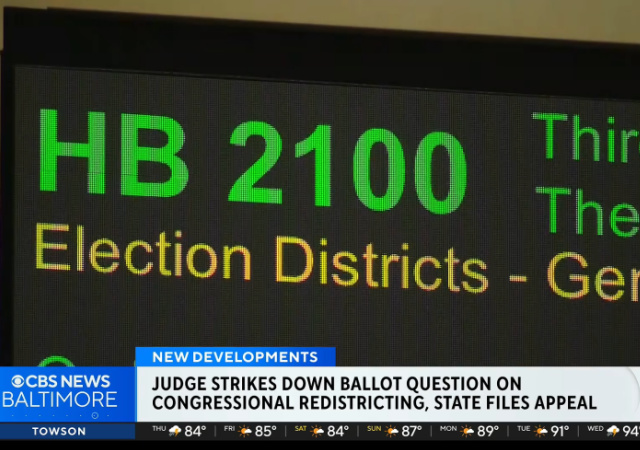
Judge Robert J. Thompson of Anne Arundel County Circuit Court blocked Maryland from adding a Democratic-backed redistricting amendment to the November ballot.
However, Thompson stayed his decision because he expects the case to go to the Maryland Supreme Court.
The amendment could give Democrats an advantage in all eight districts.
But Thompson ruled that the state Democrats violated state deadlines regarding adding ballot measures:
While the court is persuaded that the constitution does not impose period of exclusion on the legislature’s ability to propose constitutional amendments, from practical standpoint, thé calendar will. The court also finds that the legislature has passed laws to codify the ordinary process and procedure for submitting proposed constitution amendments to the people and that procedure defines the ordinary due process (notice) when the people are asked to weigh in on something as important as modifying the: state’s constitution.
The ballot question says:
The proposed Constitutional Amendment clarifies that certain standards in the Maryland Constitution apply only to districts used to elect members of the General Assembly; authorizes the General Assembly to grant original jurisdiction to the Supreme Court of Maryland to review the congressional districting plan of the State; and requires the criteria for boundaries of congressional districts to be determined by applicable federal laws.
Thompson determined that the word “clarifies” is misleading:
The court finds the used of the word “clarifies” is misleading. The argument advanced by the state is that prior to this court’s decision in Szeliga v. Lamone (Battaglia, J), the common understanding was that the Maryland districts and not to congressional districts. There is nothing in the record to suggest Constitution’s requirements for legislative districts applied only to state legislative that was ever common understanding. The ruling of the court was that the same rules apply to legislative districts and congressional districts. The status quo in Maryland is that the legislative districting requirements in the state Constitution applies to both state and federal legislative districts. As such, the word “clarifies” is intentionally misleading, and this should disqualify the ballot question as currently written.
Thompson also objected to the question including conferring “original jurisdiction over congressional redistricting cases to the Supreme Court of Maryland.”
“The Maryland constitution requires that referred question be on single issue only,” wrote Thompson. “While this court concludes it would be ideal for the Supreme Court of Maryland to have original jurisdiction in those cases, that is a separate issue from whether the Constitution’s compactness requirements apply to state or federal, or state and federal legislative districts.”
Maryland is the latest blue state whose redistricting efforts have gone down the drain.
In May, the Virginia Supreme Court struck down the Democrats’ redistricting referendum.
Donations tax deductible
to the full extent allowed by law.