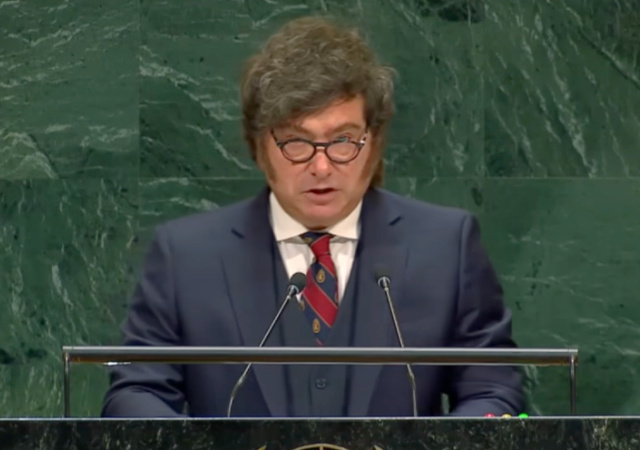
Argentine President Javier Milei brought the fire to the United Nations today.
Milei also tells it like it is. Sure, President Donald Trump can do that, but there’s just something about the way Milei does it.
Milei told the organization exactly what it has become:
When we took office of a country in ruins, on the brink of the worst crisis in its history, one thing was clear to us from the outset: we had to confront our problems with absolute honesty.
Lying to ourselves in order to feel better was going to get us nowhere.
It’s always preferable to tell an uncomfortable truth than a comforting lie.So believe me when I say that I know what I’m talking about when, in a constructive spirit, I point to the problems facing this organization which purports to guide states and arbitrate between them.
In that regard, I want to talk about three issues today.
First, what this body should have done and failed to do. Second, what it should not have done but did anyway. And third, its position in the face of the advent of artificial intelligence.
Milei reminded world leaders that the United Nations started with good intentions: everyone is free and equal, nations’ sovereignty is defended, and it’s a forum to talk and resolve conflicts.
It’s broken:
That’s to say, it’s become a useless organization whose only purpose is to sustain a cast of fatally arrogant parasites, masquerading as well-intentioned bureaucrats.
I would remind them of what Mises said: good people do not think about controlling the lives of their fellow human beings.
Those who were supposed to guarantee collective security and human rights failed in their task.
Instead, they allowed chaos, violence, and international terrorism to flourish.
The alleged defenders of human rights have sheltered bloodthirsty dictatorships and regimes that stone women in the streets.
They have systematically voted against Israel while remaining silent in the face of Islamic terrorism and the genocide of Christians in Africa.
Artificial Intelligence
We’ve seen countries and people within our government demand that the UN oversee AI.
We’ve documented the manufactured AI drama to instill fear in others.
Fear. It’s how governments gained more control over us after 9/11 and COVID.
“Moreover, under no circumstances should fear automatically translate into obedience,” said Milei.
Fear does not mean that we should cower:
But the institutions and powers created on the pretext of those alleged emergencies remain. And if for a moment we allow ourselves to believe that the lesson had been learned after so many failures, the arrival of artificial intelligence demonstrates quite something else.
The printing press, the steam engine, electricity, the internet— every great technological revolution has been accompanied by fears about what it would destroy, particularly jobs.
There is no doubt that this is one of the most effective ways of instilling fear in human beings, given the role of work as a means of subsistence.
Take the Industrial Revolution as an example. When it began, the world was home to some 800 million human beings. If, in keeping with the Luddites and the perennial pessimists, employment had at best remained constant, then, given that the world’s population has since increased more than tenfold, the global employment rate today would be at 90%.
That is absurd, something that few of us few seem to have stopped to consider, perhaps, except, perhaps those of us with a passion for reading Borges, who love his approach for testing an idea by taking it to its logical extreme.
Ultimately, these technological advances have not only failed to produce any of the catastrophes, but in addition, all of these ended up bringing an end to what human beings were able to do.
Today, we have built machines that are able to carry out tasks that only a few months ago seemed out of our reach. Where many see a threat, we see a new frontier: artificial intelligence, or superintelligence, as Donald Trump said, can double our productivity in a way that we do not yet comprehend.
To invoke Adam Smith, artificial intelligence will be the pin factory of the 21st century, and much more besides. It can transform our economies, our medicine, our education, even the way we govern.
That calls for prudence, yes. But prudence doesn’t mean fear.
Falkland Islands/Islas Malvinas
Milei used the Falkland Islands/Islas Malvinas as an example of the UN’s failure to defend a nation’s sovereignty.
In 1982, Argentina and the United Kingdom fought for 74 days in an undeclared conflict over the Malvinas Islands, South Georgia Islands, and the South Sandwich Islands.
Argentina wants it all back:
And as if that were not enough, an organization established to defend the territorial sovereignty of its members decided to look the other way with regard to the situation of the Malvinas Islands, South Georgia Islands, South Sandwich Islands, and the surrounding maritime areas.
For us, the Malvinas are a national cause.
I repeat: the Malvinas for us are a national cause.
They are also a test of the gulf that can exist between the words of international institutions and the reality upon which they purport to act.
Fifty years ago, this very Assembly adopted Resolution 3149, which calls on parties to refrain from introducing unilateral modifications while the dispute remains unresolved. Fifty years on, the situation has not changed, yet unilateral modifications continue.
Today, the Sea Lion Project is moving toward oil extraction on the Argentine continental shelf in the North Malvinas Basin, under British licenses that Argentina rejects as illegal and illegitimate. Any such activity not authorized by the Argentine Republic in this regard constitutes an unlawful act under both international law, including the UN Convention on the Law of the Sea, and Argentine domestic law.
That is why I wish to ask a question: what use is a resolution if, for decades, the other party can act in direct contravention of it, while that resolution remains intact in the archives but powerless in the face of reality? There’s no shortage of words or resolutions.
What is lacking is consequences. Because an institution that cannot ensure that its words carry weight in the real world loses the most important thing of all: its authority.
In these circumstances, those who follow the rules receive no reward for doing so, while those who break them suffer no repercussions whatsoever.
That’s why the Malvinas are not merely an issue between Argentina and the United Kingdom.
Milei encouraged the UK to resume negotiations with Argentina to find a peaceful solution because honestly…it sounds like he’s done playing nice.
COVID-19
Think it was over? Nope. Milei had more to say:
Mr. President, just as I have shown you how the UN failed to do what it was supposed to do, now I want to tell you how it has excelled at what no one asked it to do, and what it should never have been doing.
Because alongside that failure, they have built a bureaucratic leviathan devoted to deciding how the peoples of the world and their citizens should live.
This amounts to a curious mixture of anarchy and tyranny, impotence in the face of those who break the most basic rules, such as bloodthirsty dictatorships and terrorist organizations, coupled with Orwellian control and impositions on liberal democracies that abide by the rules.
We saw this with the Millennium Agenda. We saw it with the 2030 Agenda, with economic regulation, gender agendas, environmental extremism, and unchecked immigration. And every time they failed, rather than reviewing the model or apologizing, they doubled down, as they are already doing with the 2045 Agenda, which, I say now, will fail.
Milei tore apart the UN for its draconian resolutions and rhetoric during the pandemic, calling it “the one that forever should shame this organization.”
Horrendous:
During the pandemic, bodies under the auspices of this House put themselves before scientific evidence and the sovereignty of nations and promoted forced lockdown policies throughout the world that ruined jobs, that ruined the education of entire generations of children, and cost the lives of millions of people who died alone without basic medical care.
Where some allege a public health policy error, we see a global experiment in social control disguised as science.
And when a state wearing public health blinkers deprives its population of the right to work, to receive an education, and to bid farewell to their dead, this results in millions of unavoidable deaths, there is a word for it: genocide.
That happens in many countries, including Argentina, which boasted of being the World Health Organization’s star pupil. And that is why we decided to leave the World Health Organization.
Added to that is something more subtle but equally damaging: the psychological terror instilled by the state.
For years, citizens around the world were told that they should be afraid.
Afraid of their neighbors, of the air they breathe, of leaving their homes.That fear wasn’t a mere side effect.
It was the chosen instrument of their government.
Donations tax deductible
to the full extent allowed by law.