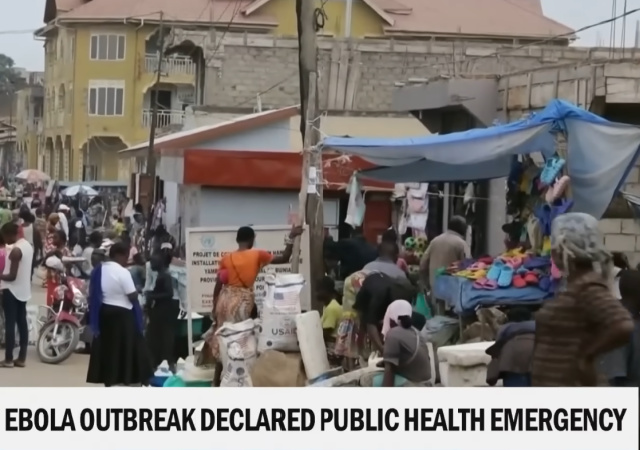
I have been covering the Bundibugyo Ebola outbreak centered in the Democratic Republic of the Congo (DRC), which highlights the grim realities of trying to contain and control a rare strain for which there are no licensed vaccines or proven targeted treatments.
Apparently, the efforts to contain the virus have not been completely successful. The Ebola outbreak has now spread to seven provinces in the African country and is showing no signs of slowing down.
According to the governor of the northwestern province of Sud-Ubangi, Jean-Rene Galekwa Vundawe, laboratory tests by Congo’s national research institute found in a sample the Bundibugyo virus, the rare kind of Ebola that caused the current outbreak.
The statement, which was issued on Thursday and reported by local media outlets on Friday, said the sample was from the Bulu health district in Sud-Ubangi. It did not disclose other information about the source of the infection.
The development makes Sud-Ubangi the seventh province affected by the outbreak — and the first in western Congo — a worrisome spread west from what was previously concentrated in the country’s east.
A case was detected in Kinshasa in May in a person who had traveled from eastern Congo, but the Congolese capital was not classified as an affected province.
#Ebola case detected in northwestern province far from epicentre, official says https://t.co/XdUFFZ1xTV
— Docteur Mbungani Mbanda (@cabinetmbungani) September 11, 2026
Local lawmaker and former health minister Jean-Jacques Mbungani indicated that the patient in this particular case was a 23-year-old man who died from the infection.
Mbungani said in just three weeks the man had departed from South Kivu province — where confirmed Ebola cases have been reported — and then traveled to Rwanda and Uganda. He then traveled to Congo’s Ituri province, the epicenter of the outbreak.
He then traveled from the northeast of the country to the northwest through the provinces of Tshopo, Mongala and Sud-Ubangi, according to Mbungani.
Doctors and local authorities in Sud-Ubangi were alerted to a patient that had a fever and was vomiting blood, Mbungani told The Associated Press on Friday in a telephone interview, adding that the man had died on Tuesday. Samples were then taken after the patient had died and were sent to the national research institute.
“It worries me. … Our province borders Congo-Brazzaville and the Central African Republic. We fear it may spread regionally,” said Mbungani.
As I noted earlier, the DRC’s humanitarian catastrophe unfolds alongside geopolitical and institutional failures that routinely receive less urgent attention. The United Nations’ recent vote on new maps, because the Mercator maps made African bureaucrats and race hustlers feel bad, is a classic example of misplaced priorities.
I am pleased that some African leaders are beginning to step up.
Dr. Jean Kaseya, head of the Africa CDC, recently gathered African presidents to discuss the Ebola outbreak. He is urging African governments to take greater financial and political responsibility for public health rather than relying primarily on Western agencies and donors.
“This response is led in Africa by Africans, for Africans, with support from our partners,” he told the two presidents — and some of those Western “partners,” or donors — at a meeting after the fancy lunch in July. “It’s not the reverse.”
The devastating 2014 Ebola outbreak in West Africa convinced the African Union that the continent urgently needed its own C.D.C. It was launched in 2017. Dr. Kaseya, who took office in 2023, is only the second person to hold the leadership position.
His leadership has split opinion in global health circles. To supporters, he has a clear vision for the continent and the ability to see it through, and he has elevated the Africa C.D.C. into a formidable political force.
…As proof of his success, he pointed to the Africa C.D.C.’s rapid growth in funding and spending; 12 recent audits, with all problems resolved on schedule; and an official African Union evaluation this year that recently rated his performance as “Outstanding.”
Powerful, well-deserved portrait of Dr @Dr_JeanKaseya. His call for African leaders to own the Ebola response is what Africa needs. Our health security must be led, financed and owned by Africans. He has my full support. Read the full portrait below.https://t.co/XM2TBXekxH
— Michel Sidibé (@MichelSidibe) September 12, 2026
I wish Dr. Kaseya good luck.
The Bundibugyo outbreak reminds us that pathogens do not respect regional boundaries, national borders, or the comforting assumptions of international bureaucracies.
African-led public-health capacity is essential, but it must be matched by transparent reporting, rapid surveillance, secure medical supply chains, and leaders willing to prioritize lives over political theater. I fear this last point is the real challenge.
Here’s hoping Dr. Kaseya’s push produces the kind of sustained action this crisis demands, before one infected traveler turns a regional emergency into something larger in scale.
Donations tax deductible
to the full extent allowed by law.