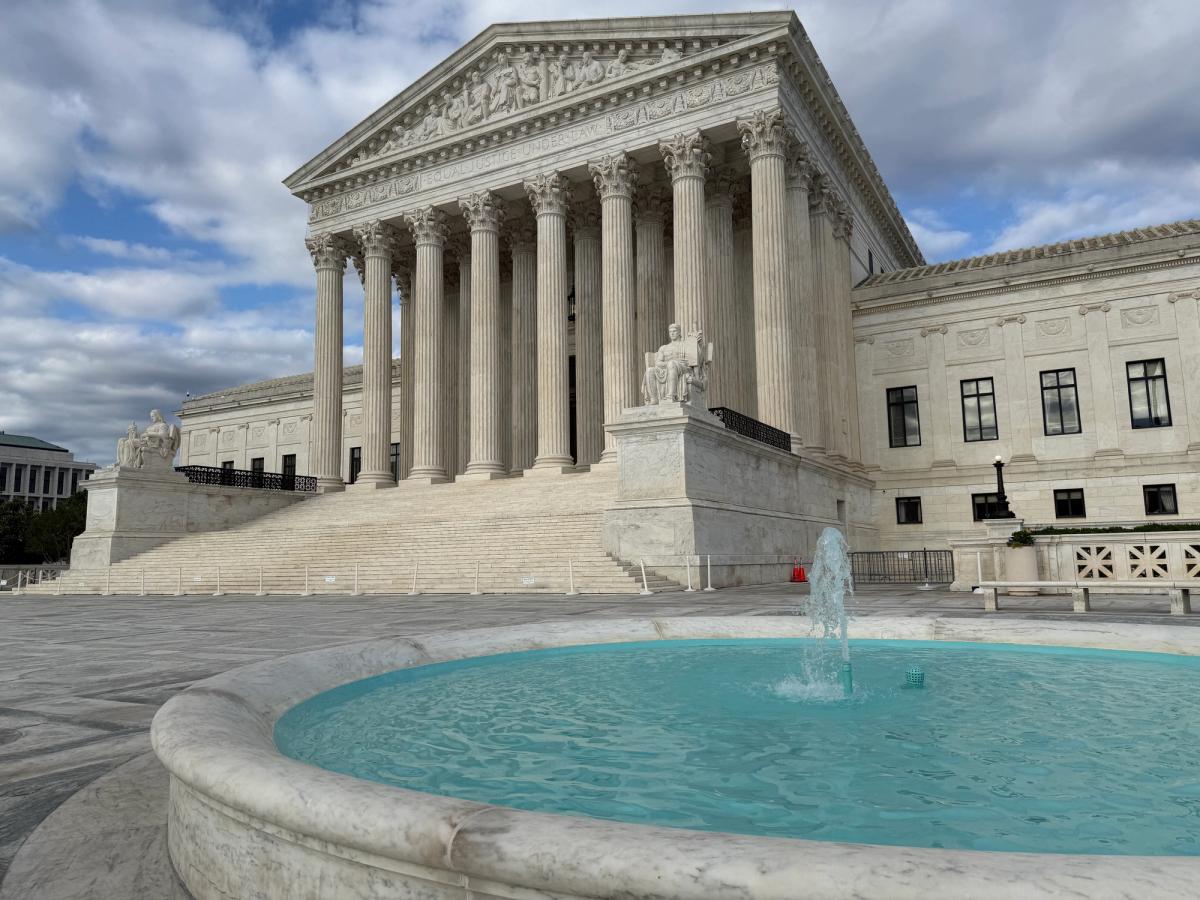
This is the fourth piece in a series on what I believe the court can, and should, do better.
***
Under longstanding tradition, the chief justice presides over oral argument and the justices’ private conferences. I propose a change. The chief justice should delegate these presiding duties to his colleagues. Doing so would promote trust among the justices and allow for the experimentation of different leadership styles.
Let’s start by clearing the brush. This proposal is constitutional. Any limits on the chief justice’s ability to delegate his power come from tradition and not the Constitution. Article I of the Constitution assigns specific powers to the House and to the Senate, and to both Houses acting together. The Constitution refers to the presiding officers of those bodies – the speaker of the House and the Senate president pro tempore – but allows each House to define their powers. Article II of the Constitution assigns specific powers to the president as the unitary executive.
By contrast, Article III of the Constitution is largely silent about what role the chief justice should play. Indeed, the phrase “chief justice” does not even appear in Article III. Article I, Section 3, Clause 6 provides that the chief justice shall preside over the president’s impeachment trial. (And in my view, even if the chief justice was unable or unwilling to preside over that trial, an associate justice could do so.) Article II references the president’s power to nominate “Judges of the supreme Court.” And Article III, Section 1 establishes the Supreme Court and provides that judges serve during “good Behaviour” and that their compensation cannot be diminished. Nothing in the Constitution would prevent the chief justice from delegating his authority to other judges.
Moreover, there is no delegation doctrine that would bar these transfers. Article II of the Constitution vests all executive power in a unitary president, but Article III provides no such vesting to the chief justice. The separation of powers does not require that only one person, the chief justice, exercise any particular authority over the Supreme Court. Indeed, the Constitution does not grant the chief justice any other authority, so there is no constitutional problem with leaving the chief justice without these powers.
This proposal is also consistent with statutory law. The Judiciary Act of 1789 stated that “the supreme court of the United States shall consist of a chief justice and five associate justices.” But that landmark statute did not define what specific powers the chief justice would have. Congress has assigned specific power to the chief justice, such as the power to select judges to the Foreign Intelligence Surveillance Court. Those authorities are likely stuck with him. But many other powers the chief exercises have been acquired through tradition. I am as much a fan of tradition as the next person, but sometimes old traditions run their course, and new traditions should begin. In sum, there are no constitutional or statutory prohibitions for what follows.
On almost every court, the presiding officer changes with some frequency. On the federal courts of appeals and the federal district courts, the chief judge changes approximately every seven years. New chiefs are selected based on a combination of age and seniority; they are not elected by their colleagues. (I have been critical of this gerontocracy, but at least it is easy to administer.) And on individual three-judge panels, the judge with the most seniority will generally preside. On some state supreme courts, the members elect their chief justice. On other state supreme courts, the voters will elect the chief justice. The Supreme Court of the United States is unique. The president nominates the chief justice, and upon confirmation, that person will serve as chief justice potentially for the rest of his life.
Under the current statutory regime, a person appointed as chief justice cannot lose that title. But no statute prevents the chief justice from voluntarily delegating some of his duties to other members of the court.
Currently, there are two primary roles that the chief performs on the court.
First, the chief justice presides over the court’s public meetings. At the start of each session, members of the Supreme Court bar will make oral motions to admit others to that bar. The chief justice usually handles those motions by himself and welcomes the new admittees. The chief justice will then call the cases and ask lawyers to begin their presentations. During argument, the chief will play traffic cop. If two justices speak at the same time, the chief will allow the more-senior justice to proceed. And under the court’s new protocols, the chief justice calls on each justice to ask questions based on seniority. The chief justice can also decide to extend oral argument as needed. Chief Justice William Rehnquist refused to do so: Justice John Paul Stevens recalled in his memoir “Five Chiefs” that Rehnquist was “vigilant in making sure that every oral argument ended on time” and would “interrupt[] an advocate in the middle of a sentence and rarely (if ever) allowed anyone any extra time.” Even before the post-COVID format, Chief Justice John Roberts let things run long.
The chief justice performs a second primary role at the court. He presides over the justices’ conferences. These private meetings are usually held on Fridays, and only the justices can attend. At these conferences, the justices vote on whether to grant or deny petitions for a writ of certiorari. The vast majority of petitions are denied without any discussion. Some petitions make it onto a “discussion” list. As Justice Amy Coney Barrett stated in her book “Listening to the Law,” “[a]ny justice can list a petition to be discussed and voted on at conference.” However, she explained, “[t]he petitions that no justice lists—the vast majority—are denied without discussion.”
It is not clear if the justices hold an ad hoc in-person or virtual conference to consider emergency applications. Justice Elena Kagan recently revealed that no such meeting took place for an emergency spending case. In 2019, Justice Stephen Breyer faulted the court for not discussing a death penalty case at conference before denying an application for a stay of execution.
The justices will generally hold a conference on the Friday after oral arguments to count the votes and assign opinions. As Barrett relayed, the “justices speak and vote in order of seniority, with the chief justice starting the process.” After a case is discussed, the most-senior justice in the majority will assign the majority opinion. When the chief justice is in the majority, he will make the assignment. Barrett wrote that “the chief justice, working with other assigning justices, attempts to equitably distribute the work.” Each sitting, and each term, each justice will have (roughly) the same number of assignments. This practice seems to be something of a modern innovation. Scholar G. Edward White wrote that “[t]here is no indication that” Chief Justice John Marshall would try to equally assign opinions based on a formal procedure. Rather, the justices discussed the cases “informally” and Marshall “took on most of the opinions himself.”
On the current court, Roberts is in the majority more than 90% of the time. As a practical matter, he thus decides who gets to write nearly every majority opinion. It is rare that anyone else makes assignments. The assignment power is important, as it could dictate how the ultimate analysis is written. Or, the chief can just assign the most important cases to himself, which he often does, as Barrett confirmed in her book.
All of these responsibilities can be delegated. The chief justice should allow other members of the court to preside over the public argument sessions, as well as the private conferences. Indeed, such delegations have happened before, by necessity. In July 1835, Chief Justice John Marshall died, and his successor, Roger B. Taney, was confirmed nine months later in March 1836. There were more than 50 cases decided over the course of the January 1836 term. During Reconstruction, there was an eight-month gap between the death of Chief Justice Salmon P. Chase in May 1873 and the confirmation of Morrison R. Waite in March 1874. In this span, more than 100 cases were decided. During these interregnums, another member of the court would have had to preside. (Further research might reveal how these duties were divided.)
Most recently, in October 2004, Rehnquist announced that he had been diagnosed with thyroid cancer. For much of that term, he was too ill to attend oral arguments and the conferences. Rather, Stevens, the then-senior associate justice, presided over these oral arguments, including the landmark cases of Gonzales v. Raich and Van Orden v. Perry. Presumably, Stevens also presided over the Supreme Court’s private conferences. Rehnquist apparently voted at the conferences by telephone. If Rehnquist was able to delegate the role of presiding officer to Stevens due to health concerns, similar delegations could be made for other reasons.
Rehnquist died on September 3, 2005. Stevens continued to perform his role as acting chief justice after Rehnquist’s death, and before Roberts took the oath on September 29, 2025. In his memoir Five Chiefs, Stevens wrote that he “had been acting as [the Supreme Court’s] chief justice since Bill Rehnquist’s death.” Stevens performed a host of duties during these 26 days. He assigned his colleagues to serve as circuit justices and reassigned the two circuits that Rehnquist had previously allocated to himself. Stevens also presided over the “long conference,” where the justices reviewed all of the cert petitions that had piled up over the summer. The court granted a host of petitions on Sept. 27 (including one from Anna Nicole Smith). The short-handed court also issued approximately 30 orders during this span. Several emergency applications for injunctions or stays were referred to the court and were denied, including a stay of execution. Even without a chief justice, the court kept on moving forward.
All chief justices are mortal and are not immune to the effects of aging. As time goes on, their ability to handle all of their tasks will necessarily diminish. These signs may be subtle at first, such as confusion during oral argument, and not keeping track of who is lined up to speak next. But over time, these slips may become more visible. It is better to delegate these tasks in a strategic fashion when all cylinders are firing than to do so on an ad hoc basis when faculties are failing.
There is another programmatic reason for delegation: Allowing other members of the Supreme Court to preside will give them deeper insights into the challenges and powers of the chief’s position. This rotation would also allow for experimentation. A junior justice may have innovative ideas of how to manage the conference, or how to structure the oral argument. For example, Barrett observed that on the U.S. Court of Appeals for the 7th Circuit, “the most junior judge talked and voted first.” Stevens recounted that Chief Justice Earl Warren started discussions with the most junior member, but Chief Justice Warren Burger “must have been responsible for” this “unfortunate reversal in the order of voting.” Roberts has apparently continued this Burger/Rehnquist practice and is the first to announce how he will vote on cases. Were Barrett or another junior justice to preside, they could flip the ordering. Ideas could be tried and abandoned if they don’t work.
The public would also benefit from seeing different faces in the middle seat. At one point, Justice Clarence Thomas, the most senior justice, could preside; at another time Justice Ketanji Brown Jackson, the junior justice, could preside. Why shouldn’t Thomas, who attended hundreds of oral arguments in absolute silence, get to manage the oral argument? Why shouldn’t Jackson, the newest member of the court who has shown a propensity for speaking more than any other justice, see the oral argument dynamics from a different perspective? While not presiding, the chief justice would sit in the seat that his colleague temporarily gave up. Everyone else stays where they are. Here, I see a virtue in this approach; forcing the chief justice to step down from presiding would promote humility and remind him what it is like to not be in charge.
The division of labor here could be done in different ways. For the simplest approach, each year, the justices could draw a number from a hat to select the presiding justice for a given term. Once a justice serves as chief, his or her name will be taken out of the hat until all other active members have served. That approach would provide more stability and continuity in the chief’s seat. It would also give the presiding justice time to develop an approach to the important role. A justice could opt out of having his or her name drawn at random. This system would be entirely voluntary – but I suspect most of the junior justices would jump at the chance to preside, barring some other extenuating circumstances.
The justices could also rotate during a given term. The court is in session for approximately nine months out of the year from October through June. There is usually one sitting per month. Each of the nine justices could serve during one sitting as presiding officer for oral argument and for the conference. In fairness, the court usually does not hold oral arguments in May and June (although they should.) But I have little doubt that this could be worked out.
Perhaps most critically, my approach would allow different members of the court to assign majority opinions. Here, more justices would be able to direct the trajectory of majority opinions. And since the selection would be random, justices could not game which opinions they can assign. Moreover, the ordering would not be announced to the public in advance. This information might allow litigators to time cert petitions and emergency applications to shop for particular presiding officers. (On the lower courts, savvy litigators know when certain judges are sitting on emergency motion panels and can time their cases accordingly.)
This reform would allow junior members to have a greater impact on the court and its practices. The Supreme Court, an institution wedded to tradition perhaps too much, could engage in experimentation of how best to function. Perhaps most importantly, the chief justice, who is assigned zero powers at the court by the Constitution, would cease exercising sweeping powers for life. All of the justices should take an equal role in guiding the court’s future.