Meghan Markle’s Russian Billionaire Connection Has a Curious LawFuel Twist
As we are all once again subjected to more emetic Harry-and-Meghan headline hogging, this time yet another trans-Atlantic move and apparently the possible resurrection of her acting gig, I’m energised by the idea of her appearing in Guy Ritchie’s gangster romp ‘The Gentlemen’. What ever part could she play? A Montecito money launderer? A narcissistic bag lady for a disgraced Royal? An undercover podcaster?
She could even provide the show with a ‘Based on Real Events’ label as she already comes with gangster connections, having bought the Montecito mansion from oligarch Sergey Grishin, whose backstory would have saved Guy Ritchie weeks in the writer’s room.
Grishin crossed swords with me, if that sufficiently described a Court bench-long row of Eastlites prepared by Simpson Grierson and carrying defamation proceedings that would bury me in damages, costs and time.
Such is one of the charming democratic features of defamation litigation.
The author of the deeply unflattering LawFuel articles, Jennifer Sulkess, had become friendly with Grishin’s former wife, Anna Fedoseeva, and both had been embroiled in litigation involving Grishin in California. Introduced to us by a US Attorney who had written regularly for LawFuel, the articles lead to a pre-defamation battle in New Zealand, about as far from Montecito as Grishin could conveniently manage.
Much of the content about Grishin had been well publicised in UK newspapers after the Sussexes made their Stateside move to California. Grishin was as unsavoury as any good oligarch could be. And like all good oligarchs he is now also dead, passing on mysteriously in Moscow in 2023.
So why sue me?
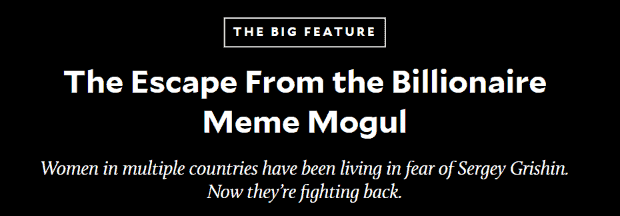
We were the weakest link. Grishin wanted to ‘get’ Sulkess after a lengthy history of legal battles over serious allegations made by her and Fedoseeva against Grishin. The Sulkess claims were meticulously documented with video, sound recordings and documents, and supported by a list of restraining orders in Californian Courts, which which were documented in a major, Mother Jones piece.
But New Zealand?
The case, a major pre-trial discovery action by Simpson Grierson and their counsel Willie Akel, is the awkwardly but appropriately named SLAPP, (Strategic Lawsuit Against Public Participation) documented in the recent analysis by Canterbury University academic Dr Mark Hanna.
We are open to these pervasive legal creatures in New Zealand. Publishers do not acquire immunity from defamation law merely because the person complaining is rich, deeply unpleasant or lives somewhere with better weather.
Months before receiving the Simpson Grierson papers Grishin had attempted to subpoena LawFuel emails from the US server, which we opposed successfully in the US after receiving a call about the email raid and arranging to have it resisted from the verandah of the Mangonui Hotel.
Grishin switched his attention to taking direct action in New Zealand and, with some background in handling defamation actions and with a little help from my friends I appeared to oppose naming Sulkess as author for obvious reasons.
There were faults in LawFuel’s own conduct of the case where Simpson Grierson sought pre-commencement discovery, but the greater faults are with the system permitting forum shopping in a plaintiff-friendly jurisdiction like New Zealand. Particularly from pernicious individuals with no local standing.
But Hanna’s point in his analysis of this and other cases is that imperfect journalism should not answer the entirely separate question of whether New Zealand provides sufficient safeguards against litigation being used to exhaust publishers before the merits are tested.
The Daily Mail Case


California recognises the problem with this type of behaviour and has a statutory anti-SLAPP mechanism allowing certain claims attacking protected speech to be challenged early. New Zealand does not have an equivalent comprehensive regime.
And the Daily Mail, who had received a substantial threat for their content about Grishin (headlines like “I”ll make your son an orphan” and so forth) pointed to their own legislative safeguards regarding these actions.
They also pointed to a video recording of Grishin boasting about how “I practically brought the Russian banking system to collapse in the 1990s.”
The Mail lawyer explained to me, over a lengthy high tea in London, how exposed we were in New Zealand to such claims, whereas they told Grishin’s KC to sling his hook when the threatening letters arrived.
Video Admissions
The video of Grishin was one of the more compelling pieces of skullduggery. Clear and unambiguos as it was.
And my headline description of Grishin as the ‘Scarface Oligarch’ was deemed a further gross travesty, allegedly linking Simpson Grierson’s client to Al Capone, apparently America’s ‘infamous gangster.’ The moniker was adopted because of Grishin’s affinity for gangster roles in both real and play life, having purchased the mansion used in the Al Pacino film and posing with machine guns in the house.
Publication of those images was more trouble. Breach of privacy and copyright, you see.
We settled, completed with the mea culpas and requisite obsequious grovelling, because defamation cases are not just for the very rich, but also mostly for the clinically insane. And six months later Grishin was dead, in suitably mysterious circumstances, at 56.

Whether he was one of pile of bodies in ‘Putin’s purge’ or some other reason is anyone’s guess.
And then came the newspapers reporting the death of the “Scarface Oligarch”, a description which evidently appealed to subeditors rather more than the courtroom references to the reputable international businessman that Willie Akel had urged upon the Court.
The most effective SLAPP does not necessarily require a judgment. Or the cost orders Gendall J was fondly dispensing to replenish the Grishin coffers and presumably to persuade me to comply with requests to name the article author.
The threat of legal annihilation is the weapon. A wealthy claimant can afford letters, applications, discovery and hearings which a small publisher cannot. Winning is desirable, but exhausting the other party can be quite useful too.
Britain now expressly recognises the problem in legislation dealing with SLAPPs involving economic crime, including an early-dismissal mechanism and costs protection. New Zealand still relies substantially on a Defamation Act passed in 1992, when newspapers were printed on paper and nobody had yet thought of anyone called Meghan Markle.
The New Zealand Act makes defamation actionable without proof of special damage. It has no comprehensive anti-SLAPP mechanism allowing a publisher confronted by an abusive public-interest claim to have it identified and disposed of quickly before the legal meter has consumed the furniture.
And that is the real lesson from my expensive acquaintance with the man who sold Harry and Meghan their house. The problem is not that rich people may defend their reputations through a phalanx of well paid enablers. They plainly should be able to. Nor is it that lawyers represent unpleasant or controversial clients. That, inconveniently for us on occasion and the opposite for them, is part of the job.
There is a Russian gangster slang for this – Bablo pobezhdaet zlo, meaning ‘money conquers justice.
The problem with these claims in inefficient expensive courts is that the process itself becomes the punishment.
If Meghan does make it into The Gentlemen, perhaps Guy Ritchie could give her a role involving a small publisher pursued by a deeply seedy but fabulously wealthy man through an antiquated legal system. She already lives in the house he sold her, so there is a pleasing economy in the casting.
Ritchie and Netflix would reject the plot as implausible.
New Zealand, on the other hand, still calls it defamation law.