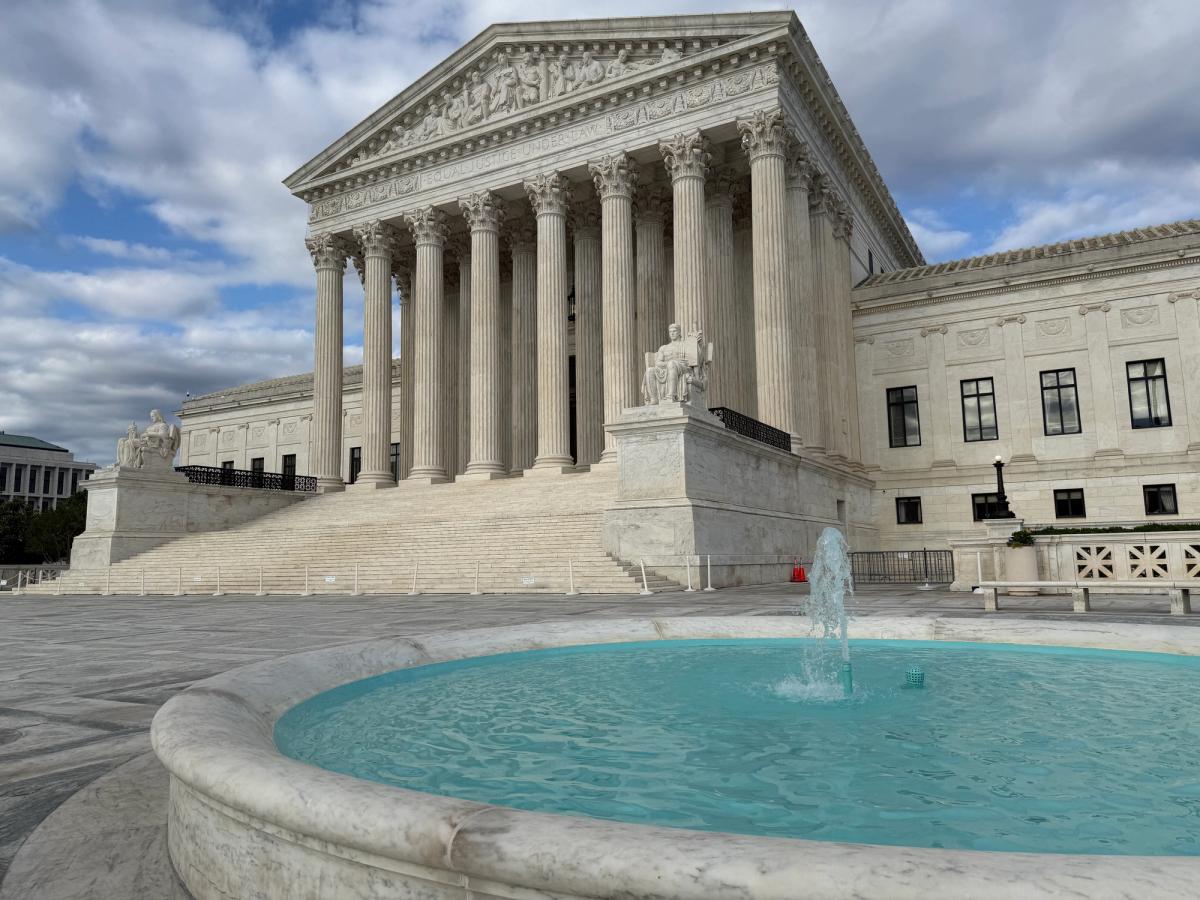
This is the fifth piece in a series on what I believe the court can, and should, do better.
***
Each term, the chief justice appoints a circuit justice for each of the twelve regional courts of appeals. These appointments are expressly authorized by 28 U.S.C. § 42. More-senior justices are usually appointed to the circuit they have the closest personal connections with. For example, Justices Samuel Alito and Sonia Sotomayor, who served on the U.S. Courts of Appeals for the 3rd and 2nd Circuits, respectively, are the circuit justices for those circuits. And, by custom, the chief justice is the circuit justice for the nearby U.S. Courts of Appeals for the D.C. and 4th Circuits.
Some assignments are made, I suspect, based on ideology. There is a reason that Justices Antonin Scalia and Alito, who grew up far from the deep south, were assigned to the conservative U.S. Court of Appeals for the 5th Circuit: to deal with death penalty emergency motions. Still, with some humor, Alito related how Chief Justice John Roberts asked him: “I think what the Fifth Circuit needs is another Italian American born in Trenton, New Jersey.” Similarly, Justice Elena Kagan, who only briefly lived west of the Potomac River, was appointed responsibility for the historically liberal U.S. Court of Appeals for the 9th Circuit. The more-junior justices are appointed to cover the rest of the circuits, as needed. These assignments are usually fairly constant and only change when the composition of the court changes.
In my article, “Bilateral Judicial Reform,” I proposed that Congress should require justices to ride circuit again and preside as circuit justice when their circuit sits en banc. Here, I will propose something simpler: Each term the circuit justices would be drawn at random to sit on the lower courts. The justices can pull a number out of a hat. No longer would the same justice preside over the same circuit year-after-year. Let the justices and the lower courts mix and mingle, to get the greatest flavor of how the judicial system works nationwide. Indeed, justices should rotate among the circuits every year to see the widest range of courts, across the fruited plain, with flyover country in the middle.
A more important part of this proposal is that the chief justice will ask each circuit justice to preside over one en banc oral argument of his or her circuit. These sessions could be timed when the justices do not have oral argument at the Supreme Court to minimize possible disruptions.
Under 28 U.S.C. § 294, the chief justice of the United States is authorized to allow retired justices to sit by designation on the lower courts. This happens from time to time. In recent years, retired Justices Sandra Day O’Connor and David Souter sat on the circuit courts. There does not appear to be a statute that authorizes the chief justice to designate an active Supreme court justice for service on a lower court. However, 28 U.S.C. § 45(b) approves such service. It states, “the circuit justice … shall have precedence over all the circuit judges and shall preside at any session which he attends.” There is some past practice here. In 1951’s Field v. United States, Justice Stanely F. Reed sat on the 2nd Circuit in his capacity as “Acting Circuit Justice.” (Apparently, Circuit Justice Robert H. Jackson was “on vacation.”) If this practice is a precedent, then the chief judge of each circuit could extend an invitation to the circuit justice to preside over en banc hearings.
I see several virtues with this proposal. First, it would allow the Supreme Court justices to become familiar with their colleagues on all of the lower courts. It is far easier to second-guess the judgments of unnamed faces on some faraway inferior court. But working with these circuit judges should improve vertical judicial comity. Circuit justices generally attend circuit judicial conferences, but there are only limited opportunities to mingle – especially in light of increased security protocols. Sitting on a panel and discussing the law in a private conference would be a far more meaningful interaction. Such collegiality is especially important where some lower court judges describe their relationship with the Supreme Court as a “war zone.”
Second, the circuit judges could impress on their circuit justice some of the problems and issues “on the ground” and seek help. It is one thing for litigants to tell the Supreme Court there is an urgent circuit split that needs resolving. It is far more effective if the lower court judges could implore their circuit justice to settle a pressing issue of federal law. That feedback, hopefully, could filter back up to the full court.
Third, the circuit justice could help give their colleagues on the lower court a “view from the top” and shed light on the trends and directions of federal law. This feedback loop would be especially important for the interim docket. Many lower court judges have expressed frustration of how to deal with the court’s unreasoned-but-precedential orders. The circuit justice could provide some guidance.
Fourth, having the circuit justice preside would give them experience as a presiding officer – a role they may never experience in their careers. (Unless, of course, the chief justice delegates his presiding authority.) Moreover, the circuit justice could preside over a bench with justices from different backgrounds and perspectives. I see a great opportunity for collaboration and learning.
Fifth, these en banc proceedings would be open to the public and to the press, providing more of a chance for the American people to see the justices. And most of the courts of appeals permit cameras, so even more people could watch the justices.
Sixth, each circuit justice should maintain a permanent chamber in the courthouse for the circuit over which they preside. And they should be expected to work there a few weeks during the year. This time would overlap with the en banc sitting. The justices would swap their vantage point of the United States Capitol for a blend of America: Boston Harbor, the Brooklyn Bridge, Independence Hall, the Mississippi River, the Ohio River, Lake Michigan, the Gateway Arch, San Francisco Bay, the Rocky Mountains, Centennial Olympic Park, and more. Plus, the justices could get to know the other judges in the building and engage in the day-to-day work of an inferior court judge.
These principles lead me to a further thought experiment. Five of the nine justices lived in Washington, D.C. before their appointments. They chose to make their home in our nation’s capital. The other four, as could be expected, moved to the nation’s capital. Under the longstanding practice, the justices are only in session about two weeks per month between October and June. And apart from oral argument and conferences, the justices do not even have to be present. For example, it is fairly common for a justice to skip an opinion “hand down” day and allow another justice to announce his or her opinion.
It would be quite feasible for a justice to commute to the Supreme Court for the session days. Indeed, Justice John Paul Stevens spent two weeks of each month from November through April in his Florida home. For all other times, the justice could work in a local chamber at a federal courthouse. Federal law requires circuit judges to reside in the circuit they are assigned to, but there is no similar statute requiring Supreme Court justices to live in Washington, D.C. I think Congress would gladly pay for some travel costs for the justices to spend less time in the capital.
I don’t even think a justice would need to purchase an expensive home in Washington, D.C. A justice could also follow the lead of many members of Congress, and use their chambers as sleeping quarters. If it is good enough for Article I, it should be good enough for Article III. (Indeed, on the Marshall court, all of the justices would stay at the same boarding house.)
I’ll add that their law clerks should join the justices on the road. There is value in keeping the law clerk’s feet planted on the ground. Working in a marble palace can distort any sense of reality. Perhaps law clerks could spend part of the year in the home chambers and part of the year at the Supreme Court. Or some law clerks could spend all of their time in either location. Or perhaps a justice could go to D.C. without any law clerks. In any event, it would serve the justices well to get out of D.C. and see how justice is dispensed across the nation.
But that is not all. The Supreme Court justices should not only get experience on the circuit courts. They should also partake in the important work of district court judges. Two current members of the Supreme Court served as trial judges, and their experience shows. Justices Sotomayor and Ketanji Brown Jackson often demonstrate a very careful concern for the workings of federal district courts with regard to procedure, the rules of evidence, and standards of review. They are also the justices most likely to object when the Supreme Court second guesses detailed fact finding from lower courts. The other members of the court, however, never sat on lower courts and have little practical experience in trial courts.
I propose that the chief justice should preside over a criminal and civil case each year – and then ask his colleagues to do the same.
There is a well-known precedent to rely on. In May 1984, Associate Justice William Rehnquist sat as a district court judge over a civil suit in the U.S. District Court for the Eastern District of Virginia in Richmond. (I have reviewed the record in this case from the National Archives but have been unable to determine the express statutory authority that allowed a lower court judge to sit by designation on a trial court.) A Supreme Court spokesperson described this assignment as “very rare,” perhaps the first such case since the 19th century. According to the Washington Post, Rehnquist expressed an interest in serving as a trial judge in a speech to the Richmond Bar Association. Rehnquist told district court Judge D. Dortch Warriner that he would like to try a case. And “Warriner then extended an invitation for Rehnquist to preside at a [Section] 1983 civil rights case to be heard June 5 and 6 in Richmond.” The National Law Journal reported that the plaintiff’s lawyer praised Rehnquist as having a “good temperament.” Ultimately, Rehnquist’s opinion was reversed by an unpublished decision of the 4th Circuit. Certiorari was ultimately denied, with Rehnquist recused.
Perhaps smarting from Rehnquist’s reversal, no other sitting justice since has tried to sit on a lower court. That fate is unfortunate and is somewhat insulting to the hardworking district court judges nationwide. No one is perfect at their job on day one. And even the finest lower court judges are reversed by the court of appeals. The justices should hone their craft and get a better sense of how litigation operates. Appellate judging is sterile, as they only see lawyers and read briefs. But in the trial courts, you see witnesses, hear from victims, and look assailants in the eye. And if the justices are reversed, they will know how it feels, and that perhaps might affect how they write opinions.
If the chief justice leads by example, I would like to think his other colleagues would follow suit.