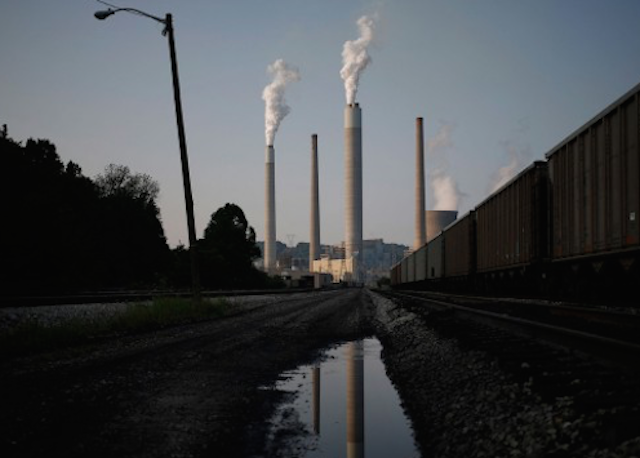
The Environmental Protection Agency (EPA) has just announced it plans to rescind greenhouse-gas limits for coal- and natural-gas power plants.
The move is the latest turn in a policy struggle over the extent of federal authority to reshape the nation’s electricity system by eco-activist bureaucrats misusing regulations intended to control the levels of real pollutants.
The Environmental Protection Agency is expected to repeal rules that limit planet-warming greenhouse gas emissions from power plants fueled by coal and natural gas, an action that Administrator Lee Zeldin has said would remove billions of dollars in costs for the industry and help “unleash” American energy.
The rule change, proposed last year, could be announced as soon as Monday, according to two people familiar with the proposal, and represents a fundamental shift from efforts by Democratic Presidents Joe Biden and Barack Obama to address climate change and clean up industrial pollution, often in low-income and majority Black or Hispanic communities.
The rule, which is expected to face immediate legal challenges, also could prevent future administrations from regulating greenhouse gas emissions from power plants, people familiar with the proposal said. They spoke on condition of anonymity because the final rule had not yet been made public.
The EPA did not immediately respond to a request from The Associated Press for comment.
The Trump administration rescinded carbon rules for power plants, the biggest industrial source of greenhouse gases in the country https://t.co/xGQO8xEDI3
— Bloomberg (@business) September 14, 2026
The elite media deems carbon dioxide (CO₂), a life-essential gas necessary for plants, part of the collection of “climate pollutants”. It also deems methane, an inherent part of the biogenic carbon cycle, a climate pollutant.
Over the past three years, I have repeatedly warned about policy built around mandates and still-developing technology. In April 2023, I said that proposed Biden EPA power-plant standards risked further burdening an already strained grid while relying heavily on carbon capture.
However, this trend began to reverse earlier this year when the EPA moved against the Obama-era endangerment finding, retreating from treating CO₂ as a conventional pollutant.
The Trump administration cited both practical and legal considerations in rolling back the power plant rules. Going forward, the rules will apply to real hazardous air pollutants.
The Trump administration says the EPA doesn’t have the legal authority to regulate GHG emissions and that the Biden-era rules required technology that is unavailable or cannot meet the 90% requirement.
The administration cited its justification for proposing the repeal of the Endangerment Finding, the scientific and legal foundation for federal GHG regulations, in its decision to repeal the power plant standards, arguing that the agency can’t regulate GHGs for global impacts under the Clean Air Act and that the law’s definition of pollution doesn’t apply in this case.
The EPA says its decision to repeal the Biden-era standards will save $310 billion. If the remaining GHG standards were also eliminated, the industry and consumers would save another $370 million, the EPA said.
The EPA says the new rule applies only to GHG emissions and does not apply to regulations on other hazardous air pollutants.
The rule change, first proposed last year, represents a fundamental shift from efforts to address climate change and regulate carbon dioxide and other greenhouse gases that trap the sun’s heat.https://t.co/qgS2ImEYrF
— NBC 7 San Diego (@nbcsandiego) September 14, 2026
Going forward, the focus of emissions for power plants will be on mercury, heavy metals (arsenic, chromium, nickel, lead, cadmium, cobalt, selenium, beryllium), acid gases (hydrogen fluoride and hydrogen chloride), and carcinogens like dioxin and formaldehyde.
In other words, real pollutants that deserve containment and control with the best available technologies.
Of course, the eco-activists will not rest.
Environmental groups also are likely to challenge the separate rule proposed Monday that could prevent future administrations from regulating greenhouse gas emissions from power plants. The proposal, expected to be made final next year, follows on EPA’s action earlier this year revoking a scientific finding that long has been the central basis for U.S. action to regulate greenhouse gas emissions and fight climate change.
In a nutshell, the EPA’s repeal does not excuse power producers from controlling genuinely hazardous emissions; it refocuses federal oversight on pollutants such as mercury, toxic metals, and other compounds that directly threaten public health.
At a time when Americans depend on dependable electricity for air-conditioning, industry, and rapidly expanding AI capability, practical policies that reinforce grid reliability and affordability without needlessly endangering the environment are likely to command far more public support than ideological mandates built around immature or prohibitively costly technology.
The Democrats and their media minions may choose to overlook those successes, but households and businesses will recognize the value of a policy that protects the air they breathe, the power system they rely on, and hopefully offers a more abundant and less expensive supply of energy.
With no sign of stopping! pic.twitter.com/xu8ok0NjSP
— Secretary Chris Wright (@SecretaryWright) September 1, 2026
Donations tax deductible
to the full extent allowed by law.