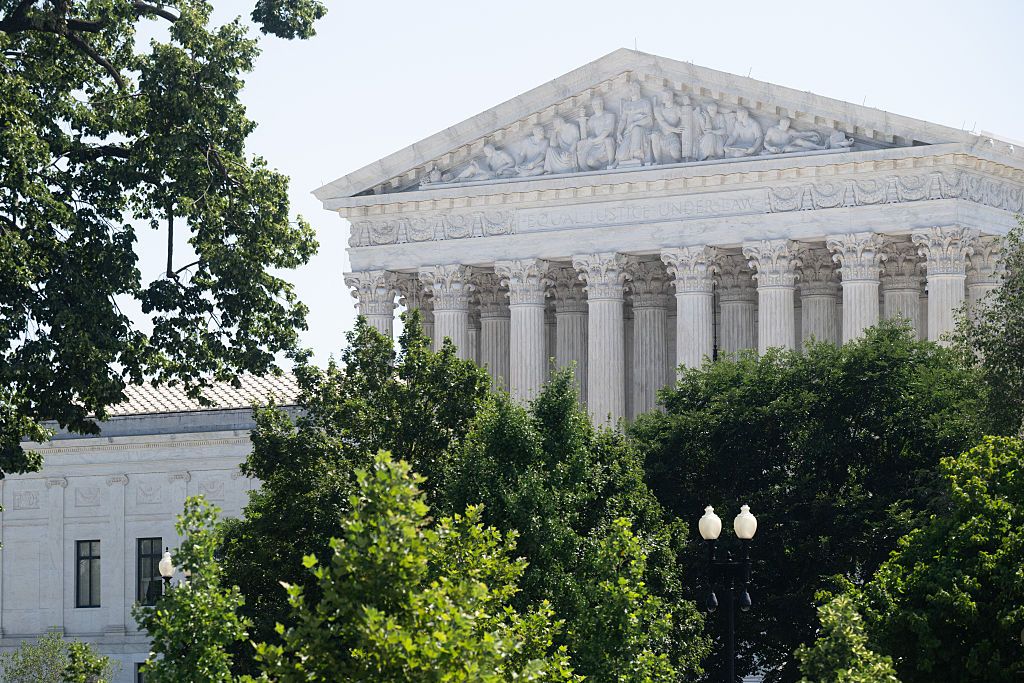
In Trump v. Barbara, the Supreme Court held that executive order 14160, which attempted to end birthright citizenship for the children of undocumented immigrants and those temporarily residing in the United States, was unconstitutional under the citizenship clause of the 14th Amendment. Chief Justice John Roberts wrote the opinion, joined by Justices Sonia Sotomayor, Elena Kagan, Ketanji Brown Jackson, and Amy Coney Barrett.
Justice Brett Kavanaugh dissented in part. He would have held that the executive order did not violate the Constitution but did violate a statute providing (in his view) for birthright citizenship. Justices Clarence Thomas, Samuel Alito, and Neil Gorsuch dissented and would have upheld the executive order.
This decision was consequential in both practical and doctrinal terms, but it could have also led to a jurisprudential reckoning. Specifically, if only one more justice had dissented, a 4-1-4 split would have resulted. Lacking a majority opinion, the decision would then have had unclear precedential value, potentially sparking congressional action of uncertain constitutionality on an issue of profound national importance.
The Marks rule
As most SCOTUSblog readers are likely aware, when five or more Supreme Court justices join an opinion, that opinion becomes a precedent and will bind courts going forward.
But what happens when there is no majority opinion?
In the 1977 case of Marks v. United States, the court faced precisely that issue. The petitioners in Marks challenged the jury instructions that led to their obscenity convictions. They argued that the lower courts had erroneously failed to give jury instructions based on the 1966 case of Memoirs v. Massachusetts. Memoirs reversed a judgment holding the book “Memoirs of a Woman of Pleasure,” commonly known as “Fanny Hill,” to be obscene.
The lower courts had not applied Memoirs because it contained no majority opinion; rather, the plurality opinion in Memoirs by Justice William Brennan, joined by Chief Justice Earl Warren and Justice Abe Fortas, contains a more defendant-friendly standard than the one under which the Marks defendants were convicted. Justices Hugo Black, Potter Stewart, and William O. Douglas provided additional votes in Memoirs to form a majority reversing the judgment. But they did not join the majority opinion, instead proposing separate standards, with Douglas authoring a concurring opinion and Black and Stewart concurring by invoking statements from previous dissents. Thus, it was unclear what the governing rule in Memoirs was.
Marks sought to address this. Under the now famous – or infamous – rule announced in that case, when the Supreme Court fails to produce a majority opinion, “the holding of the Court may be viewed as that position taken by those Members who concurred in the judgments on the narrowest grounds.” The court deemed Brennan’s opinion the narrowest grounds on which the judgment rested. The court therefore agreed with petitioners that the Memoirs plurality should have informed their jury instructions. It did not, however, state with particularity what made Brennan’s opinion the “narrowest” or how courts should identify the narrowest grounds going forward.
This issue has bedeviled courts and commentators for nearly a half century. Specifically, lower courts have divided over several contrasting approaches to Marks issues. Some courts, such as the U.S. Court of Appeals for the D.C. Circuit, have issued decisions requiring the “narrowest grounds” to be a “logical subset” of the other opinions concurring in the result. Suppose, for example, that the Supreme Court reviewed the denial of a grant under an agricultural benefits program for the owner of a large chicken farm. Suppose further that four justices would uphold the denial because the applicable statutory provision makes all animal farmers ineligible for the program; four justices would reverse the denial; and one justice would uphold the denial, without determining whether all animal farmers are ineligible, because the same statutory language makes chicken farmers ineligible. Under the logical-subset approach, the narrower one-justice opinion would control because the statute making chicken farmers ineligible is a logical subset of the same statute making all animal farmers ineligible.
Other courts, such as the U.S. Court of Appeals for the 3rd Circuit, in what we will refer to as the “results-oriented approach,” have addressed the Marks problem by seeking the narrowest opinion producing results with which a majority would agree regardless of whether it satisfies the “logical subset” rule. The 2011 case of Freeman v. United States illustrates this approach.
In that case, Justice Sonia Sotomayor opined in a concurrence that certain defendants could petition for a sentence reduction based on a change in the Sentencing Guidelines when his or her plea explicitly referred to the Guidelines, whereas the plurality opined that such a defendant could always make such a petition. Sotomayor’s concurrence is thus the “narrower”: Since the plurality agreed that such a defendant can always petition after guidelines change, it follows that those with pleas expressly referring to the guidelines can so petition. Under the results-oriented approach, Sotomayor’s opinion would thus control. Under the logical-subset approach, however, Freeman lacks a controlling opinion. The plurality opined that a judge considers the sentencing guidelines when reviewing a plea deal. Sotomayor, meanwhile, drew no such conclusion but instead focused on whether the guidelines were baked into the agreement between prosecutor and defendant. One is not a “logical subset” of the other.
In one 2013 decision particularly evocative of this issue, the D.C. Circuit denied rehearing in United States v. Duvall. In Duvall, then-Judge Kavanaugh criticized the circuit’s use of the logical-subset rule to decide that Freeman lacked a controlling opinion. Instead, Kavanaugh argued that the court should apply the results-oriented approach and determine that Sotomayor’s opinion controlled.
How Barbara could have raised a high-stakes Marks problem
If merely one justice from the Barbara majority had dissented, a 4-1-4 split governed by Marks would have arisen. This would not have been the first time an opinion based on reasoning adopted by only one justice was argued to be binding. In the 1978 case Regents of the University of California v. Bakke, involving race-conscious university admissions, Justice Lewis Powell’s opinion in the middle of a 4-1-4 split was treated by many as binding. Twenty-five years after Bakke, in Grutter v. Bollinger, the court finally adopted Powell’s opinion because five justices agreed with him on the merits. (Grutter, in turn, was abrogated, if not overruled, in 2023’s Students for Fair Admissions, Inc. v. President and Fellows of Harvard College.)
If Barbara had produced a 4-1-4 split, proponents of the executive order might have argued that Kavanaugh’s opinion constituted binding precedent. In Barbara, the majority relied heavily on the 1898 case of United States v. Wong Kim Ark, which strictly limited available exceptions to birthright citizenship under the citizenship clause of the 14th Amendment. Kavanaugh argued that Wong Kim Ark’s constitutional reasoning was erroneous. However, he observed that the relevant statute, 8 U.S.C.§ 1401(a), contains language mirroring the citizenship clause. Thus, he argued that when Congress passed immigration legislation in 1940 and 1952 containing this language it incorporated the citizenship clause as it was then understood (even if that understanding was incorrect). In other words, Congress had codified the Wong Kim Ark rule under federal statute, regardless of whether Wong Kim Ark should be followed as a matter of constitutional law.
Based on Kavanaugh’s opinion, proponents of the executive order would be emboldened to draft legislation essentially identical to the executive order, free from the constraints of a constitutional amendment needing to be passed. (In fact, explicitly invoking Kavanaugh’s separate opinion, Congress has explored such legislation.)
How would this square with Marks?
Under the logical-subset approach to Marks, Congress would not be entitled to pass such legislation given that statutory reasoning is not a subset of constitutional reasoning.
But under the results-oriented approach, things are more complicated. The question becomes whether statutory grounds are “narrower” than constitutional ones. This is largely untested, although there is intuitive appeal to the argument that a statutory holding is narrower than a constitutional one given the Constitution is this country’s most fundamental law, against which the validity of statutes is tested, not the other way around. The U.S. Court of Appeals for the 1st Circuit, for example, has found it “plausible” that a statutory opinion should be deemed narrower because it avoids addressing a constitutional issue. Constitutional avoidance – the longstanding principle that courts should exercise restraint by not deciding constitutional issues unnecessarily – certainly suggests that an opinion is narrower when it decides an issue on non-constitutional grounds. And Kavanaugh’s opinion itself indicates as much: “[I]n my respectful view, the Court should have decided the case on the narrow and straightforward statutory ground.”
On the other hand, one might respond that a constitutional ruling is parallel to, not narrower than, a statutory one, and that the results of Kavanaugh’s opinion would produce the same immediate outcome as the majority’s: striking the administration’s birthright citizenship order.
So what might courts decide here? Who knows.
A 4-1-4 scenario would thus have resulted in jurisprudential limbo and left it unclear whether Congress could legislate. Yet the current state of Marks jurisprudence allows for just that. Although this was avoided for now, at the very least, this near-miss highlights the need to clarify or reconsider this deeply confusing precedent – hopefully before another high-stakes decision creates the very problem narrowly dodged in Barbara.
DISCLOSURE: Herbert Smith Freehills Kramer (US) LLP, where this piece’s authors practice law, submitted an amicus brief in Barbara on behalf of the American Bar Association. This piece represents the views of the authors, not Herbert Smith Freehills Kramer or the American Bar Association.