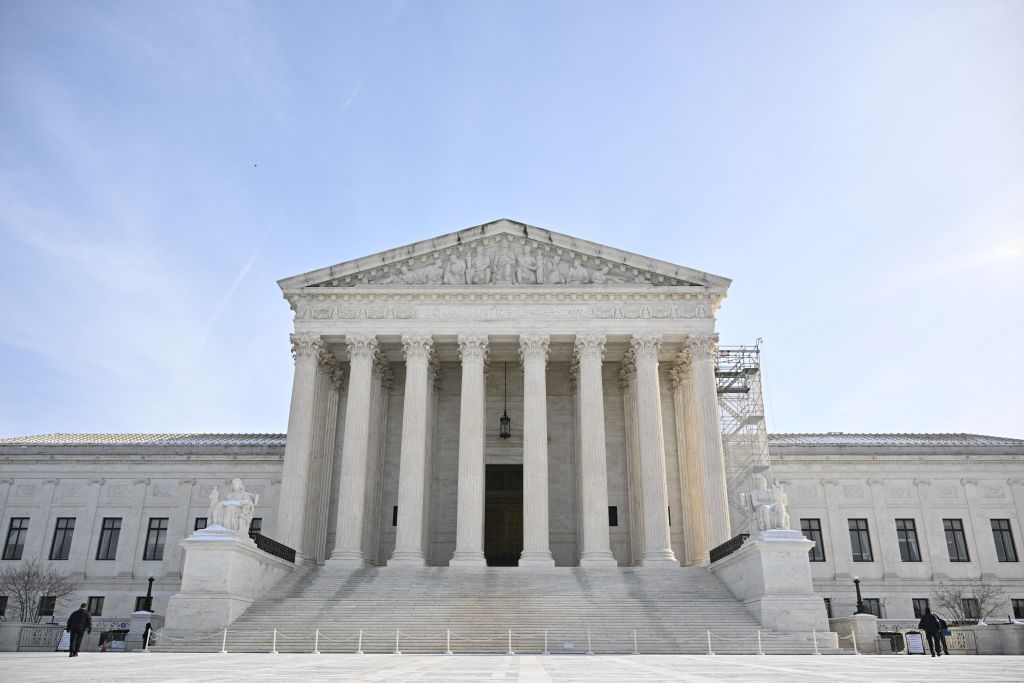
On Oct. 13, the Supreme Court will hear argument in Beaird v. United States, a case brought by a Texas man challenging an increase to his sentence for having a gun after a prior felony conviction. Like most federal criminal cases at the Supreme Court, lawyers for both Beaird and the federal government will appear before the justices. But because the federal government has urged the court to throw out the ruling by the U.S. Court of Appeals for the 5th Circuit, which had upheld Beaird’s sentence, and send the case back for another look, a third lawyer will also appear. That attorney, Anthony Dick of the law firm Jones Day, was appointed as an amicus – or “friend of the court” – to defend the 5th Circuit’s decision.
Less than three weeks later, another appointed amicus, Brian Barnes, will argue – this time in Maxwell v. Dinis, a case involving the process that inmates must use to seek a less restrictive form of custody. Like Beaird’s case, Maxwell’s case hails from the 5th Circuit, and Barnes – like Dick – served as a law clerk for Justice Samuel Alito, who is the “circuit justice” (that is, the justice responsible for emergency appeals and administrative issues) for the 5th Circuit.
Because amicus appointments have been (at least until recently) relatively infrequent, discussions of the appointments often focus on whether and when they are proper. However, a 2016 article by law professor Katherine Shaw for the Cornell Law Review looked more closely at how the court appoints amici. Shaw observed that although “[t]here is no official guidance from the Court, … public reporting about such appointments and the papers of the Justices provide some clues. What emerges from these sources is a strong sense that the process is ad hoc and relationship-driven.”
In particular, Shaw wrote, not only do amicus appointments “invariably go to former law clerks of the Justices,” but (as the appointments of Barnes and Dick reflect) they overwhelmingly (although not always) go to lawyers who clerked for the circuit justice. And indeed, press reports confirm that the phone call extending the invitation to serve as an amicus comes from the circuit justice’s chambers. A survey of the amicus appointments over the last decade suggests that the result of this tradition of having the circuit justice appoint amici has resulted in a high level of homogeneity among the lawyers who are appointed, in terms of both demographics and ideology.
From OT2016 through the beginning of OT2026, the Supreme Court made 24 amicus appointments. Of those 24 appointments, 19 (79%) were men, the vast majority of them white. And only two of the appointed amici – Amy Weil and Deepak Gupta – did not clerk at the court.
To the extent that a clerk’s legal philosophy or outlook is similar to the judge for whom he or she worked, the amicus appointments from 2016 until 2026 also reflect a high degree of ideological homogeneity. With the development of a conservative supermajority on the Supreme Court, the overwhelming majority (20 out of 24, or 83%) of amici appointments came from, and clerked for, circuits whose circuit justices were Republican appointees. Only four came from circuits whose circuit justices were nominated by Democratic presidents.
Why does it matter who argues at the court, much less in a role that is filled only a few times each term? In her 2016 essay, Shaw argued that if lawyers are “in some sense participants in the Court’s decision-making processes,” “a more diverse pool of advocates might bring to the Justices creative ways of approaching cases—ways they might not otherwise encounter, and that might ultimately enrich and even improve our body of law.” This is especially true, and perhaps important, when court-appointed amici have stepped in to defend a position that the federal government or the state government has abandoned.
Shaw also suggests that the court’s amicus-appointment practices could “suggest a route to opening or democratizing Supreme Court advocacy” because 56% of the invitations in her dataset (which covered the period up to 2016) went to lawyers who would be first-time advocates. Given the increased specialization of the Supreme Court bar (the group of lawyers who argue regularly before the Supreme Court) and the shrinking number of oral arguments that the court hears each year, the amicus appointments can help to provide a proverbial foot in the door for aspiring Supreme Court advocates.
And at the very least, a Supreme Court argument serves as a credential that burnishes an attorney’s resume, much like a clerkship or a degree from a prestigious law school. Even if appointed amici never argue before the Supreme Court again, their lone argument may nonetheless give them a leg up in applying for a new job or pitching for new business.
With women now making up more than half of all law school graduates, there is no reason why the appointed amici can’t look more like the rest of the legal profession. Now, to be fair, we don’t know what goes on behind the scenes when the justices are seeking to appoint an amicus. The major time commitment involved in briefing and arguing a Supreme Court merits case may also prompt some former clerks, however reluctantly, to decline. Moreover, until recently men have dominated the ranks of Supreme Court clerks.
But these are arguments in favor of expanding the pool of potential amici, rather than sticking with the status quo. If the justices want to continue to rely heavily on former clerks because they are known commodities and because the former clerks are more familiar with the court’s expectations, they could abandon the “circuit justice tradition” and pull from a broader pool of former clerks, no matter for whom they clerked, to serve as amici. For example, while the 11th (Thomas) and 5th (Alito) Circuits have yielded 11 amicus appointments since 2016, the U.S. Court of Appeals for the 1st Circuit (for which Justice Stephen Breyer and then Justice Ketanji Brown Jackson have been the circuit justices) has not had any. They could also invite lawyers who clerked for now-retired or deceased justices, as Sotomayor did in 2015 when she asked Catherine Carroll, a former clerk to Justice David Souter, to serve as an amicus. Alternatively, the court could turn more often to lawyers who did not clerk at the court, but who are excellent appellate advocates.
These would all be small, but important steps, in bringing the Supreme Court bar closer in line with the rest of the legal profession.
***
List of appointed amici – OT2016 to present
- Stephen Kinnaird (OT2016) – McLane v. EEOC (9th Cir.)
- Circuit justice: Anthony Kennedy
- Former Kennedy clerk
- Adam Mortara (OT2016) – Beckles v. United States (11th Cir.)
- Circuit justice: Thomas
- Former Thomas clerk
- Anton Metlitsky (OT2017) – Lucia v. SEC (D.C. Cir.)
- Circuit justice: Roberts
- Former Roberts clerk
- Deepak Gupta (OT2018) – Smith v. Berryhill (6th Cir.)
- Circuit justice: Sotomayor
- No Supreme Court clerkship
- Amy Weil (OT2018) – Culbertson v. Berryhill (11th Cir.)
- Circuit justice: Thomas
- No Supreme Court clerkship
- Paul Clement (OT2019) – Seila Law v. CFPB (9th Cir.)
- Circuit justice: Kagan
- Former Scalia clerk
- K. Winn Allen (OT2019) – Holguin-Hernandez v. United States (5th Cir.)
- Circuit justice: Alito
- Former Alito clerk
- Adam Mortara (OT2020) – Terry v. United States (11th Cir.)
- Circuit justice: Thomas
- Former Thomas clerk
- Amanda Rice (OT2020) – Lange v. California (Cal. Ct. App.)
- Circuit justice (9th): Kagan
- Former Kagan clerk
- Aaron Nielson (OT2020) – Collins v. Yellen (5th Cir.)
- Circuit justice: Alito
- Former Alito clerk
- Taylor Meehan (OT2021) – Patel v. Garland (11th Cir.)
- Circuit justice: Thomas
- Former Thomas (and Scalia) clerk
- Morgan Ratner (OT2022) – Jones v. Hendrix (8th Cir.)
- Circuit justice: Kavanaugh
- Former Roberts clerk and clerk to then-Judge Kavanaugh
- D. Nick Harper (OT2023) – Erlinger v. United States (7th Cir.)
- Circuit justice: Barrett
- Former Barrett clerk (also Kennedy and then-Judge Kavanaugh)
- Stephen Hammer (OT2024) – Riley v. Bondi (4th Cir.)
- Circuit justice: Roberts
- Former Roberts clerk
- Christopher Michel (OT2024) – Glossip v. Oklahoma (Okla. Ct. Crim. App.)
- Circuit justice (10th): Gorsuch (recused)
- Former Roberts clerk
- Michael McGinley (OT2024) – Hewitt v. United States (5th Cir.)
- Circuit justice: Alito
- Former Alito clerk
- Christopher Mills (OT2024) – Martin v. United States (11th Cir.)
- Circuit justice: Thomas
- Former Thomas clerk
- Michael Huston (OT2024) – Parrish v. United States (4th Cir.)
- Circuit justice: Roberts
- Former Roberts clerk
- Roman Martinez (OT2025) – National Republican Senatorial Committee v. FEC (6th Cir.)
- Circuit justice: Kavanaugh
- Former Roberts clerk, clerked for then-Judge Kavanaugh
- Kasdin Mitchell (OT2025) – Bowe v. United States (11th Cir.)
- Circuit justice: Thomas
- Former Thomas clerk
- Charles (Luke) McCloud (OT2025) – Barrett v. United States (2nd Cir.)
- Circuit justice: Sotomayor
- Former Sotomayor clerk
- John Bash (OT2025) – Ellingburg v. United States (8th Cir.)
- Circuit justice: Kavanaugh
- Former Scalia clerk, clerked for then-Judge Kavanaugh
- Brian Barnes (OT2026) – Maxwell v. Dinis (5th Cir.)
- Circuit justice: Alito
- Former Alito clerk
- Anthony Dick (OT2026) – Beaird v. United States (5th Cir.)
- Circuit justice: Alito
- Former Alito clerk