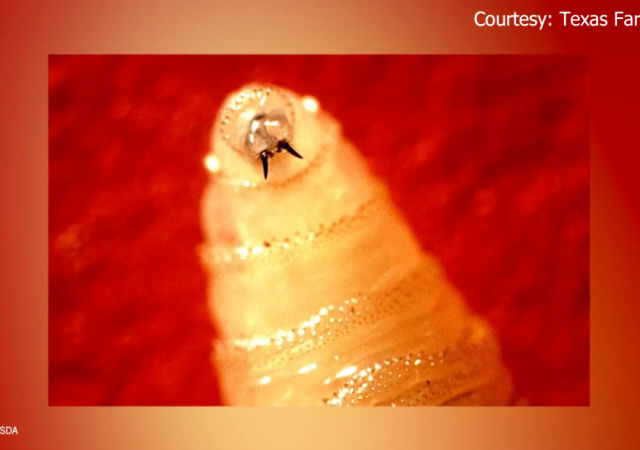
We have some good news about our country’s battle against the New World Screwworm.
Texas has lifted several quarantine zones imposed to prevent the parasite from spreading in South and Central Texas.
This comes as the number of cases of the parasitic flies north of the border aren’t as bad as officials originally had feared.
The Texas Animal Health Commission announced it has lifted a quarantine zone that originated from an infected bovine in Jim Hogg County and had extended to parts of Zapata and Starr counties, on the border. The infected animal was detected on June 26, but the commission says security protocols have prevented further outbreaks or detections of the parasitic fly in the area.
“Surveillance conducted following implementation of control and eradication measures has satisfied the criteria necessary for release of the affected area and that the movement restrictions imposed by the June 26, 2026 order have achieved their intended purpose,” the commission posted on its website recently.
Cattle imports are also entering the country through the Santa Teresa, New Mexico, border crossing.
Cattle imports resumed after 10:50 a.m. MT, Thursday, Sept. 24, after being halted for more than 16 months.
Mexican cattle ranchers with the Unión Ganadera Regional de Chihuahua are expected to export more than 400 head of cattle on the first day. The initial crossing included 101 steers, according to officials.
The importation of cattle was suspended in May 2025 because of the rapid spread of the parasitic New World screwworm in Mexico. The new imports arrive in the U.S. following an intensive inspection by both the U.S. Department of Agriculture and Mexico’s Servicio Nacional de Sanidad, Inocuidad y Calidad Agroalimentaria (SENASICA), the agency that oversees agricultural health and quality and ensures the health of each animal.
But the work to eradicate the pest is continuing in earnest. Scientists are exploring whether nitisinone, a drug already approved for human use, can kill New World Screwworm larvae.
The Foundation for Food & Agriculture Research and the University of Notre Dame are investing $140,389 to determine whether nitisinone, a drug already approved for human use, can kill New World screwworm larvae as the pest continues to threaten livestock across the Southern U.S.
Their efforts will rely on a Rapid Outcomes from Agricultural Research (ROAR) grant to pilot a study evaluating whether the Food and Drug Administration-approved compound can be repurposed as a veterinary tool. Reduced effectiveness of some commonly used treatments in South America, along with the limited number of approved control options, has increased pressure to identify new approaches for producers and veterinarians.
Research over the last five years has shown that nitisinone kills several blood-feeding arthropods — including mosquitoes, ticks, kissing bugs, bed bugs, tsetse flies, and stable flies — by blocking a key enzyme the insects need to digest blood. That same enzyme is present in screwworms.
To put the current situation in perspective, since the first U.S. case in June, 50 infestation cases have been reported (48 in Texas and 2 in New Mexico). In contrast, a USDA-authored historical account indicates that Texas livestock owners estimated treating roughly one million cases in a normal year before 1962 (the year sterile flies were introduced via a campaign in the Southwest).
Fewer screwworm infestations are good news, but they do not indicate total victory.
Sterile-fly releases, surveillance, and rapid response must continue until the pest is eradicated.
Unfortunately, these developments are unlikely to impact beef prices in the near future.
The port reopening will not immediately lower prices because it takes about five to eight months to raise imported Mexican cattle to be ready for slaughter, experts said. Further, US supplies will remain tight after persistent dryness has driven ranchers to maintain ever-smaller herds over the past seven years.
“There’s not going to be a change in beef supply from those cattle crossing the border anytime soon,” said Jeff Stolle, vice president of marketing for Nebraska Cattlemen, an industry group.
Hopefully, voters will remember the previous administration’s “War on Meat” and how seriously this administration took the screwworm spread from Mexico in the first place.
Donations tax deductible
to the full extent allowed by law.